
Richard Taylor talks Daemons
Wednesday March 14th 2007, Author: Toby Heppell, Location: United Kingdom
The Cherub class in the UK has long been associated with the backyard builder or the amateur constructor. This has been the way with the class since there was last an off-the-shelf boat available way back in the 1970s. However, the Cherub class could move into a whole new league now that it has Olympic aspirations, following the advent of two new production Cherubs, both due to take part in the ISAF Women’s High Performance Dinghy Evaluation Trials in April.
The GT60 was announced literally the week applications for entry to the ISAF Trials closed and caused quite a stir. The other production Cherub, the Hartley Laminates Cherub Daemon, has been slowly building a following in the media and alongside the Bladerider Moth, was the talk of the recent Dinghy Sailing Show.
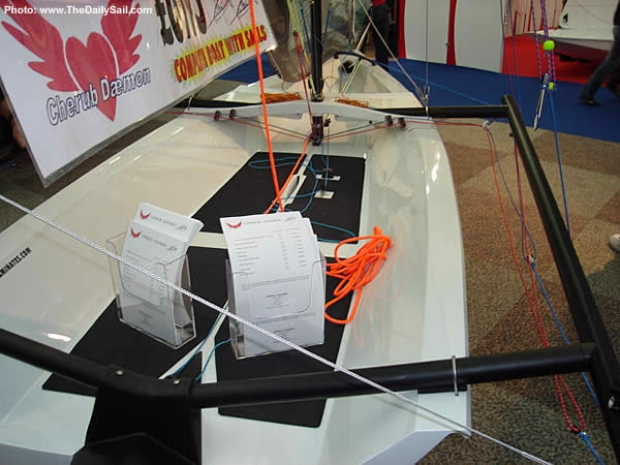
The brains behind the Cherub Daemon is Richard Taylor, although there are many more people involved in getting the boat to market. The hull shape is taken from a design of Cherub already in existence, the Slug, designed by Simon Roberts. The shape of this was slightly updated by Taylor and Roberts and will be built by relatively unknown – certainly in the boat building world - Hartley Laminates in Derby. The sails are made by Hyde and have been adapted from the Hyde International 14 sails in conjunction with Mike Lennon and the mast will be built by Selden. As a package the Daemon is a long way from the usual garden-shed affair typically associated with Cherubs.
Of course much of the focus currently surrounding this boat is due to it being considered as a boat for the Olympics. If this were the case, the Daemon would become an Olympic one design class as well as a mass-produced, easy-access Cherub design. The formation of a one design class would only occur if the boat is picked for the Olympics. There is no proposed class separation in terms of events, a la Bladerider, where one design racing separate from the main class has been proposed. If the Daemon is not selected though, Taylor still feels it will be a worthwhile boat. “It will be great for the class. You will be able to get a production Cherub off-the-shelf, removing a barrier to entry to Cherub sailing. I think it is a strong competitor to some of the SMODs [Single Manufacturer One Designs] that are already out there from different manufacturers. It also adds something new to the arena of skiff production,” he comments.
The reason Taylor has for producing the boat is simple. He has had a long association with the Cherub Class as a sailor and when he saw the brief for the Olympic Evaluation Trials knew it was something he had to do. “How often does a trial come along where the prerequisite actually fits the class of boat that you have been sailing for years and years? We just thought it would be great to give it a crack,” he explains.

Although Taylor has been largely responsible for getting the boat off the ground and for organising a builder, sail maker and others on board, he will not be involved in the future of the boat beyond the ISAF Trials. “This is not down to me personally. I will basically be out of the equation in terms of the future of the boat, so Hartley Laminates will be running the whole show.” The boat will continue to be manufactured by Hartley Laminates as a one design, but much like the Bladerider, Taylor suspects many of these boats will be adapted by their owners in this development class.
While not the most popular boat in recent history, the Cherub does have a significant amount of history behind it and this is something Taylor believes will help the case of the boat at the ISAF trials. “A lot of people have been involved with these types of boats as they graduate up through classes. It just seems to us a very natural progression instead of developing a boat completely from new, partly because if you miss the trials a brand new boat won’t survive whereas the Cherub has been in existence for over 55 years. Admittedly it's a small class, but it is very exciting if you are into it”.

Taylor comes back to the Cherub class regularly when we discuss the Daemon and it is seems clear he does consider it very much part and parcel of the class while it also just happens to be a one design for the purposes of mass production and the ISAF trials. This is a subtly different angle from that of Dave Chisholm, the man behind the Carbonology GT60 (read our article about it here.) Chisholm’s direction is to make a much more definite split between the one design Olympic class and the Cherub class. Part of this is due to the GT60 being slightly different in its construction depending on whether it is going to be a GT60 one design or a Cherub. Generally one gets the impression the Cherub Daemon is much more of a project from the Cherub Class Association – albeit through Taylor - whereas the GT60 feels less involved, in fact it is perhaps more a part of the International 14 class than the Cherub.
Due to the Cherub Daemon coming effectively from within the Cherub Class Association, Taylor believes the class is solidly behind him and his venture: “We've had complete positivity from the Cherub fleet with this project – and of course we've been consulting with the Association from the very beginning. We're proud to join the tradition of Cherub designers and builders including, of course, Frank Bethwaite, who refined many of his ideas within the class in the 1970's.”
Irrespective of their differences the Cherub Daemon and the GT60 are both facing essentially the same problem. Neither boat has been manufactured for that long, so they have no global presence currently, but Taylor does not seem overly worried by this fact. “In the brief from ISAF there is a lot more in there if you read between the lines of what these guys are actually asking for. A lot of that I am not going to tell you, but we have run the numbers sufficiently in several different areas that we will be discussing with [ISAF] over the next few months or so, before the trials,” he says rather cryptically.
Much of the reason for Taylor’s belief in the boat being able to get out internationally in time for the 2012 Olympic Games is based on his faith in the quality and speed of manufacture Hartley Laminates are able to achieve. “We are quietly confident. There is no point in over blustering it and saying ‘we can definitely build x amount of boats’. My point is that if I am going to say something then we are going to do it. I am not going to get involved in creating hype. We are confident that we have a good product that can satisfy the market,” he explains. Taylor reckons to have production tooling ready for the Daemon in about two months. After this time he says Hartley Laminates should be able to produce a boat in about two or three days per mould.”

Above: The wings are quick to dismantle for ease of transport.
After a successful Dinghy Sailing Show, the boat was finally put on the water at Draycote Sailing Club last weekend. In 15 knots of wind and, presumably fairly flat water – Draycote is a smallish inland venue – the boat managed to achieve 20.7 knots according to Taylor’s GPS. Of course this is not an actual verified speed and most of us are aware of the difficulties with accurate recording from GPS units but it does seem to bode well. 49er boat speed, by comparison, rarely gets up into the 20s, having to drive deeper on the runs and struggling to de-power on the beats as the wind increases. Taylor comments this speed was achieved without the T-foil on the rudder and without the boat properly set up. The vang for example was maxed out and they were struggling to get enough leech tension. He expects, when the boat is set-up properly they may be able to get 23 knots out of it in similar conditions. Whether this is likely or not remains to be seen but it certainly proves the designs high performance skiff nature.
Irrespective of whether the boat is able to achieve 23 knots in 15 knots of wind it certainly looks as though it will be able to fulfil the ISAF brief of being a high performance dinghy and it is almost definitely able to sail off the wind quicker than the wind - again as required in the ISAF brief.
We think the Daemon Cherub looks to be a fantastic boat and are glad it will continue to be sold even if it does not get into the Olympics. Seeing the boat in the flesh we were surprised at just how much we liked its look and how well thought out it appeared. Off-the-shelf this package would be hard to turn down. Although it is only 12ft long, coming in at just £6995 it is still a lot of boat for the money.
To see some video of the Daemon prototype out on the water, shot from a RIB click here (10MB).
| NB: This clip is formatted to play in Windows Media Player and is BIG - therefore only suitable for those with broadband connections. Mac users can now view WMV files by downloading a suitable add on to Quicktime - we for example use Flip4Mac which works a treat. The only noticable difference is that while the clip will play out while downloading on a PC, on a Mac it must download first. |
Most Read
Most Commented
Comments
Businesses


Pro businesses
-
Netherlands
-
-
United Kingdom
-
Editor's choice
Member blogs
-
 Ned Collier Wakefield: MOD70 round BarbadosWell that was intense. 12 hard fought for seconds for the win. In idyllic conditions, Tony Lawsons MOD ...
 -
 Mini Transat leg 2 reportThe second leg of the Mini Transat started on 31st October, just over a month after ...
 -
Leg 1 reportI’ve been working towards the Mini Transat now for three years. In 2013 I was part ...
Business blogs
-
 The Island Sailing Club in Cowes, Isle of Wight, is delighted that Prince Michael of Kent ...
 -
Peta Stuart-Hunt chats with the 25 year-old British solo sailor Lizzy Foreman before she sets sail ...
-
The 2015 Student Yachting World Cup (SYWoC), an ISAF-recognised event hosted and run by students for ...
Editor's Choice
All time favourites...
-
 Three legs down into Ian Walker’s
 -
 Winning all but two races at
 -
 For the first time in its
Latest Comments
Add a comment - Members log in