
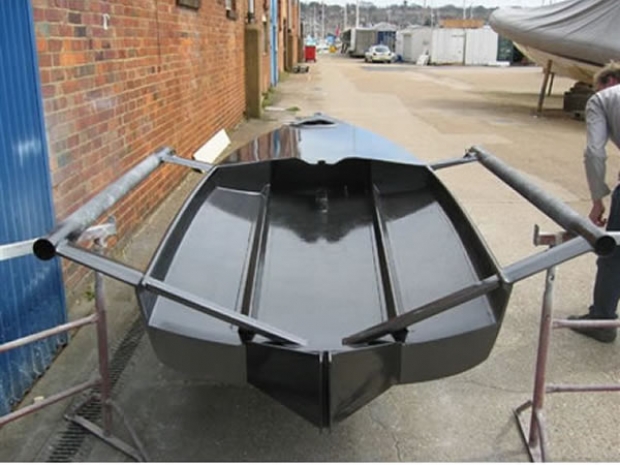
So, what is it?
With the official closing date for entrants into the ISAF Olympic Observation Trial passing last Wednesday, 15 February, so we had a brief look at the various entered boats ( here). The official entry list and the later announcement by ISAF held few real surprises, with the previously confirmed 29erXX and RS800 being joined by a Cherub and an International 14. However, there was one big surprise as the - until then – largely unheard off Carbonology GT60 was listed as the fifth and final applicant.
After some digging around we got in touch with the founder of Carbonology, and the man behind the GT60, Dave Chisholm. Carbonology is the shop front of Chisholm’s Suffolk-based composite manufacturing and sales business. Mostly the company sells raw materials for use in a wide range of fields from sports cars to boats. Chisholm himself is an avid sailor, competing in the Firefly class with his girlfriend and the International 14 with sailing partner Andy Prince. The company has a sailing team which consists of themselves and Adam May, a long term friend of Chisholm.
Although very happy out on the water in their International 14 Chisholm and Prince are light for the class and decided as a bit of fun to go and sail the Cherub National Championship in a borrowed boat last summer in Largo Bay, Scotland. “I have always slightly looked at the Cherub as being quite awkward little boats that are very much only in the home building market,” explains Chisholm. “Anyway, Andy [Prince] borrowed a boat and we went up to Scotland and had a fantastic week with the Cherub lot.” Sadly, perhaps confirming his home-made view of the fleet, Chisholm and Prince experienced a major breakage a couple of days before the finish of the championship and found themselves making the long drive back to Suffolk from Scotland a few days prematurely.
During the journey they began to discuss the possibility of designing and building a Cherub for themselves. Having considered this they soon decided everyone in the Cherub fleet was doing this already. If they were going to go to the trouble of designing their own boat they might as well offer it as a boat people could purchase. “When we thought about it, the reputation of the boat for being slightly bizarre and perhaps falling apart a bit might put people off a little. Perhaps the biggest thing that is putting people off though is there are very few people making them [Cherubs] professionally,” says Chisholm.
As Chisholm and Prince continued to discuss the potential of the Cherub it became clear they had not been giving the class the attention it deserved. Chisholm says they love the International 14 but being on the light side to sail it regularly they realised the Cherub they both wanted was in effect, an International 14 for light-weights.
At around this time the International 14 World Championships were convincingly won by Howie Hamlin sailing a modified Bieker 5 (above). Indeed Hamlin’s boat and its sister-ship helmed by Samuel (Shark) Kahn were both impressively quick at the event and impressed Chisholm. “We sat down and started to think maybe what we needed to do was get a B5 design and scale it to 12ft, keep everything exactly the same and see what happens,” he says. “We contacted the B5 designer, Paul Bieker, through Adam [May] and he was really approachable and open to the idea.” The plan, then, was still to build a Cherub to sell to the public. Chisholm and Prince had decided they wanted to build just the one boat initially and turn up at the following year’s UK Cherub National Championships with it and worry about selling some after seeing how it performed.
Bieker took another look at the designs and they decided instead of directly scaling down the B5 International 14 a few adjustments should be made. The foils, for example, would need to be almost as long and thin as those on the International 14 for the T-foil rudder to work efficiently. Bieker was then officially commissioned to draw a new set of lines based on his International 14 design in October 2006.
While waiting on the plans from Bieker, Chisholm became aware of the ISAF Olympic Observation Trials and quickly realised their new design fitted the bill in a variety of different ways. They contacted ISAF and got the information about what to do to enter a class of boat officially. Following this they quickly contacted Bieker to get his opinion on whether it would be a good idea and if he thought the design should be changed if they were to apply.
Bieker felt if the boat were to be put forward for Olympic selection there were a number of things that could be changed. As Chisholm puts it: “[Bieker] said that, in his opinion, an all carbon hull might be a little bit too high tech for the Olympic Games. He also said maybe we should take the boat without the T-foil on.” However, he adds, they felt as the boats being looked at this year would not be used until 2012 at the earliest for the Olympics then an all-carbon construction would not be a major problem, but they decided to consider alternatives to carbon and are now planning on building in the slightly cheaper S-Glass – the same material some Tornados are made from. In addition to this, the T-foil, Chisholm says, is very up to the minute technology now but in six years it will probably not be, so the decision was made to keep it.
Although Chisholm makes a good argument for the case of modern materials and the importance of up-to-the-minute designs, the Olympics are always going to have older designs because the boats need to have a global spread. The innate problem in the argument that boats are not going to be actively used in the Olympics until 2012 is; although this may be true whichever boat ISAF select they will do so early autumn, 2008. This gives any class selected in autumn 2007 (at the time of the ISAF Annual Conference) exactly one year to be available to the general public around the globe. Of course this does not mean it is impossible by any stretch, but it does seem to be a long way to go in a year.
Chisholm believes the youth of their design is actually one of the major factors they have on their side. “When you look at it, the Australians, the Brits and perhaps the USA particularly have had 29ers for a long time and if you select the boat as an Olympic class is it a good thing for sailing? If the boat is brand new everyone starts on an even keel. In some countries people will have been sailing 29ers for almost ten years, potentially. If the 29erXX was chosen for the 2012 Games those people could continue sailing in the same boat and have a very big head start on the rest of the sailors, That is not to say I dislike the 29er, I have sailed one a few times and had great fun - I just think it is something ISAF could consider.”
It is possible to see this point and if we are to try and increase nation participation on the Olympic stage then perhaps a new boat everyone starts to sail at the same time is a fair idea. However, the main issue in developing sailing further seems to be the cost more than the equality of competition and this is something that will affect any new boat considerably.
Bieker also suggested another change to the boat from the original Cherub rules concept - that of the bow. “The Cherub rule has a slightly strange bow shape which is why Cherubs often look a little bit strange and gangly,” continues Chisholm. “They have got to have 200mm of vertical surface on the bow which leaves lots of the boats with these slightly odd clipper bows.” Unfortunately changing the shape of the bow makes the boat unable to sail in the Cherub fleet leaving Chisholm with the choice of abandoning the original Cherub concept or going to the trials with a boat they are not completely comfortable with. In actual fact a novel compromise has been found. “What we have done is build a mould with the bow cut off,” explains Chisholm. “If you can imagine the point of the stem is cut completely off at about 45 degrees. This will allow us to build a Cherub from the mould by adding a Cherub bow to it or by adding our different bow you get what we call a Carbonology GT60.”

Simply, the GT60 – so called because it will have a 60kg all up sailing weight – will be a one design that can be retrofitted to become a Cherub by replacing the bow. Chisholm imagines this to be a quick job as there will be little structural load in the replaceable parts, suggesting half a day as the potential build time. In theory it is very close to the Bladerider One Design / International Moth concept in that it will effectively belong to two different classes, albeit with a little bit of dismantling and rebuilding to be done.
To us this is starting to sound like a worryingly confused boat. To start with it is a design for an entirely different class that has been scaled down to be 2ft shorter than the initial concept. Then to fit the Cherub class rules that design must be adapted and have a stick on bow, not to mention some lead as the 60kg all up sailing weight would indicate a hull weight of around 45kg, 5kg heavier than the Cherub minimum of 50kg. After all this the design must again be adapted back to having the original bow to go to the ISAF trials. In addition the boat is called the GT60 as we have heard, is based on the Bieker 5 International 14 design but is actually a B1C (Bieker 1 Cherub) with the Cherub snout on. So it is, we suppose, a GT60B1C of B5I14 parentage, -confused yet?
Once you spend some time thinking about this, however, you soon realise the confusion largely lies in the boat attending the ISAF Trials. If the boat does not get selected for the Olympics, the different bow shape becomes almost pointless and the mould would probably be rebuilt with the Cherub bow as standard. At that point you are looking at a Cherub, admittedly based on a different boat, designed by one of the top designers in the world, available to the public ready to sail.
If this is confusing, Chisholm then surprises us with what we think is an impressively astute reading of the Olympic market. His argument is; for many people, buying an Olympic boat like a 49er or a Tornado is a little like sticking your head out and saying ‘I am good enough to win in this class’. He believes there are probably less people sailing these boats on the national circuit simply for fun than many other classes and this necessarily limits participation numbers. “We realised if the GT60 were to get selected for the Olympic Games this fate is likely to befall it as well. The idea is the Cherub fleet would be snapping up the old boats, converting them back to Cherubs and perhaps adding some of their own little modifications and tweaks in the true Cherub style and then you have a good, relatively inexpensive base hull to race in the Cherub fleet,” he explains.
This seems like a plan with merit to us. Effectively what he is proposing is to split the single class out into two, leaving the small Olympic fleets sailing in a one design class buying more new equipment than most amateur sailors. This equipment then goes onto the secondhand market, after not too much use, and is snapped up by the amateur Cherub class who, through a booming second hand market, could well see a significant rise in participation.

The obvious floor in this system is if the Cherub class moves on to a more advanced design there will be no-one left snapping up the old hulls making the class once more like any other Olympic boat. Though if much of the argument for this boat’s selection lies in its modernity then perhaps seeing it at more than two Olympics’ would defeat the purpose anyway.
We wait to see how the GT60 gets on at the Olympic trials. Although we feel it will end up being a great boat to sail it seems highly unlikely this boat will ever see Olympic sailing action - it is simply too radical a move to consider compared to the competition. Perhaps this is no bad thing as the boat will then be able to go back to being what it should be: A mass market, well designed Cherub for those who are too light to sail a 14
As yet there are no available photos of the GT60. Chisholm is keeping the boat securely under wraps until its grand unveiling at the ISAF Olympic Observation Trials.
Businesses

Pro businesses
Editor's choice
Member blogs
-
 Ned Collier Wakefield: MOD70 round BarbadosWell that was intense. 12 hard fought for seconds for the win. In idyllic conditions, Tony Lawsons MOD ...
 -
 Mini Transat leg 2 reportThe second leg of the Mini Transat started on 31st October, just over a month after ...
 -
Leg 1 reportI’ve been working towards the Mini Transat now for three years. In 2013 I was part ...
Business blogs
-
 The Island Sailing Club in Cowes, Isle of Wight, is delighted that Prince Michael of Kent ...
 -
Peta Stuart-Hunt chats with the 25 year-old British solo sailor Lizzy Foreman before she sets sail ...
-
The 2015 Student Yachting World Cup (SYWoC), an ISAF-recognised event hosted and run by students for ...
Editor's Choice
-
 Three legs down into Ian Walker’s
 -
 Winning all but two races at
 -
 For the first time in its
Latest Comments
Add a comment - Members log in