
Patents in a development class?
Tuesday November 6th 2007, Author: Toby Heppell, Location: United Kingdom
Two weeks ago in an update on the Bladerider one design foiling Moth we reported that the company were attempting to patent a couple of their design ideas (see the article
here). This is causing a considerable stir within the Moth community with arguments on-going over the moral right to patent within a development class, a debate with possible consequences not just within the Moths.
Essentially much of the debate revolves around two central themes: the rights of Bladerider International to protect their intellectual property and the Moths being a development class where designs are regularly copied and adapted. “It is an emotive issue simply because the class has contributed so much to sailing over the years due to its collaborative and inventive nature,” explains 2006 Moth World Champion, Simon Payne. “Ideas are copied and developed and then copied again and made right. That has always been the case”
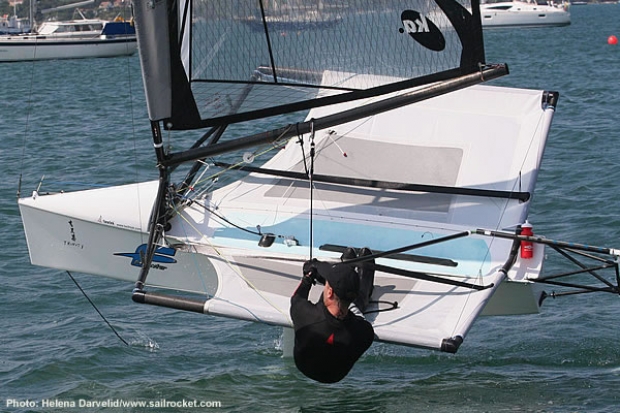
Above: Note the screw head holding the foils together.
Of course irrespective of whether or not patents are in the true nature of the class, clearly Bladerider does have the right to protect its original designs. However, there has been some discussion as to whether Bladerider International will be able to patent the two specific parts of their design they are attempting to - which are the way in which the tramps attach to the wing bars and the way the foils slot together. To Payne and many others, though, it is not the nature of the patent that is the worry, simply the principle of it. “With my many years in the Moth class and having looked at the patents I personally think it is almost academic what they are trying to patent themselves,” Payne comments. “One thing that they have done is to create a great group discussion on patents and the nature of each subject that they are trying to patent in how original it is. I think that Bladerider have to acknowledge that without the Moth class they would not exist and in effect they did copy a highly successful boat - a certain amount of respect is perhaps due to the class.”
Traditionally, over its 75 year history, the International Moth fleet has been relatively small. That is not to say there have not been builders making money from the class, but more the size of these builders’ businesses have been fairly compact.. But recently with the boom in foiling boosting numbers in the fleet, the two major foiling Moth suppliers, Full Force and in particular Fastacraft in Australia have been ramping up production to fit demand. With this being the case it was hardly a surprise a company such as Bladerider International jumped on the bandwagon with its mass production ethos to grow the market further.
There are many within the Moth fleet who feel the Bladerider significantly benefits the class and, as is shown by their sales, it clearly does a lot to create fleets of Moths where there were none before. However, the relationship between the company and the Moth class is an uneasy one. This comes down to one thing: Bladerider International are selling their boats with a large corporate ideal, whereas many of the old guard in the Moth fleet have grown up with the class being a largely amateur affair. “This is symptomatic of a class association, which is a group of owners with shared interests, coming up against a corporate entity,” comments Payne.

Although the class has never had a patent in its 75 year history that does not mean this is the first time someone within the fleet has been involved in such a debate. According to Rohan Veal, John Illet was approached by a company who were prepared to patent his foiling system back in 2004. However, because the wand system had been in the public domain for over a year, this turned out to be impossible to do.
“While I suspect most people within the class understand the need [for Bladerider] to protect their business, many people equally feel that a simple press announcement without any explanation or without delivering the news to the class first is a bit of a shame,” Payne comments. “I see a frustration, certainly within the UK fleet, as a result of communication constipation, if you will. So I feel that it is actually more of a communication issue than any particular threat to the class.”
Much of what is concerning Moth sailors is less the Bladerider patent system and more the company generally. There are those who have been very outspoken against the company from early on. What appears to have riled some is that Bladerider continue to claim their boat is a one design class that happens to conform to the Moth class rules, as opposed to the other way round.
This is not the first time a class has been spawned by the International Moth. In 1960 Alois Roland designed the Europe which was, at the time, designed to fit within the International Moth rule. A group of sailors enjoyed the boat so much they decided to form their own class and so the Europe was born.

It is here we can see why some have a problem in principle to the concept of a patent within a development class. Because of the way patent law works, it is not always enough to make a small adaptation to a design because if your changed product can be shown to be using the innovation of the patent holder then you are liable to being sued.
If the Europe design had been patented, then development in the Moth class would have been constrained, as taking the Europe design and adapting it slightly would not have been possible. “The constitution of the Moth class is to develop and go faster and improve,” continues Payne. “Bladerider has decided that that is not for them at this stage. Ultimately then the Moth design will supersede the Bladerider design. I think ultimately there will be a big decision for them to choose what they are.”
Payne feels, that if Bladerider is keen to develop its own class, as the company has said it is, then this could represent a threat to the Moth class. He believes that may be why the patients debate has raged so aggressively. The patents debate has probably got bigger than it should have, since the two patents Bladerider are applying for are almost irrelevant to future design and adaptation. So this argument almost entirely based on principle: Whether or not there is a place for patents within a development class. This issue can be debated about for a long time. In the case of the Moth it feels less like an argument about patents and more an argument between a corporation and an association. Inevitably a large mass producer of boats has the potential to steam roller over the needs of a small amateur class. But does this outweigh the extra numbers and advertisement bought in by that self same company?
Do you have a view on patents within a developement class, or perhaps have seen a similar situation before - email us: batmail@thedailysail.com
Most Read
Most Commented
Comments
Businesses


Pro businesses
-
Italy
-
France
-
United Kingdom
-
Editor's choice
Member blogs
-
 Ned Collier Wakefield: MOD70 round BarbadosWell that was intense. 12 hard fought for seconds for the win. In idyllic conditions, Tony Lawsons MOD ...
 -
 Mini Transat leg 2 reportThe second leg of the Mini Transat started on 31st October, just over a month after ...
 -
Leg 1 reportI’ve been working towards the Mini Transat now for three years. In 2013 I was part ...
Business blogs
-
 The Island Sailing Club in Cowes, Isle of Wight, is delighted that Prince Michael of Kent ...
 -
Peta Stuart-Hunt chats with the 25 year-old British solo sailor Lizzy Foreman before she sets sail ...
-
The 2015 Student Yachting World Cup (SYWoC), an ISAF-recognised event hosted and run by students for ...
Editor's Choice
All time favourites...
-
 Three legs down into Ian Walker’s
 -
 Winning all but two races at
 -
 For the first time in its
Latest Comments
Add a comment - Members log in