
Bladerider dominance
Tuesday July 3rd 2007, Author: Toby Heppell, Location: United Kingdom
With the advent of the foiling Moth, so back in May 2006 International Moth sailor and sail designer, Andrew McDougall, announced his intention to build a full production one design foiling Moth – the Bladerider. With distribution on four continents, and possible adoption as an Olympic class plus the appointment of 2005 International Moth combined World Champion and Australian foiling supremo Rohan Veal, to the sales team and former America’s Cup winner John Bertrand to the board so Bladerider has been setting itself up to take dinghy foiling to the masses. What remained uncertain was how the Bladerider, launched to the UK public at the Dinghy Show this year would stack up against the competition.
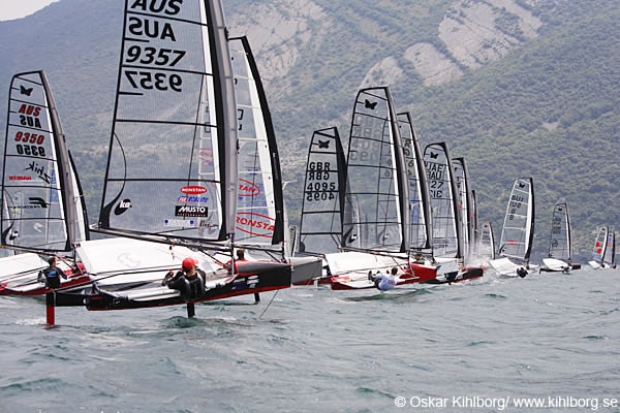
Last week we were finally able to see the Bladerider out against a variety of other designs at the International Moth combined World and European Championships, and boy did it impress. Following Simon Payne’s win on a Prowler last year, Veal took victory at the event with a day to spare and with eight straight first places. In addition to this, second place was also awarded with a day to spare to Scott Babbage, also from Australia and also sailing a Bladerider.
On returning to shore after victory on the penultimate day of racing Veal was a business-like mood, his cold clinical style reflective of the nature with which he dispatched his opponents through the course of the week. “These things never really sink in for a while. It is great to do well in every race, but I don’t know how to explain it. It just is what it is at the moment and maybe next week I will be more excited,” he commented. “I think if I had some people who were a bit more up against me and switching places it might have been a little better. It happened on occasion with Scott [Babbage] and Andrew [McDougall] but once I started to settle down I ended up way in front most of the time. For me it was not really racing for much of it. It was just a case of going out and going round the course fast and coming across the line for the win.”
Having returned to being a class above the rest, Veal seems to almost feel let down by the competition this year as he explains his favourite type of racing is with many boats close together fighting for positions. It is not hard to see his point; on the first day (also the windiest day) Veal managed to lap all but the top three places and won by almost five minutes - a fantastic margin in a 30-40 minute race with boats capable of speeds approaching 20 knots. However, the breezy conditions could well have played a part in these margins, as newly crowned European Champion, Simon Payne, explained after the final, lighter wind, day. “I think what we have seen today is there is nobody particularly dominant in these conditions at both the front and the middle of the fleet. It would have been a different Championship had it been like this the whole time. I think it would certainly have been closer. Of course that is to take nothing away from the guys that have won in the breeze. They have earned every penny of it.”
Veal did go out on the water to race on the final day but struggled, having to do penalty turns, and never made it back to the front of the fleet. Instead of crossing the line further back he chose not to finish and so preserve his perfect scoreline. Although Veal was potentially not sailing at his best (there was no small amount of drinking in the Aussie camp on the penultimate night) this still could be telling as to the best conditions for the Bladerider and perhaps Veal himself. “If I am absolutely honest Rohan is always going to do well in a breeze. He has always had the edge on me in big winds. He is bigger, he is stronger, he is 20 years younger and he sails more. I think he has done great this week,” commented Payne.
For his own part Veal seemed confident about the speed of his boat and his sailing in all conditions. “We had really strong winds and I was pretty confident with that. When we got the big wind on the first day I think I won a race by about five minutes. We also had plenty of moderate races and when you get the moderate winds it allows everyone to bunch up a bit more so the margins were smaller. Whatever conditions we got, I felt happy with. We never really got a light wind race and that is when you really have the opportunity to pull away. If you can get up on the foils and others can’t, then you really have the chance to get ahead and do your airborne tacks and airborne gybes consistently. We have not had the opportunity to do that yet.”
Certainly the big breezes at this year’s event saw little in the way of new sailing technique. There has been much discussion both inside and outside of the fleet about foiling tacks and dead level foiling gybes. However, in the course of our time at the event we failed to witness a single foiling tack and, though airborne gybes are commonplace, it was only the very top percentage of the fleet managing to pull off the tricky manoeuvre with any finesse.
Whether or not Veal is the better sailor in the windy conditions clearly, the Bladerider was also the quicker boat. On the final day of racing Veal and Payne swapped boats in between races. “The Bladeriders are a very stable platform,” explained Payne, this year still sailing his 2006 championship winning Prowler. “I sailed Rohan’s boat between races and it was much, much easier to sail. Their control systems are much more sophisticated than ours. Having sailed it I feel very confident that we now know what we can do start to match their pace in a breeze.”

The opinion that the Bladerider’s secret lies in her control systems is one shared by many. Out on the water it was obvious that in the breeze the Bladerider sailors were able to push that much harder due to this ‘stable platform.’ A number of sailors and designers such as Adam May and John Ilett had been looking at the boats last week and echoed this point. The control systems being so sorted comes as little surprise as Veal and McDougall have been very open about their focus on developing this area. When we spoke to them both back in January this year (article here) much of our conversation was to do with foil adjustment development. Perhaps what has surprised most is simply the amount of difference these control mechanisms have made to the boat. “Six months ago we were a lot slower than the other Prowlers and now we are almost one to two knots faster than most of them,” explains Veal.
When it comes to the controls, there are two key areas where the Bladerider is leading the field. Firstly the rudder system does not have a flap, but rather the entire gantry cants relative to the transom, changing the angle of attack for the whole foil (much like the T-foils on many of the Morrison International 14s). This has been tried before on foiling Moths but was dropped early on as being unworkable. The important aspect of this rudder system is that once set up it is significantly lower drag than other flap systems (the foil can be a thinner section as no hinge need be incorporated in it), though exact set-up can be tricky.

Above: Bladerider flapless rudder system (left). The standard Fastacraft system (right).
The second thing the Bladerider team have done is to simply up the efficiency of almost every working component within the foiling system. For example the rod used to push and pull the flap on the main foil is as far back as it is possible to get. On most other foils the rod is halfway down the flap, this means when there is load on the foil (when there is water going past it) it requires more pressure from the wand to pull or push it. With the Bladerider system less effort is required to push the flap and so the sensing wand digs into the water less and thus causes less drag. Although this may seem like a trifling detail it can be a major factor. “When you think about how fast these boats are travelling, something small like that can make a major difference. If you have a few areas where you are making those savings the package is going to be quicker,” explained May after a week of nosing at the system. In addition to the flap being more efficient the team have tried as many different worm screws, wands and gearing systems as possible, ultimately ending up with a simple, effective, professional package.
But it has not been all sunshine and smiles in the Bladerider camp, as breakages plagued the boats both before and during the Championship. A number of centre foils were snapped as well as some of the actual hulls coming apart: Graham Vials’ entire deck managed to come away from his hull in the last race of the week for example and the team ran out of spare foils over the course of the event. There had been some rumours circulating about teething problems with the Bladerider’s construction which these breakages seemed to confirm. However Veal seems confident these issues have been remedied. “My boat is a pretty old boat, one of the early ones and we have had a lot of issues with them. A lot of those early boats are here and many of them are going really well here, Scott’s and mine as an example. Andrew has a much newer boat and it is really bulletproof,” commented Veal. “Would I change anything? Probably on the production boat we will reinforce a few bits here and there to make it a little bit stronger. It will make it a little bit heavier but I don’t think that will really make any difference. The main thing is to make them absolutely bullet proof so that anyone can jump on them and nothing will happen. At this event we have made our boats bulletproof and proved that they will not break. We just have to copy them now so everyone can have the same experience.”
With most feeling the control systems are key on the Bladerider it will, presumably, not be long until the rest of the fleet catch up, after spending time on their own gearing systems. This is something already being thought about by most at the top of the fleet. “I am going to keep this boat for the summer and then maybe Lia [Ditton] will have it or something like that,” explained Payne. “I have a new boat coming which is going to be full of interesting little advances. That will be a Fastacraft boat and will be taking the package to the next level, I think. It will definitely take some of the gearing ideas from the Bladerider but I think the hull will be different. Specifically there will be less of it. It will still retain the Fastacraft quality and peace of mind that you get from buying the boat, in that it doesn’t break.”
Veal himself is looking forward to the challenge of others catching up. “Now I think we have set a new benchmark and next year we will hopefully have all the boats up at that same sort of level so that should be a really good World Championship. I will be looking forward to that one for sure,” he concludes.
With the Bladerider commited to a one-design philosophy presumably the hope is the class is able to sell enough boats while they remain the fastest on the race track to have solid one design fleets. For sure the rest of the International Moth designers will be going back to the drawing board for their control systems, trying to get back that edge. Now, once again, it is a waiting game until the 2008 World Championships, likely to take place in Weymouth.
Most Read
Most Commented
Comments
Businesses


Pro businesses
Editor's choice
Member blogs
-
 Ned Collier Wakefield: MOD70 round BarbadosWell that was intense. 12 hard fought for seconds for the win. In idyllic conditions, Tony Lawsons MOD ...
 -
 Mini Transat leg 2 reportThe second leg of the Mini Transat started on 31st October, just over a month after ...
 -
Leg 1 reportI’ve been working towards the Mini Transat now for three years. In 2013 I was part ...
Business blogs
-
 The Island Sailing Club in Cowes, Isle of Wight, is delighted that Prince Michael of Kent ...
 -
Peta Stuart-Hunt chats with the 25 year-old British solo sailor Lizzy Foreman before she sets sail ...
-
The 2015 Student Yachting World Cup (SYWoC), an ISAF-recognised event hosted and run by students for ...
Editor's Choice
All time favourites...
-
 Three legs down into Ian Walker’s
 -
 Winning all but two races at
 -
 For the first time in its
Latest Comments
Add a comment - Members log in