
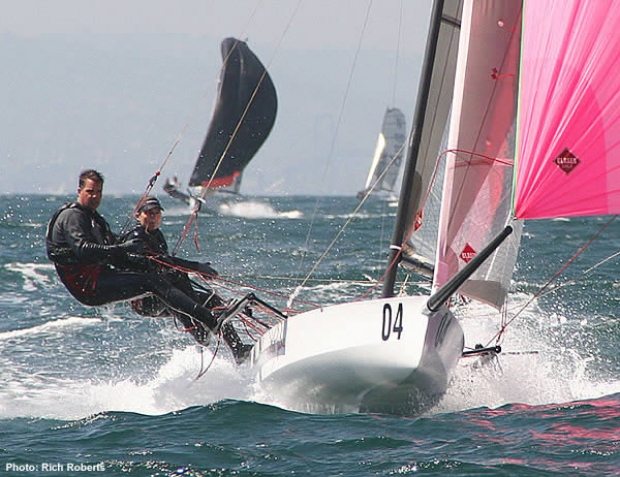
Ultimate women's skiff?
Friday May 18th 2007, Author: Toby Heppell, Location: United Kingdom
The International 14 has been at the top of the high performance dinghy platform for umpteen years, its position among development classes has ensured it remains one of the most inspirational boats in the sailing world. 2007 will be a special year for the class, as they celebrate the 80th Prince of Wales Cup, their National Championship and the oldest trophy in dinghy racing. In addition to this the class has been kicking up a stir recently by attending the ISAF Women’s High Performance Dinghy Trials in Hyeres. Behind this bid are a number of female International 14 sailors who are passionate about their class.
UK-based Katie Nurton first got into International 14 sailing six years ago. Prior to her joining the fleet she had been campaigning a 470 with regular crew Barbera Watson for just over four years up until the Olympic Games in 2000 when she decided a change in class was due. At this time she was living with two other International 14 sailors, Ed Reeves and Mo Gray, and had “no choice” other than to buy a 14, as she puts it.
It was not, however, purely a case of selling the 470 and getting an International 14 straight away. Nurton says did look at some other boats as possibilities. “I remember just after I stopped sailing the 470 I went out in a Laser 4000 with a female friend of mine. She was saying I should get a 4000 because it is so much better than an I14. At that exact moment two 14s just went past us so fast, we both looked up and I said; ‘that’s why I’m getting a 14.”
In addition to living with 14 sailors and seeing one roar past her while sailing a 4000 Nurton also remembers the 14 class being particularly proactive in their marketing at the time. “I think the idea of going 14 sailing was always in the back of my mind. However, I do remember a while ago there was loads of 14 advertising and the class had grabbed a fleet sponsor. I saw them a lot then and I think I always knew that was what I wanted to sail one one day., but it was not until I started getting to know all the 14 sailors that I started to think it was actually realistically possible,” she explains.
Like a fair number of women who sail International 14s Nurton sails with a male crew. “I sail with a guy called Nigel Ash,” she goes on. “He used to be one of the top windsurfers in the UK. It was kind of lucky that I found him actually, I was looking for a crew and his brother was a 14 sailor as well and he said, ‘Oh my brother wants to learn how to sail but he has never sailed a dinghy before.’ We have been sailing together for four or five years since then.”
Nurton is keen to add that although she sails with a male crew it is more than possible to be competitive in an International 14 with an all female crew. “I have sailed a few times with a female crew. In fact I did sail 14s for a bit with Barbera Watson - my old 470 crew – a few times, early on so it is perfectly possible. The way the rigs are currently set up means the boats do not feel so nice with that little weight in them, but it is possible as the recent Olympic Trial in Hyeres proved.”
Another female 14 sailor who sails with a male crew is Tina Bayliss who together with husband Trevor took second place at last year’s International 14 World Championship in San Francisco. “For me the brilliant thing was Tina Bayliss doing so well at the worlds last year,” continues Nurton. “Generally [Nigel and I] were always just trying to get round the course when it was windy. We were always good in the light winds, but not so good in the breeze. I guess I never really thought it was possible to do that well in the really windy weather but now seeing her doing so well it is really inspiring. Previously we would start the race and be thinking ‘lets just get round the course’, although you perhaps don’t admit that to yourself at the time. It is really great to see her and Trevor storming it in the breeze, it’s really inspiring.”
Although it is more than possible for two female sailors to compete in the International 14 class, we wondered how possible it would be for them to compete and be a threat to the top positions. “This year I have done a couple of events with Louise Hickey - one of the top female 14 crews - and we were doing okay. In the bigger breeze we did struggle a bit and on the three sail reaches we were obviously not as quick but that is simply because the other people were a lot heavier than us. It would be the same for any lighter team.”
Of course on of the main reasons the International 14 has been in the news recently is in relation to the ISAF Women’s High Performance Dinghy Observation Trials. Two International 14s were taken to the event and while many thought they only stood an outside chance of selection and were really only at the event as a bench mark, they performed surprisingly well. Many of the women at the event enjoyed sailing the boat and although the wind was predominantly light throughout the week there were no real problems with even the lightest teams managing to handle the 14. Many still feel the boat is unlikely to be selected due to its highly technical nature and relative cost, but it is certainly proving itself to be a class that stands up alongside more contempory equivalents while women are able to sail and enjoy it even if it may be outside of Olympic competition.
With the International 14 being a development class there are a number of different rig shapes and sizes around and this enabled the class to take two different rigs to the ISAF Trials in Hyeres on the two different boats they had available. “One of the rigs we took to the Trials was the same height as other 14 rigs but the top is designed to twist off a bit,” comments Nurton. “I do not know if you saw the top of the rig Howie Hamlin used last year at the 14 Worlds, but this is based on a similar concept. They have a really square top so they are able to blade off and de-power dramatically, so it has the same sail area but de-powers much better. Also some of the area for the top of the mainsail was moved onto the jib with that, so although we did not actually lose any area we significantly lowered the centre of effort,” Nurton comments.
As a an ex-470 sailor who moved into high performance skiff sailing it may seem to many that Nurton is exactly the sort of sailor ISAF would be likely to attract if they introduced a women’s high performance two person dinghy to the Olympic Games for 2012. However, this is not the case as she explains. “I sort of sailed the 470 for four or five years and then when I was coming to the end of that I made the decision to stop all of that and sail something a bit different. I probably would not go back again although it would be quite tempting. It is a different lifestyle for me now I am a bit older and am working full time. In fact I am probably a bit too old to do it now anyway.”

While she makes these comments one still gets the impression Nurton would be tempted to sail in an all-female Olympic skiff class.Even if she did make the move it seems unlikely she would give up sailing the International 14 which forms such a big part of her sailing these days. “The massive appeal of the 14 for me is that it is a development class and so a class for life,” she comments. “There are some people sailing the boat now that are in their 70s and have been sailing it for their whole adult life. It is great because you get a brilliant selection of people who have been sailing the boat for years and are a major part of its history. And you get to go really fast.” Certainly it seems Nurton is not planning on leaving the 14 class anytime soon as last year she invested in one of three new boats (above) built by her brother George Nurton (see interview here).
It seems the female International 14 sailors are looking more and more competitive on the international stage. The boat is still one of the less likely candidates to be selected for the Olympic Games but this may well be a good thing. Although two females can undoubtedly be competitive in the class it does seem like the boat could well be the ultimate mixed doubles fleet, something the IOC are keen to discourage at Olympic level.
Most Read
Most Commented
Comments
Businesses


Pro businesses
-
Netherlands
-
United Kingdom
-
Italy
-
United Kingdom
Editor's choice
Member blogs
-
 Ned Collier Wakefield: MOD70 round BarbadosWell that was intense. 12 hard fought for seconds for the win. In idyllic conditions, Tony Lawsons MOD ...
 -
 Mini Transat leg 2 reportThe second leg of the Mini Transat started on 31st October, just over a month after ...
 -
Leg 1 reportI’ve been working towards the Mini Transat now for three years. In 2013 I was part ...
Business blogs
-
 The Island Sailing Club in Cowes, Isle of Wight, is delighted that Prince Michael of Kent ...
 -
Peta Stuart-Hunt chats with the 25 year-old British solo sailor Lizzy Foreman before she sets sail ...
-
The 2015 Student Yachting World Cup (SYWoC), an ISAF-recognised event hosted and run by students for ...
Editor's Choice
All time favourites...
-
 Three legs down into Ian Walker’s
 -
 Winning all but two races at
 -
 For the first time in its
Latest Comments
Add a comment - Members log in