
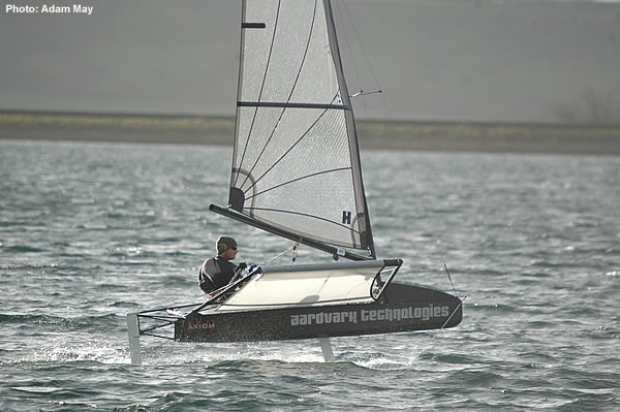
Bristol based foiling
Thursday December 6th 2007, Author: Toby Heppell, Location: United Kingdom
Recently, the Moth class has been growing at a rapid rate for such an extreme machine. This surge in numbers has reinvigorated the class with more builders popping up all over the world, but particularly in Australia and the UK.
Up until last year foiling Moth options were reasonably limited with the two main suppliers being Full Force Foils, run by Linton Jenkins in the UK and Fastacraft, run by John Illet in Australia, building the Mistress and Prowler designs respectively. Then there was the launch of the well publicised one design foiling Moth, the Bladerider, produced by Bladerider International. But the Moth class has always been home to smaller builders and this continues to be the case.
Over the past three years in deepest darkest Bristol, Mike Cooke of Aardvark Technologies has been developing his own design of Moth, the Axiom. Although Cooke is a long way from moving his operations out to China and mass producing his boat (Bladerider-style), he is planning on selling the design and will be taking orders in the new year.
Cooke and his Aardvark Technologies brand are well known throughout more design friendly classes such as the National 12s and Cherubs. Though we have spoken with him before about some of his other designs ( here), the first time we saw one of Cooke’s Moths in the flesh was at the Moth World Championships this year at Lake Garda. Back then he was sailing his third version of his Axiom design and, having launched it only recently was still struggling with some of the aspects of the new boat. Despite the 20 knot wavy conditions in Garda being far from a perfect testing ground, Cooke walked away from the event with some good ideas of what needed refining on his design.
Cooke headed home to continue work on tweaking his boat to get it just right and also began the process of looking into making a fourth incarnationof the Axiom tree. Cooke re-appeared with his mark three version of the boat at the UK National Championships and proved just how quick the design could be, claiming sixth position overall and pushing some of the top sailors in the country.
The last couple of months have seen Cooke off the water as he sold his Axiom 3 and finished the building of his first Axiom 4. This was launched last weekend and is the design Cooke will be selling in 2008. So what is new about this boat?
The first thing that is striking about the boat is actually not the hull itself but the foils. As we have commented on in the past, Moth hulls are now looking more and more similar as designers conform on what makes a boat on foils fast. Following the dominance of the Bladerider at the World Championships, which many put down to a superior foil system package, there is now even more focus on the under water wings.
Cooke builds his own rudders and centreboards and his rudder in particular looks unique. Firstly, like the Bladerider, he has gone for a fixed foil and adjusts the rudder gantry in its entirety, instead of using the flap technique used by most other Moth builders “I've had the canting rudder on my previous two boats. It simplifies the build of the rudder foil quite a lot and even with the best will in the world there are always seams with a flap,” Cooke explains. “While flaps do have their advantages in some areas the ease of build makes up for that.”

The other striking thing about the rudder are its tips which are swept up very dramatically. Again the Bladerider has similar rudder tips but are not nearly so extreme. “They are swept up to 90 degrees in the last few inches of the foil. The general idea behind this is to reduce induced drag from the tip in the same way as a foil fence would, but (hopefully!) more effectively,” Cooke explains.
Despite the hulls all beginning to have similar features there are still some things Cooke has done to his Axiom design that take it a step further than other manufactured Moths. “The bow has a similar radius to my last boat and Adam [May’s] Weapon design,” he comments. “The boat is so narrow up front that buoyancy there is pretty useless and getting rid of it has other benefits, like reducing the side profile for improving the steering when low-riding. I think getting rid of the pointy corners has to be good from a safety point of view too. The hull shape has much more volume in the rear end than my previous three and the bows have got more vee'd and finer too.”
The latest version of Cooke’s Axiom design encompasses many previously tried ideas but also misses out others that were less successful. On his previous boat, for example, there was no deck, with the tramps simple meeting in the middle. This idea has fallen by the wayside on the mark 4. “The trampolines on my old boat fastening in the middle were good, as it was nice and comfy and there was little to hit yourself on during crashes, but the lack of a steady floor under you makes life interesting sometimes,” Cooke explains. “The problem was, everyone else who sailed with it hated it, as they were used to having hull there. It was a bit of a shock to the system sailing the new boat and suddenly there was boat there to walk on! It was also easier to make the racks demountable for transport and storage - my previous boats have always been one piece.”

With Cooke being a smaller builder than many of those producing Moths, for sale his building techniques are limited. “The boat is all carbon/foam using Sicomin Epoxy from Matrix Composites,“ Cooke says. This type of wet lay-up is pretty low tech these days with widespread use of pre-preg carbon and autoclaves; however, Cooke adds that with a bit of care and practice you can make anything. Despite this the boat weighs about 30-32kg all up which is a competitive weight for a modern foiling Moth.
It used to be that the Moth fleet was full of home builders but those days have all but passed as production methods have moved beyond the ability of the average home builder. As a boatbuilder with relatively low tech resources Cooke describes the main difficulties he has encountered over his three year, four boat journey. “Building the foils is pretty tough going to start with - it always takes a few shots early on to get in the right ballpark,” he comments. “There is an awful lot of carbon in there. The boats themselves are actually pretty easy and if you are interested in building them yourself, there are plenty of people in the class like Adam [May] and myself who are quite happy to point people the right way.” Despite this Cooke does say if he were starting from scratch it would make a bit more sense to buy an off the shelf product. However he has learned a lot and enjoyed the experience.
We liked the look of Cooke’s previous version of his Axiom design and from the photos we have seen are excited about the newest one. Just how competitive the boat is will have to be proved at the World Championships in Weymouth next summer. However, another builder in the UK and indeed worldwide is no bad thing at all.
Most Read
Most Commented
Comments
Businesses


Pro businesses
-
Netherlands
-
France
-
-
United Kingdom
Editor's choice
Member blogs
-
 Ned Collier Wakefield: MOD70 round BarbadosWell that was intense. 12 hard fought for seconds for the win. In idyllic conditions, Tony Lawsons MOD ...
 -
 Mini Transat leg 2 reportThe second leg of the Mini Transat started on 31st October, just over a month after ...
 -
Leg 1 reportI’ve been working towards the Mini Transat now for three years. In 2013 I was part ...
Business blogs
-
 The Island Sailing Club in Cowes, Isle of Wight, is delighted that Prince Michael of Kent ...
 -
Peta Stuart-Hunt chats with the 25 year-old British solo sailor Lizzy Foreman before she sets sail ...
-
The 2015 Student Yachting World Cup (SYWoC), an ISAF-recognised event hosted and run by students for ...
Editor's Choice
All time favourites...
-
 Three legs down into Ian Walker’s
 -
 Winning all but two races at
 -
 For the first time in its
Latest Comments
Add a comment - Members log in