
Tied after 16 races
Wednesday October 17th 2007, Author: Toby Heppell, Location: United Kingdom
Last week the US Olympic Sailing trials took place at various venues around the country. This sudden death Olympic qualification regatta, where (unlike the Team GBR process) whoever wins is immediately assured of a berth at the Games regardless of past form, was always going to be an exciting prospect. Before the event it was relatively easy to identify the classes where the main battles would be taking place. One such class was the Laser.
Like Tom Slingsby and Michael Blackburn in the Australian team, Brad Funk and Andrew Campbell (see interviews with them here and here respectively) have been trading blows around the International Olympic Circuit for the past year and a half and going into this regatta we were finding it hard to choose between them (see our Trials pre-view here). Funk was selected by US Sailing to represent the States at the 2007 Pre-Olympic Games in Qingdao in August. However, while he was over there Campbell went off to the Pan-Am Games and managed a phenomenal first place against multiple World and Olympic Laser Champion, Robert Scheidt. Clearly this was set to be a battle royale and our money coming into the event was on Campbell, though only just. “It was definitely not an easy regatta,” Campbell explained to TheDailySail. “I knew it was not going to be easy going in. I did not know it was going to be quite the two boat race that it turned out to be though.”
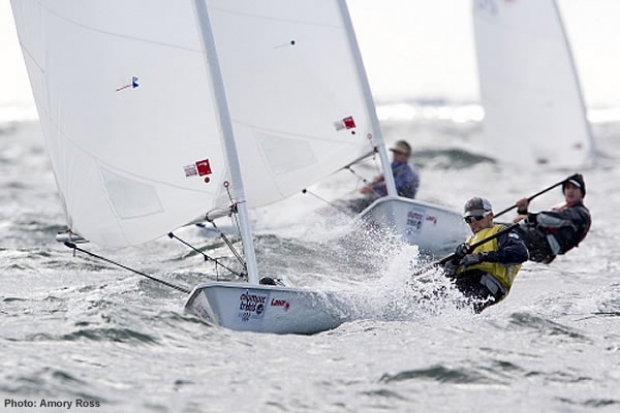
As predicted the event was extremely close with Campbell eventually winning the regatta from Funk on count-back after the pair finished tied on 44 points after 16 races. In fact Funk and Campbell were far enough ahead of the fleet to match race one another during the final couple of races and inevitably things got tricky. Campbell was ahead of Funk by five points, but was holding a bigger discard heading into the final day, so clearly Funk would be planning on sailing Campbell down the fleet. At the first windward mark with Funk just ahead he made his move and sailed Campbell out of the course and into the spectator fleet. In amongst all the confusion Funk made a protest stating that Campbell had failed to keep clear of him.
The pair continued the race from there and sailed back up the fleet with Funk taking the win over Campbell. Campbell finished the last race of the day just ahead of Funk to leave the pair tied on points meaning it would all come down to the protest room. Campbell matter-of-factly describes what happened: “Brad tried to pin me up past the windward mark and we sailed into the spectator fleet. I kept clear of him the whole time and I was adamant about that during the protest. I made sure I kept my space. He gave me room to get round a few powerboats properly and no fouls occurred,”
Despite these slight on and off the water difficulties Funk and Campbell are good friends. However, they both spend much of their time training with different groups. Campbell has mostly been sailing with the Canadian Laser sailors, while Funk tends to spend more time with the Australians and Europeans. With the Olympics now approaching we wondered if this would stay the same or if the two Americans would train together in the build-up to the Games. “I am not sure of Brad’s plan at the moment. We spoke briefly last night at dinner and he is not really sure what he will be up to,” Campbell explained. “I think we are both going down to Australia for the winter circuit. I think I will spend a fair amount of time sailing with the Canadian guys as I have done for the last year or so, as that has gone well so far. Hopefully I will be able to tag along with them and help them get ready for their trials at the Worlds. After that I will hopefully go to Europe for the European season until May or June and then come home and spend some time in San Diego training, trying to get ready for the light airs in China.”
With two sailors as close in performance as Campbell and Funk clearly Olympic selection is always going to be tricky. Perhaps in circumstances such as these the US ‘first past the post’ trial system is the best for the job, getting rid of any ambiguity. “I guess it is modelled on the Olympic Games so they try to pick players who they know are capable of handling high pressure situations,” says Campbell. “That is not to say doing the trials similar to the British or other systems where you qualify at other regattas are not high stress situations. There are definitely merits in all systems and it is interesting that we are really the last country that hangs onto this winner-takes-all idea.”
Despite understanding the system and feeling it has some definite pros Campbell says he did not particularly enjoy the pressure last week and found the regatta especially draining. “I do not think it is something anyone enjoys, except the people watching,” he exclaims. “I can assure you all my family and friends were not enjoying the week. It is a high stress environment, there is no doubt about that. However, I might not enjoy it but we all understand it, we have all grown up with it and we all know what to expect. If another system came along we could adjust, but as it is, it is nothing we can’t handle.”
In truth we still think there is nothing to choose between Campbell and Funk and we also believe at this stage whichever one goes to the Olympics they would stand an equal chance of medalling. However, Campbell must be congratulated on an incredible performance. To have two sailors training over the course of two years and finish tied on points after 16 races is phenomenal and we certainly enjoyed watching the action unfold last week. While this competition will certainly have benefited both sailors, now it will be a case of seeing how well Campbell can do up against the likes of the powerful Australians, Paul Goodison, New Zealand’s Andrew Murdoch and the other big guns in the class.
Most Read
Most Commented
Comments
Businesses

Pro businesses
-
-
-
Italy
-
United Kingdom
Editor's choice
Member blogs
-
 Ned Collier Wakefield: MOD70 round BarbadosWell that was intense. 12 hard fought for seconds for the win. In idyllic conditions, Tony Lawsons MOD ...
 -
 Mini Transat leg 2 reportThe second leg of the Mini Transat started on 31st October, just over a month after ...
 -
Leg 1 reportI’ve been working towards the Mini Transat now for three years. In 2013 I was part ...
Business blogs
-
 The Island Sailing Club in Cowes, Isle of Wight, is delighted that Prince Michael of Kent ...
 -
Peta Stuart-Hunt chats with the 25 year-old British solo sailor Lizzy Foreman before she sets sail ...
-
The 2015 Student Yachting World Cup (SYWoC), an ISAF-recognised event hosted and run by students for ...
Editor's Choice
All time favourites...
-
 Three legs down into Ian Walker’s
 -
 Winning all but two races at
 -
 For the first time in its
Latest Comments
Add a comment - Members log in