
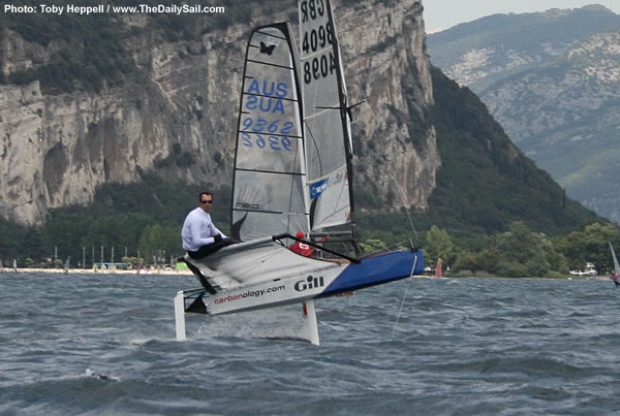
Potent combination
Wednesday November 14th 2007, Author: Toby Heppell, Location: United Kingdom
Recently on the UK Moth website a rumour surfaced as to a new collaboration between top UK Moth sailor and designer, Adam May and carbon technology engineer Dave Chisholm, builder of the GT60, an evolution of the Cherub and a contender in the trials for the now shelved women’s high performance doublehander Olympic class.
May is well known in the sailing world as a coach and Olympic Tornado sailor, but in recent years has become increasingly associated with the International Moth fleet. One of the first foiling Moth sailors in the UK, May has always been heavily involved in the design of his own boats, though admittedly he has not always designed and built them from scratch.
Chisholm’s history is largely in skiff designing, building and sailing. This year at the Cherub National Championships, which coincided with the Moth Nationals, Chisholm was sailing his GT60 - modified to fit Cherub rules. However, mid-way through the event his crew unexpectedly had to leave, leaving Chisholm some free time. Due to this Chisholm took May’s Moth for a sail and was immediately hooked. “I have sold the International 14 and sold the GT60 now. Moth sailing is just so exciting, new and different,” he says.

Although now very keen on the Moth, originally Chisholm’s heart lay in the more traditional high performance skiff world. “I said to Dave a while ago that he needs to build a Moth. He ummed and aahhed a lot and in the end decided to do the GT60 for the Trials instead because he said he was a skiff fan at heart,” May comments. “Since then when he was without a crew at the Cherub Nationals I gave him a go and that was it. Initially he just wanted to build himself a boat and was all ready to dive in and make one. I said ‘hang on though, you need to know the boats very well before you can build them’, so we started to discuss ideas.”
Following the Moth National Championships in Weymouth, May was due to be out of the country for a number of weeks in his role as an RYA coach. His new Moth, then, was not going to be used and Chisholm, a long time friend of May’s, jumped at the chance to borrow his boat. “Adam lent me his boat for the later end of the summer. The idea, with me being a composites engineer, was to act as a sounding board for a new boat for him to take to the Worlds next year,” Chisholm explains.
Following this time in the boat, May and Chisholm sat down together and ran through their ideas for what the new design should look like. Since then they have decided to build the boats together, producing two boats, sailing them against May’s current ‘Weapon’ design before going to the World Championships in Weymouth in 2008 with a fast new boat that has been fully bought up to speed.
Although May has been deeply involved in the creation of all of his previous Moths, he says this is the first one that he sat down and designed from scratch. “Previously I have bought a hull from Linton [Jenkins] but this is the first time I have started from a blank sheet since we did the first Mistress 1,” May explains. “Linton and I sat in his lounge and designed that boat and it was a fairly conservative first hit. We did not really want to stray too far from a classic Moth. The second one I did, I did not want to build the whole thing from scratch so I got a Mistress 1 shell and I hack-sawed it up. That is the first time I went to low freeboard. I guess that was the first proper low freeboard boat. I also started to play with harder chines as I wanted it to do a little better in that marginal just-skimming-the-surface mode. I felt the U section on the Mistress 1 stuck when you touched down at speed.”
Since then May says Jenkins designed the Mistress 3 which was all his own work, with a little input from May. Following this, with his commitments to the Victory Challenge America’s Cup team, May chose not to build a boat from scratch once again, opting instead to modify a Mistress 3 hull. “I went down on the freeboard again and also introduced the radiused bow as I feel you no longer need the waterline length unless we are going really slow then the waterline is halfway up the bow. Also when you tack and come off the foils it is easier with the bow effectively missing,” he explains.

So with both the input of May and Chisholm what can we expect to see next year when their two boats are launched? Most Moth designs seem to be going through roughly the same process at the moment: to reduce freeboard and create a large flat panel for when the boats touch town, coming off the foils. Essentially May says that the top sailors are spending so much time foiling around the race track, the boats are now being built with foiling in mind more than being a boat adapted to foiling.
So then, with May’s last boat having very little freeboard are we to see him go even further down this route? “All the shapes have evolved to lower freeboard and I seem to have got close to the practical limit there. I spent most of Garda with my bow quite deep underwater,” he admits. May does add that for a time he and Chisholm considered going very extreme on the freeboard as a specialised Weymouth Worlds boat, where the racing will take place in the relatively flat water harbour. However they ruled this idea out later on.
Essentially May says he has tried to focus in keeping the resistance of a high speed touch down to an absolute minimum and many of the trends in the new boat reflect this. “Freeboard-wise the new one is the same as the last one and we have kept the radiused bow. It also has the hard chines, although they blend out so it is a more gradual transition to a hard chine shape. We have also put a keel line on it. So the boat has a ‘V’ shape that is pretty shallow along the centreline, almost at wing angle which is a bit powerboat like. Again that is form minimal resistance on the high speed touch down but also when going upwind heeled when you touch down you are landing on a flatter panel rather than a square corner which can allow water up the sides.”

May is confident they stand a good chance of success in building a fast boat. As he says, all of his boats have been reliable and with the addition of Chisholm’s ideas, skill and material access this could turn out to be a very fast Moth.
However, there are a number of people building their own Moths and many of these have a good pedigree so why, you may ask, have we taken such an interest in this one? Well here we have guessed at a few things. When we last spoke to Chisholm, before his involvement in the Moth he was looking to produce a large number of GT60s for general sale to the public if it won the spot for the Women’s high performance doublehander at the Olympic Games in 2012.
Since then, though the boat was not selected to move on - although ISAF did ask him to build a 13ft version - and matters were made worse when on Friday the event itself was not selected. So presumably Chisholm would have the ability to produce a high performance carbon boat in decent numbers. Also one has to ask why May needs to involve Chisholm, when he is capable of building his own boats himself. Perhaps it might be for Chisholm’s expertise and materials access, but we feel it is likely the pair are looking to build and sell Moths in numbers. When we asked about this both May and Chisholm said their current plan was to build and take two boats to the Worlds and do well in them. However, they would not deny the possibility of turning their new foiler into a production boat in the future.
So then could this be the start of the next big UK Moth manufacturing partnership, or is it simply two friends building boats together? At this stage we are not certain one way or another, but for sure this will be a potent partnership to watch in the lead up to the Worlds.
Most Read
Most Commented
Comments
Businesses

Pro businesses
-
Italy
-
United Kingdom
-
France
-
Netherlands
Editor's choice
Member blogs
-
 Ned Collier Wakefield: MOD70 round BarbadosWell that was intense. 12 hard fought for seconds for the win. In idyllic conditions, Tony Lawsons MOD ...
 -
 Mini Transat leg 2 reportThe second leg of the Mini Transat started on 31st October, just over a month after ...
 -
Leg 1 reportI’ve been working towards the Mini Transat now for three years. In 2013 I was part ...
Business blogs
-
 The Island Sailing Club in Cowes, Isle of Wight, is delighted that Prince Michael of Kent ...
 -
Peta Stuart-Hunt chats with the 25 year-old British solo sailor Lizzy Foreman before she sets sail ...
-
The 2015 Student Yachting World Cup (SYWoC), an ISAF-recognised event hosted and run by students for ...
Editor's Choice
All time favourites...
-
 Three legs down into Ian Walker’s
 -
 Winning all but two races at
 -
 For the first time in its
Latest Comments
Add a comment - Members log in