
Moving on up
Wednesday October 31st 2007, Author: Toby Heppell, Location: United Kingdom
Quite often when ISAF are considering a change at Olympic level they will call for a Trial to be held, such as the one this year in Hyeres for the Women’s High Performance dinghy. A variety of classes usually turn up to these events, from those that only just fit the given brief to those designed specifically for it. Of course even though trials are held new equipment is not always selected and one would assume, in this case, any new design would be quickly resigned to the back of someone’s garage. However, this is not always the case as the Musto Skiff has been slowly proving over the last eight years.
Recently the Musto Skiff has been taken on by Ovington Boats who build 49ers, 29ers and International 14s among many others. But this is the latest in a series of changes for the class throughout its eight year life although a little digging shows that these changes are more in name than much else throughout the boats history with each new company involved in the class predominantly consisting of the same people.
The Musto Skiff was actually developed back in 1999 by long term German Contender sailor Dr Joachim Happrecht to fit with an ISAF brief calling for a “Fast single hander - the single hander should be capable of a high performance compared with existing International classes on all points of sailing (including downwind) and provide equal competition for a wide range of crew stature. The ideal boat should require athletic prowess and be challenging technically and tactically.” Back then the boat was called the OSP (Olympic Single Hander) until Nigel Musto ran into it at the Dusseldorf Boat Show and, inspired by its impressive nature immediately spoke to his long term friend Tim Tavinor from Devoti Sailing. Following this, Tavinor and, his then business partner, Luca Devoti went to have a look at the boat following the ISAF Trials in Lake Garda.
Soon it was decided that Devoti would take on the boat with backing from Musto and the class was launched under the name of Musto Skiff. However, although Musto were sponsoring the class and Devoti were bringing it to market it was actually Ovington boats who were making the hulls even seven years ago.

In 2004 the company responsible for bringing the boat to market changed from Devoti to Victor Boats. As Musto Skiff sailor, Rick Perkins, explains this was more a surface change than a real company buy-out. “In 2004, Tim [Tavinor] and Luca [Devoti] decided to terminate their partnership and shut down Devoti Sailing in the UK,” he says. “At the same time Tim started up Victor boats and continued doing what they had been doing. So in essence it was really nothing more than a name change.”
As mentioned above the class has now been fully bought out by Ovington Boats who were still making the hulls for Victor Boats as they had since the class began back with Devoti. “Ovington were always building the hull and have always been promoted as the builder of the hull, but the business had grown to such a level that Victor Boats could no longer cope with demand,” Perkins comments. “Victor Boats is small specialist boat builder who do things like the optimisation of Shirley [Robertson’s] Yngling and are the UK dealer for Finns, so as you can imagine they have got a fair bit on. It got to a stage where the Musto Skiff needed more attention to take it to the next level. A decision was reached that Ovington Boats would take full ownership of the project allowing the class the ability to grow and get the attention it needed.”
Although the class is moving to Ovington Boats having full control the association are still keen to keep some continuity. As such Paul Manning of Victor Boats will continue to supply all the regatta support at events so as to provide a familiar face for all competitors. Clearly this does show a continued interest from Victor Boats even if they no longer have a share in the profits and one gets the feeling they still consider the Musto Skiff their baby. “The guys at Victor Boats want to see the class go from strength to strength and they did not want to limit it,” confirms Perkins. “It is very magnanimous of them as they could have just sat on it making their profit, but obviously Ovington is more able to mass produce boats.”
Part of the reason the class has seen a move to a larger company in recent years is due to a large and continued increase in sales. What is perhaps most interesting is that early on the Musto Skiff class looked as though it would be extremely niche. Specifically the difficulty of sailing the boat, in addition to its being made solely in the UK, led to the class being viewed as one that would only ever see a few British sailors in it. However, over the years this has proved wrong, with slow and steady increases in sales and a constant flow to sailors overseas. Last year the class was awarded ISAF recognised status, meaning they had the right to hold an officially sanctioned World Championships if they so wished.
It is interesting to note that in an age when classes tend to burst onto the scene with a great deal of fanfare and then start to fizzle out, that the Musto Skiff seems to have almost done the reverse. “Many of the people involved come from other big classes, so most people in the class know what it means to be in a solid International class and what needs to be done to achieve that slow steady growth,” Perkins explains.” Our class is much more of a member’s class. We are very innovative in the way that we run things. We started doing e-newsletters four years ago and I have now noticed that other class associations are starting to do the same thing. We also do some text message services at events. The culture of the class, because we have been able to build it from the ground up, is very friendly and helpful.”

This approach is definitely something drawing a number of sailors into the fleet. Three time Endeavour Trophy winner, Nick Craig, due to take delivery of his first Musto Skiff this weekend says this is one reason he joined the class. “It is just such a great class and it is really well run. When you look at the website and see all the information there and how they communicate with their members, it is very impressive,” he comments.
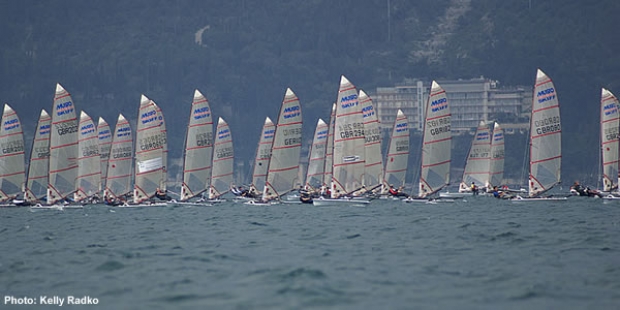
And Craig is not the only person who believes this to be the case as this year, following ISAF recognition, the class held their first ever World Championship in Lake Garda and were surprised by the number of attendees. “At the Worlds we got a bit caught out actually,” Perkins exclaims. “We were expecting a healthy fleet and I was telling everyone that we would get 80 boats and people thought I was getting a bit over excited. In my heart I thought we would have 70 and then when we got there we had 86. We were expecting a good event, but not that many.”
This size of fleet at the Worlds had a slight effect on the UK National Championship though. As Perkins explains, most Musto Skiff sailors are limited in the amount of holiday they can take and for many it became an ‘either or’ decision to make. “We had the UK Nationals Championships after the Worlds. We had 44 boats there, really we were hoping to break the 50 barrier. When you have an event such as Garda which is very attractive you are always going to get a smaller turn out at the nationals though,” he says. Perkins anticipates this is likely to be less of an issue next year with the World Championships in Lake Silvaplana, Switzerland as this is a less well-know location and so will probably attract fewer sailors.
The history of the Musto Skiff is slightly odd, being designed for an Olympic spot that never existed and having gone through three different sellers. But the class has slowly grown throughout all of this to reach the point it is now at, a genuine international class. Interestingly if ISAF were to look for a new high performance singlehander now, the Musto Skiff would probably be the most obvious choice.
Most Read
Most Commented
Comments
Businesses

Pro businesses
-
France
-
United Kingdom
-
Netherlands
-
United Kingdom
Editor's choice
Member blogs
-
 Ned Collier Wakefield: MOD70 round BarbadosWell that was intense. 12 hard fought for seconds for the win. In idyllic conditions, Tony Lawsons MOD ...
 -
 Mini Transat leg 2 reportThe second leg of the Mini Transat started on 31st October, just over a month after ...
 -
Leg 1 reportI’ve been working towards the Mini Transat now for three years. In 2013 I was part ...
Business blogs
-
 The Island Sailing Club in Cowes, Isle of Wight, is delighted that Prince Michael of Kent ...
 -
Peta Stuart-Hunt chats with the 25 year-old British solo sailor Lizzy Foreman before she sets sail ...
-
The 2015 Student Yachting World Cup (SYWoC), an ISAF-recognised event hosted and run by students for ...
Editor's Choice
All time favourites...
-
 Three legs down into Ian Walker’s
 -
 Winning all but two races at
 -
 For the first time in its
Latest Comments
Add a comment - Members log in