
From Tukey to the USA
Wednesday October 24th 2007, Author: Toby Heppell, Location: United Kingdom
The Bladerider International foiling Moth burst onto the scene last year with much fanfare. Since then we have seen the company go from unknown, to dominating the Moth market, culminating in Rohan Veal winning the World Championships this summer by a significant distance.
Olympics
When Bladerider first appeared on the scene the company had a great many aims. One much discussed possibility was the potential for the boat to be picked up by ISAF as a new Olympic class. With the ISAF Annual Meeting set to take place next week the likelihood of the Bladerider having an event selected for 2012 that would suit them feels to be waning somewhat. Rohan Veal, Bladerider’s International Sales and Marketing Manager, confirms that this is not really the company’s main push at the moment. “At the moment [ISAF] are only choosing the events for the Olympics and obviously nobody knows what those events are going to be,” he explains. “We are not really pushing the Olympic option too hard now. Basically if there is any chance that an event will open up with criteria that we might fit into, we will submit the boat for selection and then we will see what happens when they choose the classes in 2008.” It does feel as though the best chance for the class will not be the 2012 Games, but rather 2016, by which point, of course, sailing could well have moved on.
Mass production
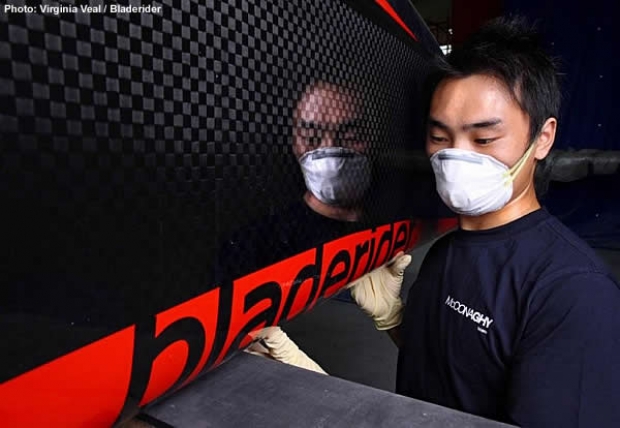
One of the most potentially exciting things about the Bladerider when it burst onto the scene was the plan to produce foiling moths at McConaghy’s large factory in China and so sell large numbers of boats in a short period of time. In short the Bladerider was billed as ‘foiling for the masses’. However, there was much concern both within and outside of the Moth class that there simply was not the demand to fulfil what were in effect very ambitious numbers. So far though, sales have been going very well and though they are not quite up to the numbers originally quoted they are still much better than many expected.
 When we spoke to Bladerider designer, Andrew MacDougall and Rohan Veal earlier this year they stated that the results at the, then imminent, World Championships would not effect sales greatly. As Veal commented at the time, “the worlds result will only have an effect on people buying boats in the Moth class if they want to race in the Moth fleet. If they want to go foiling and have fun in a [one design] class then we should be able to get a boat to them in a week.” Despite this we still feel the World Championships result has had a large bearing on the sales figures for the company.
So just how many boats have been sold so far? “I think it is pretty close to a hundred. We have sold just over ten in the last few weeks,” Veal explained. “Boat 91 is being built at the moment and then I have another ten orders sitting here, so I would say that by the end of November we will have shifted 100 boats, but then we have pre-sold some boats for next year as well.”
Of course with Bladerider International being an Australian company we assumed that many of these new boats would be going to new and old Australian Mothies, though Veal is adamant this is not the case. “I would say that there is an even split pretty much between Australia, the UK, North America and mainland Europe so maybe 20 percent of sales going to each of those and then the rest are spread between some slightly more unusual countries. Actually we have sold over ten to Switzerland and three to Japan, we have sold one to Turkey, and there has never been a Moth there. Two also went to Monaco,” he exclaims.
In addition to this there is also a reseller in Russia and one in Hungary where boats have been bought as well and the UAE. Also recently appointed is the the company Vital Minds, run by Michael Airey, who are to be in charge of distribution in the UK and Ireland for Bladerider.
As one might imagine the boats going to these countries, where Moth sailing has never had a foothold, or in some cases never existed before, the boats are primarily going to middle aged sailors who use them as weekend toys. “It does tend to be business professionals in their 40s and 50s,” Veal confirms.
However throughout Europe, America and Australia there are a few different types of sailor getting their hands on Bladeriders. “There are quite a lot of pro sailors buying them from the America’s Cup and some Olympic sailors. Then we have 20 to 30 year old amateur weekend warriors who take it seriously,” Veal explains. Interestingly there has been some take-up by youth sailors as well and, very impressively a boat has just been delivered to an 11 year old in San Diego. “We have just taken another order from a girl who is about 13 or 15. I have met her but I can’t remember her exact age,” Veal adds.

The USA
With a significant proportion of boats going to North America it seems the chances are, we may see at least a couple of American sailors at the next Moth World Championships in Weymouth 2008. Veal confirms that this is a definite and says it is really only a case of how many there will be.At the moment he expects about four Bladeriders to make the trip from the US. This is particularly encouraging as, although America used to be involved in the International Moth fleet, with past World Champions as well as hosting the event, it has been around 30 years since a US sailor has attended a World Championship.
In fact what the Bladerider seems to be doing particularly well is delivering boats to where there were none or very few before. When the company was launched it was fairly obvious some boats would be sold to Australia, some to the UK and some to the active European countries. However, now one could argue that they are almost solely responsible for building new fleets in a broader range of countries. “I have just got back from a trip to New Zealand and there has been huge interest over there,” Veal comments. “We took three boats out there straight away and we got a call instantly ordering boats. We think there will probably be about ten there in the next few months.”
Not just a Moth…
Although the boat measures as an International Moth it has always been the company’s plan to also run the boat as a one design class, providing separate racing outside of the International Moth fleet. Already with boats going to so many areas of the world, Bladerider is potentially not too far away from claiming International status, which would be a major boost to their Olympic hopes. “At our current rate we are projecting about 400 sales by November 2008, which would easily give the Bladerider International status,” says Veal. “We still see it as a boat that conforms within the Moth rules, so it is a class within a class. The intention is definitely to have a one design boat but still keep the boat as a Moth.”
With 100 boats out of the door already and another 300 on the way when will we see our first Bladerider specific event? “There are a few Bladerider specific events on the cards, but they will not be organised by us. They will be organised by re-sellers and enthusiasts who want to sail the boats. At the moment I know that New Zealand, Helsinki, Amsterdam and Dubai are planning them,” confirms Veal. “I am going over to Dubai next week to help organise theirs. I am going to try and sort it so all the boats are supplied and it is all set up, but they organise the event.” For us this was a little disappointing as, when the class was launched, we got the impression the company would be organising somelarge scale events that might help promote foiling Moth sailing. It now looks as though the company has chosen a fairly typical route, effectively leaving it to regional class associations to look after their own events.

Teething problems
Despite a great deal of success Bladerider International has had their own share of difficulties. Firstly many of the earlier boats to come out of the moulds were faulty and needed to be replaced, leading to a situation at the World Championships where a theoretically one design boat existed in a variety of different forms, with different builds and foils. Veal admits this was frustrating, but is something that has now been all but cleared up. “Obviously we were still fairly early in our production run this year and we did have to replace some boats. Anyone who did need replacements had new everything from scratch. It was a bit annoying that all that happened, but I guess that is something you have to deal with when you set out to mass produce these sorts of things.” These were not just a few minor problems, however, as demonstrated by
Graham Vials who came in from the final race at the Moth World Championships with his deck having ripped of his hull, leaving a three inch gap down one side of his six month old boat.
To remedy these design issues to boats have had to be beefed up. Originally the boats were coming out of the moulds at 8kg. Since then there has been an extra 2kg of carbon added to bring hull weight up to 10kg. This is a little disappointing with weight reduction being one of the key concerns in Moth building. Veal argues otherwise: “We could get them down to eight or nine kg but the weight is not really an issue. The hull seems fine at 10 kg. In terms of performance it is in the right spot. It is also a bit stiffer which is better. We have found a lot of difference in the feeling you get through the boat when it is 10kg compared to 8kg, and we want the boat to last longer which beefing up helps with too.”
Patents
Most recently the company has come under direct fire from a number of factions within the Moth fleet after they began the process of trying to patent a number of parts on the Bladerider. This includes the way the two part foils slot together for easy transportation and the trampoline to rack attachment. The main argument levelled at the company is that the simple act of legally protecting new designs is not in the spirit of a development class. If Fastacraft’s John Illet had patented his own wand mechanism for controlling foiling and if 75 years of Moth development had somehow been protected, the Bladerider itself would not exist.
It is hard to argue with this point of view but it is also clear that as a company Bladerider does have a right to protect their own original ideas by law. This on-going discussion is still very much in the early stages and, as yet, there is no statement from Bladerider with regard to the problem. Veal was, himself not keen to discuss the issue stating only “do I think that patenting parts on an open class is good for the class? I would say no and I don’t know how much to expand on that. It is obviously good from a business point of view but in the end I am not sure how much it is going to benefit us or the class. I don’t know if they will get approved. I have been involved with [patents] before and they are difficult to get and very expensive.”
This issue is much larger than we have stated here and we will be going into it in more detail at a later date. Veal says the company will have a statement with regards to the patent soon at which point we will revisit this problem in a fuller manner.
Most Read
Most Commented
Comments
Businesses

Pro businesses
Editor's choice
Member blogs
-
 Ned Collier Wakefield: MOD70 round BarbadosWell that was intense. 12 hard fought for seconds for the win. In idyllic conditions, Tony Lawsons MOD ...
 -
 Mini Transat leg 2 reportThe second leg of the Mini Transat started on 31st October, just over a month after ...
 -
Leg 1 reportI’ve been working towards the Mini Transat now for three years. In 2013 I was part ...
Business blogs
-
 The Island Sailing Club in Cowes, Isle of Wight, is delighted that Prince Michael of Kent ...
 -
Peta Stuart-Hunt chats with the 25 year-old British solo sailor Lizzy Foreman before she sets sail ...
-
The 2015 Student Yachting World Cup (SYWoC), an ISAF-recognised event hosted and run by students for ...
Editor's Choice
All time favourites...
-
 Three legs down into Ian Walker’s
 -
 Winning all but two races at
 -
 For the first time in its
Latest Comments
Add a comment - Members log in