
The big media push
Monday September 24th 2007, Author: Toby Heppell, Location: United Kingdom
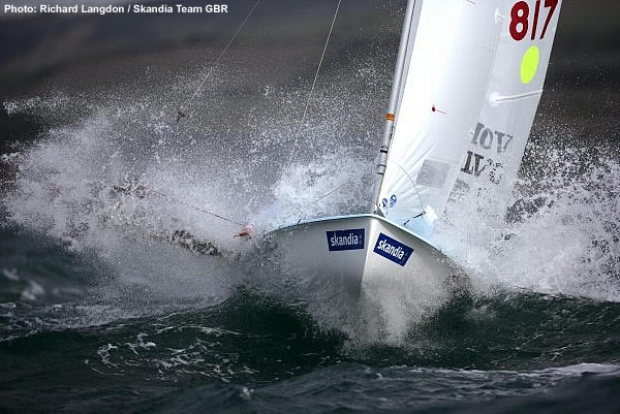
This weekend saw the conclusion of the second ever Skandia Sail for Gold regatta. Although still in its infancy this event is the RYA’s flagship Olympic classes regatta and as such is likely to become a huge deal in the next cycle as sailors descend on Weymouth to get a taste of the 2012 Olympic sailing venue.
This year the regatta saw a reasonable turnout with the event already being bigger in this respect than a number of older and technically higher profile regattas such as Sail Melbourne. Interestingly, although Sail for Gold is a larger regatta than Sail Melbourne it is unlikely to reach the same degree of importance due to ISAF regulations: ISAF has a rule which limits Grade 1 events to three per continent. As Europe already has established Grade 1 events in Hyeres, Kiel and Holland, Skandia Sail for Gold will probably never be more than a Grade 2 event – as is the case with the well attended Princess Sofia Trophy in Palma.
The fact that the event is so new and thus not so important to ISAF rankings has been one reason attendance has remained fairly low but there are a number of other contributory factors. “The event is establishing itself on the international calendar and hopefully word is getting out that it is good,” commented RYA Racing Manager, Rob Andrews. “I think this year quite a few people are pretty tired. When we first planned the dates a number of years ago we still did not know the dates of the World Championships for 2008. It now transpires that the majority of the Olympic class World Championships are down under in early 2008. For people who have just got back from Beijing and the Olympic qualifier in Cascais, July and August has been pretty busy so in September some nations are taking a bit of time out. We are still happy with the number of nations that came though.” As mentioned above it is expected by most that the event will really take off in the next Olympic cycle as sailors look towards the London 2012 Games. “In 2009 it will be up there with Hyeres and other big regattas on the world circuit,” Andrews confidently asserts.
Despite the fact that the event has yet to see thousands of sailors attending like the other big European Championships, a considerable amount of money is being poured into Sail for Gold, particularly the media side of the operation. Simon Hiscocks – sailing at the event in the 49er with youth sailor Ollie Spensley-Corfield after missing out on Olympic selection – commented that the event was “effectively a live event and it all looked pretty slick. Watching the other medal races onshore there was a great atmosphere.”
This is a thought reflected by a number of teams we have spoken to and Andrews confirms there is a major push on the media side at the moment. “We have two agendas: we have an agenda to try and get some coverage of the sport as a whole but also we have a 2012 agenda,” he states. “We believe [the 2012 Olympics] will be heavily TV driven. We also believe that if technology is not completely proven by say 2010 or 2011 then the IOC broadcasters will not use some of that technology. So there is a great need to trial it now. From a purely British, RYA point of view this is our - not even once in a lifetime, but once in god knows how many lifetimes – opportunity. We have top performers in the shape of people winning medals. Now we need to get the sport out to the public so they can understand it and engage in it and possibly have a go at it - then the whole industry benefits.
This view is not only held by the RYA but also by UK Sport who funded much of the media output taking place over the week in Weymouth. Andrews comments that UK Sport is keen to try and help the sport at this stage in the hope that it will become much more self-sufficient come 2012. Many sports are able to rely on ticket entry to events to ensure at least a base line of revenue. Sailing, however, does not have this luxury, so it is important that media coverage is good and broad to gain as wide an audience as possible. This should encourage more sponsorship, hopefully enabling the event to ‘clean its face’

To this end the RYA are effectively testing a great number of different initiatives which they can later analyse so they can begin to work out what the best way is to get sailing out to the public. These initiatives range from fairly old technology to very cutting edge. On the side of older technology, this year a local radio station – Airwaves – took up audio coverage of the event on Thursday, Friday, Saturday and Sunday. For those living within the Dorset area this meant being able to tune into their local radio station and receive full audio commentary from expert sailors.
On shore and at the venue there was a large three metre by four metre screen playing out live TV to spectators of the action on the water. This was being beamed back to shore and cut together by APP Broadcasting in real time, allowing up to the minute delivery of important races for those at the venue. In addition to playing on a big screen in Weymouth the live TV was being streamed to the Sail for Gold website allowing potential viewers from across the globe to watch the action. Andrews told us that they do not have the actual viewing figures for the medal races – they are being worked out this morning, but he thinks they may be in the region of 15,000 people, an impressive number if this is the case.
At the end of each day there was also a video podcast available for download with a round-up of that day’s racing. This podcast was being played on a big screen at the Southampton Boatshow throughout the course of the event. This partnership with the Boatshow is something Andrews has spoken about with us before. The plan is that people come over to see the show and hopefully take a day to catch the action in Weymouth on the same trip.
Within this TV broadcasting there were number of other media delivery systems being trialled. “There was a mini camera initiative. So we had Stevie Morrison’s boat with four mini cameras on which we could switch around,” Andrews commented. “That was fine until the start, however, because it was quite windy they were flogging quite a bit of main and as they sheeted on part of the transmission system was destroyed. We still got lots of good pre-start stuff so that was very positive.” Clearly when the Olympics rolls around in 2012 having four mini cameras on a number of boats should give some great video of what is going on onboard. This would also have the useful side effect of providing some using training footage for the younger generation.
One of the big buzz-words in Olympic sailing at the moment is ‘tracking’ and this is something we have seen slowly permeating into the dinghy world over the past few years. Currently we feel, we are a little way from seeing this GPS-based technology being used to its full advantage but this is something the RYA, alongside tracking experts, Traxu are working on. Unfortunately this week there were some problems with the system which left it as the clear weak link in the media chain. “The Traxu trackers had problems transmitting back to the shore,” admitted Andrews. “We think it was probably because there were so many different frequencies operating. All the live filming was micro-waved back the TV and radio commentators on the water were transmitting back. All the coaches and all the overseas coaches were on radio channels etc. So the Traxu stuff got knocked out, which is a great shame because hooked into that was the same player that was used on the internet for the America’s Cup. We had done a lot of different animations on that which we could use but which never got utilised.”
Still many of these delivery systems are in a test stage and Andrews says they now know they need to secure the Traxu frequencies better and next year the technology should be more robust thanks to the lessons learned at this event.
Clearly although Skandia Sail for Gold is not currently a giant among Olympic classes regattas it is set to be in the near future. The RYA and UK Sport together are making good progress with media delivery systems now, before the event becomes as big as it inevitably will be. If the sailing in Qingdao is the light wind regatta most expect it to be Sail for Gold and ultimately the 2012 Olympics with exactly this sort of media delivery, combined with an exciting breezy venue could put Olympic sailing back on track as an exciting, watchable sport.
Most Read
Most Commented
Comments
Businesses

Pro businesses
Editor's choice
Member blogs
-
 Ned Collier Wakefield: MOD70 round BarbadosWell that was intense. 12 hard fought for seconds for the win. In idyllic conditions, Tony Lawsons MOD ...
 -
 Mini Transat leg 2 reportThe second leg of the Mini Transat started on 31st October, just over a month after ...
 -
Leg 1 reportI’ve been working towards the Mini Transat now for three years. In 2013 I was part ...
Business blogs
-
 The Island Sailing Club in Cowes, Isle of Wight, is delighted that Prince Michael of Kent ...
 -
Peta Stuart-Hunt chats with the 25 year-old British solo sailor Lizzy Foreman before she sets sail ...
-
The 2015 Student Yachting World Cup (SYWoC), an ISAF-recognised event hosted and run by students for ...
Editor's Choice
All time favourites...
-
 Three legs down into Ian Walker’s
 -
 Winning all but two races at
 -
 For the first time in its
Latest Comments
Add a comment - Members log in