
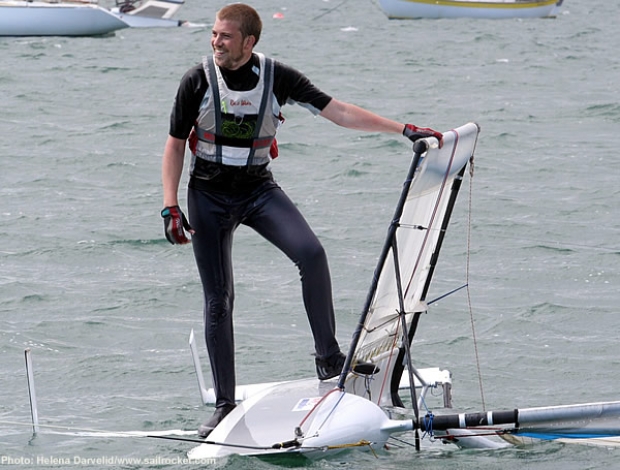
First time foiler
Wednesday September 12th 2007, Author: Toby Heppell, Location: United Kingdom
Back in June of this year I wrote a piece about my first experience in a foiling Moth I had recently purchased (see the article here.) Back then I had managed to sail the boat only once and in four knots of wind did not manage to get up onto the foils. Now, a couple of months later I have had more - if slightly limited - success.
Originally I had planned on buying a Moth near the start of the summer and so saving myself a lot of cold swimming during the winter months. However, I had not considered just how busy the summer was to be for me and consequently my time spent in the Moth to date has been severely limited. I have managed to hit the water a few times though and now have my Moth wings after a few different occasions of perfect wind strength and some free time providing me with a number of frankly awesome, though for the most part rainy, sails.
My first proper foiling experience was actually at the National Championships in late July. I entered the event assuming that although I had yet to sail the boat, apart from my first sail, it would be useful to be around so many top Mothies for an extended period of time. Well this turned out to be extremely true. I headed out onto the water for my first day at the nationals (I was two days late in arriving, due to other commitments) late for the start and still rigging up when others were on their way out. The wind was blowing about 10-15 knots and a long downwind to the start should have been perfect to pop the boat onto the foils, getting used to the sensation before rounding the committee boat, hitting the line at pace and sailing off to a respectable finish, or so I hoped.
I carried the boat out into the water righted her and hopped in (I have yet to make this look graceful and continue to use the half fall, half roll, flailing my arms until they come across the mainsheet and tiller technique.) This year I have witnessed a great deal of Moth sailing so I knew what to expect. The boat would accelerate and as it did that I would sit back and then I would be up on the foils and off, easy as that. I sheeted in, the boat accelerated and with a great sense of anticipation I sat back and waited……..nothing happened. Okay, no problem, I thought, I’ll give the main a little pump just to help me up onto the foils and try sitting back a little further giving the foil a better angle of attack……nothing happened. I carried on sailing out to the start area and on a couple of occasions in the bigger gusts if I worked very hard I could get the boat out of the water for short periods of time but it felt nothing like the experience I was expecting. I carried on to the startline and managed to capsize as I tried to gybe round the pin. I took this opportunity to check all the foil controls were right, which they seemed to be.
I righted the boat and with most of the fleet now at the windward mark I decided to sail about by myself for a while and see if I could get the boat properly onto its foils. I spent what would in almost any other class be a great hour or so blasting around Portland Harbour but was really struggling to get the boat onto the foils in any real way. I decided to head in and see if I could get another Moth sailor to sail my boat around and check the set-up. It just did not feel right for the boat to be that much hard work to get onto the foils, after everything I have heard about sailing Moths.
After racing had concluded for the day Adam May and I discussed the problems I had been experiencing and he took my boat out for a spin to see what the trouble was. To my dismay he got the boat up, jumped in and was promptly foiling around the bay happily, putting my earlier performance to shame. However, my worries were somewhat allayed when May returned and commented that the boat was very tricky to get up onto the foils and that a spacer was needed at the bottom of the gantry to kick the rudder backwards a little bit. With this done I headed out onto the water to try again. Once again, however, I struggled to get the boat onto the foils, though this time with May on the water it was a quick swap between boats and he had discovered the problem. It was a simple issue this time - the cable that connects the control rod on the main foil to the front sensing wand had come loose in its deck fitting. Because of this when the wand was being pushed backwards the whole cable was flexing and the inside was not moving and adjusting the flap as it should.
Adam and I swapped boats once again after he sorted this problem and I decided in an effort to make foiling as probable as possible that I would start off by heading on a tight (ish) reach. I righted the boat, sheeted in the sail sat back a little and popped effortlessly out of the water, onto the foils.
Much has been written about the sensation of foiling and the thing that is most often stated by people is the sound, or rather lack of sound, that the boat makes. I was going to try and write about some other facet that first struck me but I simply can’t. The lack of noise is the most powerful thing about getting up on the foils with only a slight, low whistle coming from the wind zipping past. It is simply like nothing else I have ever done and in that first instance I knew this is what I wanted to do as often as possible for as long as possible.
The second thing is the acceleration is huge. Before you know it the boat is hammering along and the whistle is increasing in both volume and pitch. After a few seconds of the boat accelerating and the whistle increasing I suddenly became aware I was a long way up and must be reaching full foil height. Then, without any further warning the boat ‘lost grip’ as the foil broke the surface of the water. As you can imagine when this happens the foil just skids out from under you, the boat slows and crashes back into the water, throwing you forward with the violence of the deceleration. I was rather surprised to find when I opened my eyes that the boat was still upright. As it turns out these crashes (in flat water at least) rarely seem to result in a capsize.
Adam May came alongside me and explained that I had made a rookie error - after sitting back to encourage the boat onto the foils you then need to shuffle forward to ensure the boat does not keep climbing but rather sits level, he also added that sheeting on and bearing away (so de-powering and slowing the boat) would produce a slightly less aggressive deceleration. I set off again and was once more amazed at the sensation and the silence except for the ever increasing whistle. This time I knew what to do and as the boat accelerated I started to shuffle forwards. Clearly this was not something to take your time about as once again the foils broke the surface and the boat did exactly the same skid and crash move as before. Still I was learning and the next time I travelled for quite a way and decided to try and head upwind.
I would like to tell you in fine detail exactly what happened, but I am unable to due to the speed of events. I think as I headed up I needed to hike a little harder than I was, as the boat began to luff it started to heel a little to leeward and then things got really funny. The boat bucked around a bit and I dropped the main before being unceremoniously dumped in the water to windward.
Going upwind is a good deal more work than downwind but is significantly less scary to begin with. The first, and one of the oddest things to get used to is how much you need to foot to get the boat onto the foils initially. It is pretty clear, even when not racing against any other boats, that the decision to go bow down and get the boat foiling must be huge in marginal conditions as the ground lost just trying to get the boat up to speed would be considerable. Still once up on the foils, much like downwind, the acceleration is impressive and the difference in speed is simply huge. Control upwind is a little easier, though I felt as though I were luffing to control my ride height a little too much as opposed to positioning my body perfectly. About an hour into my sail I noticed that some of the lacing eyes that hold the trampolines to the side of the boat had pulled out so I headed back to the shore and Adam May kindly offered his services and his garage for an overnight repair. Secretly I was delighted by all this - not only had I been out foiling all day, but would now be out repairing my boat all the evening - I could not have felt more of a Moth sailor!
Sadly this was the best of my National Championships. After picking the boat up from Adam’s and rigging up again the next morning I headed out on the water only to find the boat behave very erratically. I also noticed after a few windward capsizes that in my haste to get out on the water I had rigged my kicker up incorrectly and so it was not cleating. I headed back to shore to re-thread the kicker and try to discover what was making the boat foil so erratically. When I got ashore and checked out my foils it was soon obvious that the push rod that runs all the way down the inside of the training edge of the main foil and attaches onto the flap on the horizontal foil had come detached and so was just moving up and down in a hole as opposed to pushing and pulling the foil flap up and down. This looked like it would take a bit of gluing so begrudgingly I packed up the boat and sought some advice on the control rod repair. As it turned out the repair was fairly easy to do and only took about and hour, though by the time I had realised this and done it, it was too late to go out sailing.
The final day at the Nationals dawned with high winds making no racing possible. So concluded my first Moth National Championship with not a single finish to my name. However, I did learn a lot and did a decent amount of foiling. Having got this far with other boats around I have since been out on the water a few different times. I am still struggling a little with fore and aft body trim, though this is getting better every minute I sail. The next step for me will be to try and perfect some manoeuvres as currently gybing tends to result in me getting wet about five times out of ten. I’ll keep you posted.
Most Read
Most Commented
Comments
Businesses

Pro businesses
-
-
United Kingdom
-
France
-
Editor's choice
Member blogs
-
 Ned Collier Wakefield: MOD70 round BarbadosWell that was intense. 12 hard fought for seconds for the win. In idyllic conditions, Tony Lawsons MOD ...
 -
 Mini Transat leg 2 reportThe second leg of the Mini Transat started on 31st October, just over a month after ...
 -
Leg 1 reportI’ve been working towards the Mini Transat now for three years. In 2013 I was part ...
Business blogs
-
 The Island Sailing Club in Cowes, Isle of Wight, is delighted that Prince Michael of Kent ...
 -
Peta Stuart-Hunt chats with the 25 year-old British solo sailor Lizzy Foreman before she sets sail ...
-
The 2015 Student Yachting World Cup (SYWoC), an ISAF-recognised event hosted and run by students for ...
Editor's Choice
All time favourites...
-
 Three legs down into Ian Walker’s
 -
 Winning all but two races at
 -
 For the first time in its
Latest Comments
Add a comment - Members log in