
Developing foils
Wednesday August 29th 2007, Author: Toby Heppell, Location: United Kingdom
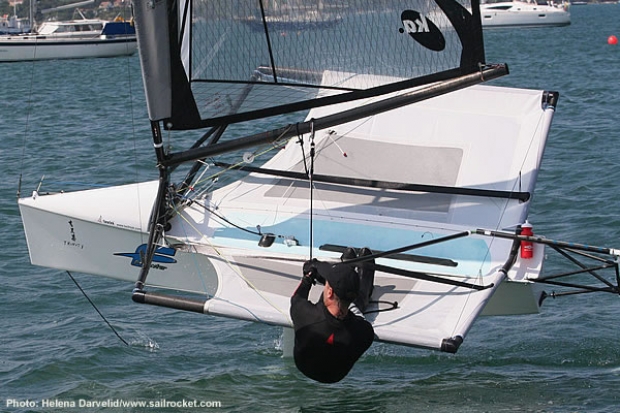
Recently somebody wrote on a Moth forum: 'Foil development; finished yet?' At this year's Moth World and UK National Championships we had a look around and all signs would point to the answer being a resounding ‘no’ with competitors displaying a range of foil sizes, styles and configurations. In truth the class is still very much in the early stages of foil development and many designers are still feeling their way around the subject.
One of the fantastic things about attending events in a class that, like the Moths, had a major development only a few years ago and has since taken off in a big way (no pun intended), is that you are able to see the Darwinian-like evolution of developments from the start to the newest designs.
The very first foils to be produced and sold were by Fastacraft in Australia and a few boats are still sporting this design. Being the earliest, these big square tipped foils have features geared more to experimentation than speed. They were large and square primarily because this made them easy to build from one mould and allowing foils size to be reduced by chopping down the ends.
These early designs proved to be more unstable fore and aft than was desirable and were quickly shortened and reduced in size with the effective extra area removed being put on the rudder foil to even out the balance. From this point on, the ratio between main foil size and rudder size has not radically altered and it is generally accepted this configuration provides the most balanced foiling platform.
With the ratio between the foils now established and with a number of crews perfecting the art of foiling, development moved on to the refinement of foil shape, build, size and control mechanisms. Linton Jenkins of FullForce boats made a slight adaptation to the early Fastacraft design. His primary modification was to produce a more faired in flap, allowing a reduced flap size due to an adaptation of the attachment and pivot method. This had been tried by John Ilett at Fastacraft but he soon disregarded it, due to its effect on the effective span. Since this time FullForce flaps have slowly grown out again.
Around this time there was also some development on the rudders. A couple of sailors and designers tried their hand at using an entirely fixed non-articulating T-foil rudder, relying on wand control and body movement to alter the pitch of foil. Alex Adams experimented with a Jenkins foil of this type, but the idea was dropped. Other developments in the T-foil rudders followed similar lines to those in the International 14 class with experimentation around the idea of abandoning the independent rudder flap in favour of the entire rudder articulating on its gantry. Some work was carried out on this in Australia, however, this idea only really started to look effective with the birth of the Bladerider later on.
Next came a move to reduce drag and foil size by the development of elliptical foils (below), again a move by Jenkins. Elliptical foils, in theory, should create less drag, through their smaller size, and provide a more efficient shape than the previous square ended tips. Jenkins himself used these at the 2004 European Championships in Lake Garda. These foils proved to be fast at the event and in training. Sam Pascoe (who is heavier than Jenkins) managed to achieve some impressive top speeds in training though he struggled in racing partly due to his weight. At the World Championships in Denmark he was having trouble with height upwind and depth downwind as well as getting back onto the foils quickly after a tack. It therefore became apparent that a solution would be to have foils designed and built tailored to the weight of each and every sailor individually. This was an unlikely option as the cost of each foil would be greatly increased, so the idea fell by the wayside.

Meanwhile in Australia, John Ilett at Fastacraft began to produce tapered, slightly elliptical foils that were larger and less radical than the ones designed by Jenkins (below). These were less suspectible to variations in crew weight, but lost some top end speed due to the drag created by the larger and slightly squarer foil section. At this moment all the new Fastacraft foils are this shape, though there are rumors Ilett may come out with a new shape for the Worlds next year.

Following these innovations the Bladerider leapt onto the scene earlier this year with much fanfare and sporting a radical looking set of foils, the most significant aspect of them being a refinement of some of the low key work already done in Australia with fixed rudders and canting gantries. The pros and cons of this system are being debated even today. In theory this system, similar to that found on the Morrison 14s, should make the boat harder to set up, but should also reduce drag due to the foil being thinner as it does not need to incorporate a hinge system within it.

Both Bladerider foils were also sporting bulbs on their nose. The theory behind this is twofold: Firstly for ease of shipping the Bladerider foils come in two parts with the bottom foil being able to disconnect from the main vertical foil. The bulb allows the vertical foil to slot a significant way into the horizontal foil, something that would be impossible on the traditional, slimmer foils. Secondly the bulb reduces the interference drag caused by the pressure fields of both – vertical and horizontal – foils interacting. The bulb nose reduces this problem and can often be seen on other hydro-foiling craft. Again the debate as to the effectiveness of this is by no means over and we may well see more bulb nosed foils in the future.
Below: The screw that holds the horizontal and vertical sections together is visable here.

Finally Linton Jenkins has produced what is being dubbed a polyhedral foil (below). This is a foil with square edges that tapers towards the tip. This foil has many of the advantages of the elliptical foil, principally the reduced drag, but the squared shape means, in theory, it is able to be easily chopped down for lighter sailors thus being a refined foil suitable for sailors of any size. However, currently we have yet to see any of the foils cut down so most are sailing around with the same size foils irrespective of their weight.

When speaking to any Moth sailors or designers the one thing they all say unanimously is there is still a great deal to learn about foil design on their boats and there is a long way to go before we are anywhere near optimum shapes or designs. And, who knows, maybe there are still be innovations to come.
Most Read
Most Commented
Comments
Businesses

Pro businesses
Editor's choice
Member blogs
-
 Ned Collier Wakefield: MOD70 round BarbadosWell that was intense. 12 hard fought for seconds for the win. In idyllic conditions, Tony Lawsons MOD ...
 -
 Mini Transat leg 2 reportThe second leg of the Mini Transat started on 31st October, just over a month after ...
 -
Leg 1 reportI’ve been working towards the Mini Transat now for three years. In 2013 I was part ...
Business blogs
-
 The Island Sailing Club in Cowes, Isle of Wight, is delighted that Prince Michael of Kent ...
 -
Peta Stuart-Hunt chats with the 25 year-old British solo sailor Lizzy Foreman before she sets sail ...
-
The 2015 Student Yachting World Cup (SYWoC), an ISAF-recognised event hosted and run by students for ...
Editor's Choice
All time favourites...
-
 Three legs down into Ian Walker’s
 -
 Winning all but two races at
 -
 For the first time in its
Latest Comments
Add a comment - Members log in