
Barely any wind, but not a lottery
Thursday August 23rd 2007, Author: Alistair Skinner, Location: Australasia
So with the regatta over and Team Skandia GBR presumably not displeased with the end results with an unprecedented five golds, it is a time to reflect on the past two weeks.
The statistics will show that in most classes the majority of the races were achieved.
How they were achieved is perhaps a little less favourable with, on some days, the fleets being towed out to the starting areas only to be towed back. On at least one day this happened twice. On another day at least racing didn’t start until right at the time limit of 1600 with some sailors returning to the harbour in the dark - not the safest situation in an unlit sailing dinghy.
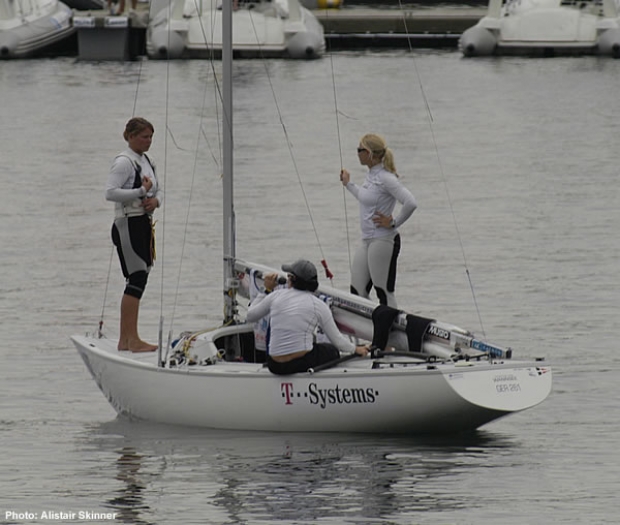
One of the most regularly seen images of the event was the AP flags over all classes in the heart of the venue.Certainly most days the competitors spent some time, sometimes a lot of time, hanging around in temperatures in excess of 30°C, often on the water, with approaching 100% UV reflectivity.
Could you imagine a 100m running event where the heats and/or final was billed to start at 1200 and didn’t happen until 1600 because the track wasn’t ready, with the athletes expected to spend at least some of that time hanging around in the sun?
It will no doubt bring another round of China bashing but let’s not forget that China is relatively new at this game and very new at running sailing events of this magnitude.
The question I would ask first of all is what happened to the due diligence that IOC or ISAF did or should have done to ensure they didn’t place the 2008 Olympic Regatta in a location where there was a historic lack of the most basic requirement (after water) for a sailboat regatta.
I say historic because the main reason the Germans had a concession here, and that the Japanese were so keen to be here was because of the sheltered harbour of Qingdao.
It is kind of like expecting a long jumper to compete without a sand pit.
Sailors have been heard to describe it as 'a scandal' or the conditions as 'heinous', some armchair admirals even made the suggestion that it should have been moved to Hong Kong - not the best of suggestions where the local clubs suspend their sailing calendar due to the typhoon season.
I’m biased but on the second weekend of the event while I was cooking under a hot sun in Qingdao with no wind my fellow club members at the Shanghai Boat & Yacht Club were enjoying 15 knots of breeze.
The hardware, however, is awesome with the Qingdao Olympic Venue being quite simply the best base for competitive sailing I have ever seen. Little touches matter and every morning the people were out with deck brushes scrubbing the launching ramps because the sea grass grows quickly in summer.
Sure it’s not perfect on the ‘software’ side of things, but the Chinese will do their utmost to ensure it will be as close as possible - even they cannot control the wind - and are already checking out what needs to be improved.
I had lunch on one day with Dr Alex Dong, Deputy Director of the Olympic Marina site and even he was asking what needs to be improved. I mentioned the delays in the media getting results, especially the remote media who were using the internet as an information tool with Sailingscuttlebutt.com claiming it took 15 hours for some results to be posted. (Other sites had people on the ground so this wasn’t so important). The next day there seemed to be an improvement. Coincidence perhaps but the point is, as I mentioned in my earlier article, that the test event is designed to benefit the local organisers as well as the competitors.
What concerns me more is that with the Olympics being very much, these days, concerned with the media dollar and putting in or taking out sports with as much the TV viewer in mind as anything less than excitement will surely threaten the sport’s continued involvement in the Olympic Movement even though it is one of the world’s larger participative sports.

This puts a huge load on Weymouth to redress the balance next time around and perhaps the IOC and ISAF will have learned a lesson to be a little more thorough with their checking and due diligence with regard to wind speeds and tidal currents at the sailing venue in the future - I certainly hope so.
The bottom line though is that although the racing wasn’t as exciting to follow as it would have been if all boats had been powered up. But the pundits that stated that it will be all down to luck have been proved wrong with all the podium spots filled by ISAF top 20 ranked sailors except two, and one of them was Ben Ainslie (yes he doesn’t feature in the Finn Top 20) and around 80% of the Medal Races being filled by top 20 teams and those guys are all ‘in the hunt’ at any championship.
Perhaps the expression “The cream always rises to the top” might just be true.
Where luck would come in is if next year there is no wind and Competition Manager Qu Chun’s concept that one race could constitute an Olympic Regatta and medals awarded on the that basis.
Now that would be a scandal but I don’t think it will come to that. Let’s pray for wind and remember that in Pusan, South Korea just across the sea from Qingdao had similar concerns in 1988 and I remember correctly breezes at the event got up to the high 20s.
Another interesting fact is that Pusan’s harbour cost around US65m while Qingdao is reputed to have cost in the region of US250m - for just 11 events and 400 athletes. This may be a much bigger worry for the long term future of sailing in the Olympics than lack of wind.

Most Read
Most Commented
Comments
Businesses

Pro businesses
-
United Kingdom
-
United Kingdom
-
-
France
Editor's choice
Member blogs
-
 Ned Collier Wakefield: MOD70 round BarbadosWell that was intense. 12 hard fought for seconds for the win. In idyllic conditions, Tony Lawsons MOD ...
 -
 Mini Transat leg 2 reportThe second leg of the Mini Transat started on 31st October, just over a month after ...
 -
Leg 1 reportI’ve been working towards the Mini Transat now for three years. In 2013 I was part ...
Business blogs
-
 The Island Sailing Club in Cowes, Isle of Wight, is delighted that Prince Michael of Kent ...
 -
Peta Stuart-Hunt chats with the 25 year-old British solo sailor Lizzy Foreman before she sets sail ...
-
The 2015 Student Yachting World Cup (SYWoC), an ISAF-recognised event hosted and run by students for ...
Editor's Choice
All time favourites...
-
 Three legs down into Ian Walker’s
 -
 Winning all but two races at
 -
 For the first time in its
Latest Comments
Add a comment - Members log in