
Change afoot
Thursday August 2nd 2007, Author: Toby Heppell, Location: United Kingdom
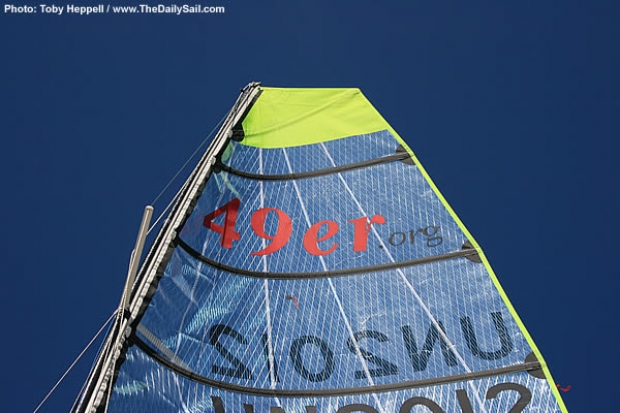
At the recent ISAF Sailing World Championships, the 49er class unveiled plans to test a new carbon fibre rig. Currently the class sports a two piece mast with the bottom section made from alloy and the top section made from fibreglass.
It is a widely held opinion by some, both inside and outside of the 49er class, that competitive 49er masts will last roughly a season and a half and are not all the same, so it can be hit and miss as to whether you get a good one. Many top teams hang onto their best for the most important events such as World Championships. Clearly then there is work to be done in this area and it is encouraging to see the class pushing itself to keep developing at a slow and steady pace.
If the class does choose to go to the new carbon mast there will be a lot less weight at the top of the rig and this will reduce the righting moment required to keep the boat flat. With the average weight of 49er sailors decreasing in recent years it is therefore important for the class to ensure the boat keeps to at least the current average weight. To prevent weight from reducing further still, if the class updates to a carbon rig the sail area will also be increased by 0.5m2. Much of the additional area will be added in the form of a square topped mainsail, a lot like a smaller version of the sails we saw on the winning International 14s at this year’s World Championship in San Francisco.
The suggestion of changing from an old mast to a new one that is also made out of a more high tech material, coupled with the introduction of new sails has not gone down well with the entire fleet. A number of sailors thedailysail has spoken to have expressed concerns that this is just a way for the 49er manufacturers to ensure they sell an entire fleet’s worth of masts, as well as new sails. It is hard to ignore the fact that if this change were to go through someone would be selling a lot of masts and a lot of sails, so this is a fair point to raise.
Speaking to 49er designer, Julian Bethwaite, he told us why this is being considered now: “Really because the technology is now available to create a much better mast and save sailors a lot of money is the major reason,” he comments. But how? “The net result of everything that is being done is that instead of the top guys owning two, three or even four masts a year, they might own one or two. For the weekend warrior or non-rock star guys it will mean that you have one mast that will virtually last indefinitely. So basically the major reason is that people will be able to spend a lot less money.”

Above: The current 49er rig.
Bethwaite says there are two primary ways in which the masts longevity will be increased. Firstly the new mast will be a smaller diameter tube and this will reduce the compression and the tension on both sides of the mast. In addition to this the change to a square topped mainsail should reduce the amount of work the mast has to do and increase the amount of time it will remain good for. On the current 49er rig set-up, if a gust or more pressure hits the sail, the mast flexes allowing the top of the mainsail to automatically de-power. This naturally means the mast is having to do a lot of work over the course of its life as it is more or less constantly flexing, sometimes a significant amount. If the fleet change to the new rig and carbon mast then the square top of the main will self de-power more than the current main and so will mean the mast has to flex less, therefore giving it a longer life - in theory.

Another point that has been raised by a few 49er sailors we have spoken to is that of cost. It is all very well stating that the new mast will last longer than the old one and so save sailors money but this statement is only true if the cost of the new mast is similar to that of the old one. Typically a carbon mast costs substantially more than than an alloy and glass one. Bethwaite argues this is not going to be the case. “Carbon is becoming a much cheaper commodity,” he comments. “There was a worry a couple of years ago that the price of carbon would go through the roof, but it has recently stabilised and come down. Now with the cost of energy the price of aluminum is going through the roof.” He gives the impression that the new 49er mast will not be wildly more expensive than the old one. There are of course economies of scale too – a large number of these masts will have to be built, but the main reason we expect this is simply that the 49er is an Olympic class and as such is under huge pressure to keep the boats realistically available for as many nations as possible throughout the world.
There are other benefits in switching to a new mast and mainsail set-up. One such improvement will be the performance of the boat. “A 3kg weight saving in a mast will make a big difference,” comments Bethwaite. “We are expecting the boat to go upwind at maybe half or three quarters of a knot faster.”. Of course by increasing the performance of the boat racing clearly there will be an unfair advantage to those who go out and buy a new mast straight away, so some form of grandfathering measures will have to be introduced “There will probably be weight equalization brought into power for the first couple of years,” explains Bethwaite. “Again I am guessing. This is the class’ decision to make, not mine. We are certainly talking about strapping some lead to the rig for the first couple of years.”

In addition to these points Bethwaite says creating a mast gives them the opportunity to iron out a few of the gremlins that have sprung up over the years with the mast. The two masts we saw in Cascais featured a number of new ideas. One is a change to the Gnav. Currently the 49er system has a great deal of friction and parts of this regularly bend and break requiring them to be fixed fairly often. However in Cascais one of the new Gnavs (Below) was principally the same as the 29er, where a fixed rod is attached to the mast and pulled along the boom by a purchase. This system is not perfect, however, and the rod is sometimes prone to jumping off the boom. Another idea we liked was the mainsheet disappearing into either side of the boom (above). This would enable the sail to be sheeted closer to the centerline and looks much neater and tidier. Many of the 49er sailors we spoke to agreed the system was nice, but seemed to feel it was more hassle than it was worth with there being no obvious way to do a quick fix if the sheet broke out on the water or during a race.

Interestingly we heard a comment from one sailor that a change to a new mast will be good for him as it means all the established top teams will have to start from scratch. “We have gone out of our way to ensure that the rig has a much wider sweet spot,” Bethwaite comments. “To give you an example my son has not sailed for five or six years, he has been off surfing, and he jumped in the boat with a complete rank amateur and they were just cruising upwind at 11-12 knots. Now those are the sort of speeds it takes a good rock-star to get up to. That is what we want. Really I would compare it to jumping into a new high performance racing car. In the old days you used to have to really know how to drive but you get in a new one, put your foot on the floor and you are off.” Perhaps, then, this indicates the boat will be like starting all over again for many.
Finally although Betwaite does not comment on it we can’t help but wonder if there are any other factors at play in this decision to go to a lighter, carbon mast. Specifically one of the main reasons we have heard so far for the 49er with a sport rig not being considered for the Women’s two person High Performance Dinghy spot at the 2012 Olympics is that it is hard for two lightweights to right the boat. Clearly a lighter carbon mast would go a long way to solving this problem. If the 49er class does switch to the new mast it would seem more likely we will see a 49er Sports at the next Olympic Observation Trial.
Nb: So far the two rigs seen in these pictures are prototypes. The 49er Class Association will make a descision about the change at a later date.
Most Read
Most Commented
Comments
Businesses

Pro businesses
-
-
-
Netherlands
-
United Kingdom
Editor's choice
Member blogs
-
 Ned Collier Wakefield: MOD70 round BarbadosWell that was intense. 12 hard fought for seconds for the win. In idyllic conditions, Tony Lawsons MOD ...
 -
 Mini Transat leg 2 reportThe second leg of the Mini Transat started on 31st October, just over a month after ...
 -
Leg 1 reportI’ve been working towards the Mini Transat now for three years. In 2013 I was part ...
Business blogs
-
 The Island Sailing Club in Cowes, Isle of Wight, is delighted that Prince Michael of Kent ...
 -
Peta Stuart-Hunt chats with the 25 year-old British solo sailor Lizzy Foreman before she sets sail ...
-
The 2015 Student Yachting World Cup (SYWoC), an ISAF-recognised event hosted and run by students for ...
Editor's Choice
All time favourites...
-
 Three legs down into Ian Walker’s
 -
 Winning all but two races at
 -
 For the first time in its
Latest Comments
Add a comment - Members log in