
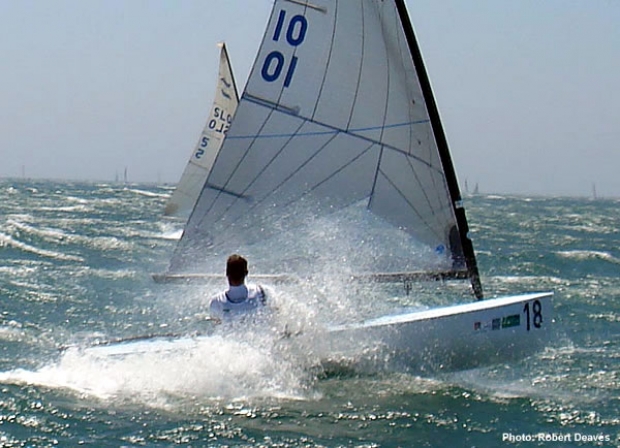
Big winds in Cascais
Wednesday July 11th 2007, Author: Toby Heppell, Location: United Kingdom
All week blustery conditions have been causing some major problems in Cascais at the ISAF World Sailing Championship. The 'outer loop' on the most seaward course five particualrly has seen the biggest breeze with winds gusting up to 40 knots on occasion. This has provided 'lively' conditions for boats that normally have an upper wind limit around the 25 knot mark. Some races on this course have turned from races into 'survival' while for others, such as the 470s, it resulted in some serious carnage...

For Britain's Shirley Robertson the biggest day was on Saturday. She describes the conditions: "Here it is a bit of everything and it is a mad place. You look out to the west and it is blowing about 35 knots and then you speak to those racing inshore and there is hardly any wind.
"Saturday was probably the most frustrating race for us really. As we got further and further up the course it got windier and windier. We are good in the breeze and we were leading at the top mark by a good 100m. When we got to the top mark there were people behind us struggling to tack it was that windy. In a Yngling that is really windy as we are not really over canvassed.
"So we got round the mark and said ‘okay lets keep this simple.’ We got through the set okay which is always the wobbliest bit. We were off and running and we thought 'okay we're fine, we are fine.' All of a sudden, I think a gust came from above, from the cliff, and we wiped out, which would not have been so bad in itself because I think the next ten boats then wiped out in that same gust. But the spinnaker halyard only came down a metre and I do not know what it jammed in, but we were upside down for about eight minutes... that was really frustrating.
"Of course then in the Yngling it is not like you just get it back up. It is now full of water to the gunwhales almost and the kite is wrapped around everything...a real mess. Still we sorted it all out and managed to climb back to tenth. That might be the race that saves our bacon we will see.
"On the last run when we put the kite up others did not and I think we took something like 12 or 14 boats on that run. If we had not done that then we would not have been in a position to challenge.
"It is frustrating for us because normally when we are in wind we are the best. I sort of pride myself in my heavy weather boat handling. It is not like we saw the gust rolling in and prepared for it. It just hit the top of the kite and wiped us out as it did a lot of other people.
"For me it shows the calibre of the team that even when we are right at the back and full of water we were not giving up, the girls were not giving up, it is a real pleasure to sail with them."

For Finn sailor Matt Howard Saturday was also the 'big' day: "We were on the outer loop of course five, during race five or six. There was talk of it being up to 33-35 knots out there but you don’t really know if that is a little bit of boat park exaggeration. It was certainly a bit of a Finn grave yard out there...
"I was in the blue fleet so I was on the inner loop [course]. On the inner loop it was about 15-20 knots, we did our upwind and downwind on that part of the course. Then we did the top reach and as you reached out [to sea] the wind speed just increased and increased and increased. As you got to mark two it got to the point where you were sailing along the top reach with the sail completely flogging.
"We got round mark two and turned to head downwind, it was a good 30 knots, but with massive seas and we were picking our way through the yellow fleet who should have finished in front of us, but we were coming through the detritus of that fleet.
"There was one guy there, Joao Signori (BRA), he had been leading the yellow race and he finished alongside us because he had stacked it in. I think only nine boats in the yellow fleet crossed the finish line without capsizing.
"Someone broke a boom which is pretty well unheard of in the Finn class. Of course he machoed it up and said he was pumping one to one in 30 knots and it suddenly snapped, but I am not so sure about that! So it was very, very marginal and the problem was the coach boats did not want to go round the outside of that course because it was so windy. There were probably only two or three ribs out there for safety cover.
"It was, not exactly scary, but at the time I was thinking ‘I have definitely got a bit on here.' You end up leaving the centreboard down so it is ready to step on when you capsize, but it was pretty tough. As we came through the yellow fleet there were guys that looked absolutely knackered. They were sat there, heads down just trying to survive the run. They had obviously rolled it in a lot and Finns are brutal to get up from a capsize.You are trying to grab hold of effectively a metal blade and getting onto it you can cut yourself on it."
Typically in that weather, Howard says, you either broach to windward or you are so concerned about not broaching to windward with the boom in the air you oversheet the main and you screw up and go head to wind capsizing that way. "That is much more preferable because then you step on the centreboard get the boat back upright and you do not lose too much.
"The difference it has with the sail area being a lot larger and the mast being all the way forwards, is that you are much more likely to pitchpole. That is really more of the danger in the Finn rather than it rolling or broaching - the worry is sticking it into the back of a wave, whereas in a Laser you do not tend to get that quite so much.
"The windward broach is pretty bad and it takes quite a long time to get up. Also because the Finn is a bit of a bathtub you are then full of water which means if you do get yourself going again the likelihood is you will go down the mine and pitchpole. So it is a downward spiral where the more water you get, the more likely you are to capsize and the more you capsize, the more water you get."
To dump water from the cockpit the Finn is fitted with two big bailers and the transom has flaps allowing the water to rush out of the back. "You have to be going quick though and even then it still takes a couple of minutes to get through."
On the Finn they tend not to capsize as much as in a Laser, because the boat has a much bigger rudder offering more control, but when it does capsize it is a whole lot harder to right.

For 470 sailor Joe Glanfield the big race was also out on course five, but on Sunday in their fourth race, in the early evening: "Course five is by far the windiest course. But there is a bit of a wind line so the inner lop is much lighter than the outer loop. Most of our race it was not that windy - about 16-20 knots.
"When we were approaching the windward mark for the last time it had picked up a lot. I guess it had increased by a good ten knots and the wind had gone a long way right. We were in third at the time and very close to the two in front. When we came round the mark, we felt pretty comfortable to hoist in that breeze, so we did a hoist which was fine and as soon as I set the spinnaker the mast just fell down. I think that must have put a lot of people off because then basically no-one hoisted for that leg. There was a boat that came round in 15th, set the kite and got to first."
"It was a bit unlucky really, we didn’t capsize or anything we just popped the kite and that broke the speaders, which in turn broke the mast.
Six 470 are believed to have broken masts in that race. Typically 470 masts break when you capsize or bury the bow into the back of a wave. "It is very unusual to do it like we did. With the benefit of hindsight, knowing that no one else would set a kite I think we would not have done and had a comfortable finish - but that is how it is.
"It was definitely not the windiest I have sailed in. It was very isolated and over a very short peiod of time but it did get very windy at that point in time. Generally I think we were alright. If the mast had not broken I did not feel as though we would capsize at any point. I felt quite comfy. The big thing is the distance between each wave, if that is quite short it is really hard to keep the bow out, but they have been quite good here. It should have been okay, but it wasn’t."
More of Robert Deaves photos of the Finns on the following pages....

Most Read
Most Commented
Comments
Businesses

Pro businesses
Editor's choice
Member blogs
-
 Ned Collier Wakefield: MOD70 round BarbadosWell that was intense. 12 hard fought for seconds for the win. In idyllic conditions, Tony Lawsons MOD ...
 -
 Mini Transat leg 2 reportThe second leg of the Mini Transat started on 31st October, just over a month after ...
 -
Leg 1 reportI’ve been working towards the Mini Transat now for three years. In 2013 I was part ...
Business blogs
-
 The Island Sailing Club in Cowes, Isle of Wight, is delighted that Prince Michael of Kent ...
 -
Peta Stuart-Hunt chats with the 25 year-old British solo sailor Lizzy Foreman before she sets sail ...
-
The 2015 Student Yachting World Cup (SYWoC), an ISAF-recognised event hosted and run by students for ...
Editor's Choice
All time favourites...
-
 Three legs down into Ian Walker’s
 -
 Winning all but two races at
 -
 For the first time in its
Latest Comments
Add a comment - Members log in