
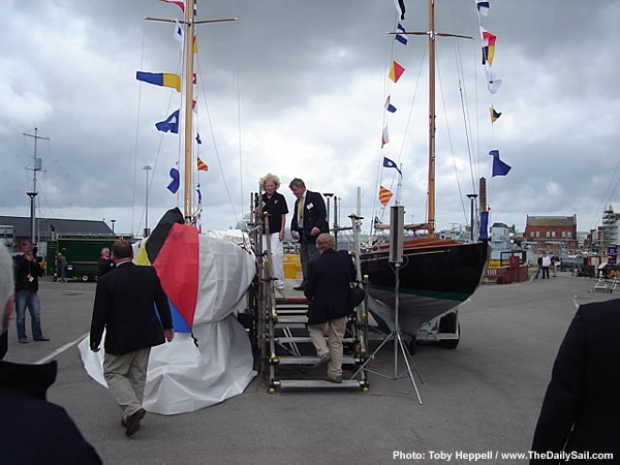
Just before the grand unveiling of the all new fibreglass Victory
Fibreglass classic
Wednesday May 16th 2007, Author: Toby Heppell, Location: United Kingdom
The Victory Class is one of many clinker-built one design classes still sailed locally in various areas of the UK. A number of these exist on the Solent with the XOD being perhaps the most famous. The Victory fleet, sailed from various Portsmouth Yacht Clubs, is less well known and partly as a result of this has always seen lower turnouts. However, in recent years the numbers have dwindled further still.
Following this significant decrease in boats in recent years the class has made a switch to building fibreglass hulls, a prospect they do not take lightly for the obvious reasons. Time is in short supply for many in the modern world meaning maintenance heavy boats are things people tend to avoid. The switch over to fibreglass hulls reduces maintenance and time costs and is something many older designs will potentially need to consider in the coming years if they are to survive.
The Victory class was designed in 1934 by Alfred Westmacott and is a 21’ one-design day-boat. For 73 years the boats have been racing regularly in Portsmouth and have competed for many years at Cowes Week. However, by 1951 90% of all the boats around today had already been built. This has left the majority of the fleet at least 50 years old which is a long time for any boat. Because of this the class felt it was loosing potential new members as the wooden boats available needed a great deal of time and attention lavished on them.
The switch to building fibreglass boats has not been a quick process. In fact it was almost four years from agreeing on the concept and the launch of the first boat in Portsmouth Harbour last week. Clearly the class as a whole must have been fully aware of the dwindling numbers as there was little in-class fighting throughout the decision making process.
With the fleet decided something must be done the question was what? As the association began to review the problem they had a number of ideas and even, for a while, considered joining a new class or designing a new boat. It was quickly decided, however, the Victory class was too important to simply let die and the solution of building boats in fibreglass came about. It is testament to the close nature of this class there was little bickering in the association about ruining the future of the Victory by making plastic boats as one might expect of a classic yacht class.
Early on it was decided the wooden boats should be able to remain competitive against the new fibreglass hulls with the wooden yachts still hopefully being sailed by those enthusiastic enough to deal with the maintenance but a whole new group of sailors bought in by the easy low maintenance fibreglass hulls.

The decision to ensure the wooden boats remain competitive actually made the boat building process a lot more difficult than if they were trying to update the class and increase the speed of the boats. To get the shape of the mould absolutely perfect it was decided that a boat would have to be sacrificed. “Victory, Z23 was sacrificed by the owner as the boat around which the mould would be based. The boat was taken into Dave Heritage’s workshop following their first place at Cowes Week in 2006,” explained Dixon.
As the hull of Z23 was over 50 years old and made from timber there was clearly a lot of work to be done on fairing and filling before a mould would be able to be produced from it. In fact Heritage and his team spent over 600 man hours sanding, filling and sanding again before the boat was in good enough shape to be used.
To keep the new boats from being far quicker than the traditional wooden boats it was important that they weighed the same, but there were other factors of equal importance. “We had to work quite hard on the weight distribution. It was not just about getting the boats to be the same weight but that weight had to be in the same place as the wooden boats. This was really important because we sail on the Solent in the famous Solent Chop. If the new boats were lighter in the ends or heavier then they would we significantly faster or slower through the waves,” Dixon comments.
To some extent this concept of even sailing throughout the fleet is in keeping with rules already in existence in the Victory Class. It is clear the association wishes to keep the class as far away from ‘cheque book sailing’ as possible and rules have been bought in throughout the years to ensure this stays the same. The class has a rule, for example, only allowing owners to buy a new suit of sails every three years. Interestingly identical fibreglass hulls seems to be going a long way to continuing this tradition of fair play.
Although there were no performance enhancing changes made to the boats, that is not to say the new fibreglass hulls are exactly the same as the old wooden ones in every way. Members were asked if there was anything they would like to see different about the inside of the boat. One thing that came up as obvious to change was the introduction of more buoyancy inside the boat, stopping them from semi-sinking as can be the case in heavier clinker built hulls that have filled up with too much water from a broach or a nose dive.
Below, the inside of a new fibre-glass Victory


Above, the inside of a wooden Victory.
It was also decided early on to make sure the new boats did not stand out too much from the old wooden ones. As such the new fibreglass Victorys have wooden trim and a wooden mast and from a distance the prototype boat was all but unrecognisable compared to the older wooden boat it was stood next too.
The Victory class has a number of different unique touches the association feel make the boat too important to simply let disappear slowly over time. One of the more interesting aspects of the class is every Victory is painted all in black but the waterline paint and the boot topping varies between the small yachts. As the class does not have any one club they call home sailors belong to a variety of different clubs. Depending on what club the owner of each Victory belongs to changes the colour of their waterline; red is for Portsmouth Sailing Club, grey is for Eastney Cruising Association, white for the Royal Naval Sailing Association, green for the Royal Naval Club and Royal Albert Yacht Club, light blue for Electricity Sailing Club and yellow is Hardway Sailing Club.
Interestingly it can be said that to a small degree this tradition has played a part in the decline of sailing boat numbers over the years. “Every year when I take my boat in for some repairs the boat-builder says if we would just paint them any other colour than black then they would react less to the heat and would need less repair work doing to them, but it is tradition,” jokes Victory sailor Jeff Dixon.

Perhaps more interestingly than this there is a fleet of Victory boats who do not have the black hulls. Due to the class’ close affiliation with the navy (based in Portsmouth Harbour) a number of boat were taken by the navy to Gibraltar. The Gibraltar based Victory fleet is slightly different with running backstays and the aforementioned lack of black paint. When we jokingly ask about the possibilities of a World Championship we are surprised to learn there is already one, of sorts, that takes place. “Every so often a few of their sailors come over here or some of us go over there and race against one another. We do not take boats with us we just race in the local fleets,” commented Victory sailor Malcolm Stewart.
The Victory Class association early on made the decision to take on the cost of building the mould and producing the first boat themselves so they did not have to rely on anyone else for producing future boats. This is, of course, a fairly costly service but the class association managed to find an interesting way around this. Many years ago the class had invested in a shed in Portsmouth as a place for members of the class to rent while they effected repairs to their boats. In recent years alongside the decline of members wanting to spend time performing maintenance on their boats the use of this warehouse has become sporadic. The class elected to sell the warehouse which had, rather conveniently, increased significantly in price leaving the class with enough cash to pay for the development of their fibreglass moulds and first production boat, roughly £50,000 in total.
With the first fibreglass boat being launched last week the future of this class is still unclear. However, five class members have already put their deposit down for new boats and a number of younger sailors have taken on the restoration of some older, cheaper, wooden boats as long term projects. This all suggests a rosy picture at least for the very near future.
Most Read
Most Commented
Comments
Businesses

Pro businesses
-
United Kingdom
-
Italy
-
-
United Kingdom
Editor's choice
Member blogs
-
 Ned Collier Wakefield: MOD70 round BarbadosWell that was intense. 12 hard fought for seconds for the win. In idyllic conditions, Tony Lawsons MOD ...
 -
 Mini Transat leg 2 reportThe second leg of the Mini Transat started on 31st October, just over a month after ...
 -
Leg 1 reportI’ve been working towards the Mini Transat now for three years. In 2013 I was part ...
Business blogs
-
 The Island Sailing Club in Cowes, Isle of Wight, is delighted that Prince Michael of Kent ...
 -
Peta Stuart-Hunt chats with the 25 year-old British solo sailor Lizzy Foreman before she sets sail ...
-
The 2015 Student Yachting World Cup (SYWoC), an ISAF-recognised event hosted and run by students for ...
Editor's Choice
All time favourites...
-
 Three legs down into Ian Walker’s
 -
 Winning all but two races at
 -
 For the first time in its
Latest Comments
Add a comment - Members log in