
Which boat for 2012?
Wednesday April 25th 2007, Author: Toby Heppell, Location: United Kingdom
Taking to the waters of South France last week six skiffs prepared to start a long fight for Olympic selection in 2008 for the 2012 Games. The Women's High Perfromance Dinghy Observation Trial in Hyeres gave us the first chance to see the Olympic candiates in one place together and enabled sailors to give their comparitive views on all the boats.
A number of things are important to note about the event. Firstly, and most importantly, the reason the Trials were taking place was not to select a class for the Olympics in 2012 or even to narrow down the field. ISAF called the Trials principally to see whether there was suitable equipment for use, were a women’s high performance dinghy to be introduced at the ISAF annual conference in November 2007. Furthermore even if ISAF were to introduce a women’s two person high performance dinghy event to the 2012 games the decision on which boat would be selected would not be made until the annual conference the following year, November 2008.
This all means no matter what the opinion on the boats being sailed at the Trial this year we are still a very long way from knowing what, if any, boat may be selected.
Essentially the Trial in Hyeres last week was successful in that we know those on the ISAF Technical Committee will be reporting back to the ISAF Executive Committee next month stating there is suitable equipment available were the decision made to include a women’s high performance dinghy at the Olympic Games. There are also, as yet unconfirmed, rumours of another trial being held at a later date, hopefully testing the boats in more wind. When we asked ISAF about this they would neither officially confirm nor deny it but it seems a likely option given the persistently light conditions throughout last week.
Before we begin to look at each individual boat and their relative performance in Hyeres last week it is worth taking a moment to remind ourselves of the fundamental criteria set out by ISAF in their initial announcement in March 06:
• High Performance – The dinghy must be able to sail faster off the wind than on the wind;
• Main Target – Female crews (average combined weight 120-140kgs)
• Safe – Easy to recover by the crew after capsizes and without any external help.
• Lowest cost as possible – The lightest hull weight possible, targeting a price of €14,500 (Euros), ex-works, ready to sail. Closed class rules.
• Optional Characteristics – Twin Trapeze. Asymmetric Spinnaker.
In addition, the class must have the unquestioned ability to meet the requirements of International Class status within a reasonable time, along with worldwide availability of materials and opportunity for construction.

All boats present at the Trial last week fell solidly into the high performance category, all were skiffs and able to sail faster off the wind than on the wind. There was some capsize testing which proved all boats were able to be righted by female crews, though some struggled righting the International 14.
The ‘lowest cost possible’ comment is very open to interpretation. Certainly none of the boats at the event were inexpensive but all were said to be able to be sold for around the 14,500 Euro mark. The RS800 is close to the top end of the budget coming in at roughly 14,150 Euros. Although it is not clear how much a one design Olympic International 14 would cost it is fairly safe to assume the two boats present at the Trials cost well in excess of 14500 Euros apiece.
The optional characteristics of twin trapeze and asymmetric spinnaker were present on all boats with the exception of the 29er which has an asymmetric spinnaker but only one trapeze.
This leaves two criteria for the boats to fit: firstly the target weight range and secondly the ‘unquestioned ability to meet the requirements of International Class Status in reasonable time.’ The weight aspect is hard to judge after only a week of sailing in light winds. However, a number of the heavier teams commented that both the 29er and the 29erXX were particularly struggling with their weight. In contrast, although the International 14 was not causing problems out on the water, the lighter crews were fully powered up and quite a long way down on the wire even in the light winds. This may well mean the boat is too powered up for the lighter teams in windier conditions. To really get a grasp on how well the various classes fit the bill in terms of weight range they would need to be tested in a variety of conditions. All we can really say for now is that the 29er is the least powerful and the International 14 the most powerful of the contenders.

The ability to meet the requirements of International Class Status is a hard one to answer. It is safe to assume the production boats; the 29er, 29erXX and RS800 would all be able to produce enough boats to get the class to international status. In fact the 29er already has international status and with only an upgraded rig and some small modifications required to change into XX mode it would seem these two classes are way ahead of the field. The other classes are less assured of meeting the requirement we will have to wait and see.

29er
Many looked at the 29er as an ‘also ran’ in Hyeres, it was rarely seen as a realistic option for Olympic selection. There were a number of different things sailors picked up on but interestingly the thing most commented on was the class’ status as a youth boat. “I think we would all be a little disappointed if the 29er were picked. It is a youth class not an Olympic class,” commented British 470 sailor, Saskia Clarke.
In addition to being seen as a youth boat the lack of a second trapeze on the boat made it seem a little tame compared to the others. However, the 29er is still one of the more inexpensive offerings in addition to having the biggest following internationally.

29erXX
Of the twin wire skiffs, the XX seemed to be the most underpowered throughout the week. It was clear from most people stepping out of the boat they were struggling to both get wired much of the time. “The 29erXX was really sensitive and felt the twitchiest,” explained GBR sailor Rebecca Marriott. “We were at the heavier end of the weight scale and we really felt it could not cope with our weight out on the wire. It felt really very weight sensitive.”
When we spoke to Dave Hall about how it was going in Hyeres he admitted they would have liked a little more breeze throughout the week. It would be easy to write this off as a comment made by someone with an underpowered boat. It is worth mentioning, though, that for much of the week if you looked at the 49ers training they were often struggling to be fully powered up and twin wiring.
A comment raised by a number of sailors not trialling the boats but in Hyeres for the Semaine Olympique Francaise the following week was how nice it would be for the women’s Olympic skiff to match the Men’s Olympic skiff much like the Laser and Laser Radial. This is, perhaps, another string to the 29erXX’s bow and though by no means decisive it is certainly something to consider.

International 14
Going into the Trial this was seen very much as the top end in terms of power and cost with little chance of Olympic selection. In honesty this is still the case in many respects, the boat seems to be simply too powered up, too expensive, with too far to go to be a one-design class to make it to the Olympics.
Having said this when you asked any sailor what their favourite boat is irrespective of the Olympics the answer was almost always the International 14. To some extent this could be put down to the light wind which left the International 14 as the most powered up boat. There was a 90% rig on one of the boats and a full rig on another but even the 90% seemed to be carrying a lot more power than lighter crews may be able to cope with.
It does seem though even if this boat does not make Olympic selection it has once again proved itself to be one of the most aspirational classes available today.

Cherub Daemon
One of the things most regularly commented on to us about the Cherub Daemon were the T-foils in the rudder. Many were of the opinion that the addition of a T-foil was one step too far in what would already be a big change for many female Olympic sailors. “I am not sure these are really needed on the back - they are tricky,” commented Sylvia Vogl, Austrian 470 helm. In addition to feeling they were a step too far, many wondered if they might make the class too different from the 49er, therefore confusing the public.
There were also some concerns expressed to us that both Cherub Daemons felt different to sail, a worry for two boats that should be identical in shape. This is most likely down to both boats being built in different places. The first Daemon was built by Aardvark Technologies out of carbon and is very much the prototype, while the second was built by Hartley Laminates out of S-glass and is how all future Daemons will be built. This difference between the two boats seemed to reinforce a number of peoples’ concerns about the boat being a Cherub, a class associated with amateur builders.
The Daemon did seem to produce a number of smiles though and generally the reaction to the boat was good.

GT60
The GT60 was the only class at the Trial to only have one boat present.As a result not everyone was able to sail it. Simply there was only one boat present because thus far there is only one GT60 in existence.
It was hard for people to judge the boat in any real context as it is still in the prototype stages to some extent. However, the reactions of most did seem to be good. The main concern expressed with both the Cherub Daemon and the GT60 is their waterline length, leaving a cramped cockpit and a slightly disappointing upwind performance against boats such as the RS800.
As with the Cherub Daemon there is also a worry about whether enough boats can be built to make the class viable. Interestingly Dave Chisholm, the man behind the GT60, believes he has a solution to this. “Basically the boat is made up of panels and these can all be built in different locations. The boat only needs to be put together right at the end when all the panels come together. This way is fast and eliminates individual manufacturers competing for who can build the fastest boat,” he says.
The GT60 is another boat with a T-foil on the rudder and the same concerns were expressed about this as they were with the Damon. Sadly on the last day of sailing the T-foil section broke away from the rudder while going downwind with Carolijn Brouwer, Belgian Tornado sailor, at the helm. “It was really fun and going great then all of a sudden bang, the foil was drifting out the back of the boat,” she commented on returning ashore.

RS800
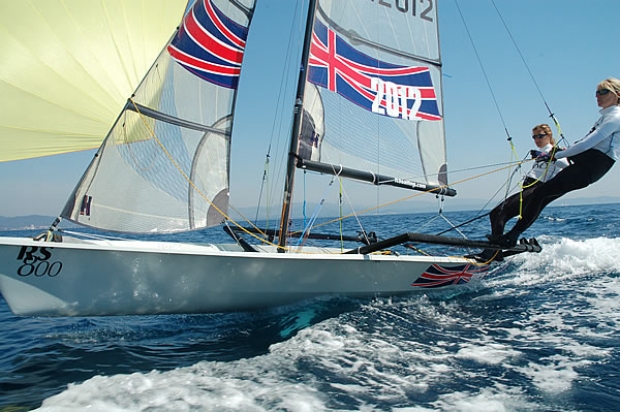
The 800 was perhaps seen by many as the pick of the boats at the event for a variety of reasons. Firstly, although it has not got a big international following like the 29er or 29erXX there is a big builder behind it and global sales would seem to be more than possible. The waterline length of the boat (16ft) means it was fast upwind and downwind without being too much work to handle.
The boat is not without its cons though. “I think a lot of people here are worried the 800 might be too easy to sail. It is definately the easiest here, and people might see it as a bit patronising,” commented Rebecca Marriott. Although this may be the case the boat did seem to ‘win’ on most other factors.
It would be interesting to see how the boat faired against the other classes were the Trial to take place in breezier conditions. We suspect the other boats might begin to look a lot more desirable if the wind was a little higher. “We feel the boat has shown itself this week and if there were to be a trial in more wind we think the RS800 would just continue to show how good it is,” commented Martin Wadhams of LDC Racing Sailboats.
All in all the Trial achieved its goal and identified there were potential Olympic skiffs available, taking us another step towards seeing one at the Olympic Games in 2012. But which boat that may be is almost impossible to answer at this stage. Currently we feel the RS800 is the favourite, but this could change in a breezier location. Manufacturers will also receive feedback from ISAF about their respective designs, so expect to see some changes to the classes this year. Finally if another Trial is held to decide which boat may become a new Olympic class, different boats may also be invited. As mentioned we are now one step closer to a female skiff in the Olympics, but we are still many steps away.
Most Read
Most Commented
Comments
Businesses

Pro businesses
Editor's choice
Member blogs
-
 Ned Collier Wakefield: MOD70 round BarbadosWell that was intense. 12 hard fought for seconds for the win. In idyllic conditions, Tony Lawsons MOD ...
-
 Mini Transat leg 2 reportThe second leg of the Mini Transat started on 31st October, just over a month after ...
-
Leg 1 reportI’ve been working towards the Mini Transat now for three years. In 2013 I was part ...
Business blogs
-
 The Island Sailing Club in Cowes, Isle of Wight, is delighted that Prince Michael of Kent ...
-
Peta Stuart-Hunt chats with the 25 year-old British solo sailor Lizzy Foreman before she sets sail ...
-
The 2015 Student Yachting World Cup (SYWoC), an ISAF-recognised event hosted and run by students for ...
Editor's Choice
All time favourites...
-
 Three legs down into Ian Walker’s
-
 Winning all but two races at
-
 For the first time in its
Latest Comments
Add a comment - Members log in