
Light winds and injuries
Thursday April 5th 2007, Author: Toby Heppell, Location: United Kingdom
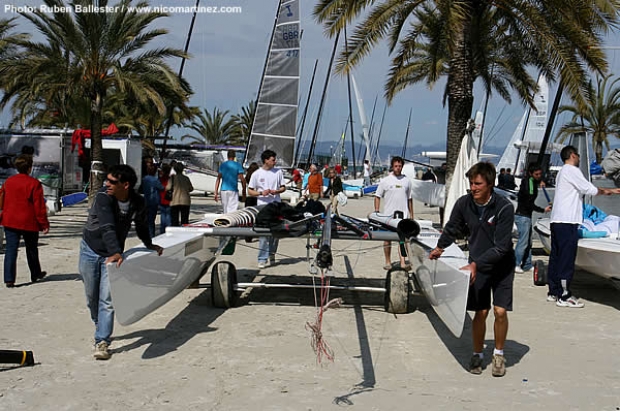
The Princess Sofia Trophy is the first big Olympic classes event of the European circuit. With racing taking place in April it is often a light wind venue with temperatures not quite high enough to bring in really big thermal breeze. This year, in particular the event has offered up some extremely challenging conditions as British Tornado sailor, Will Howden explains.
Racing for the first two days of the championship was extremely difficult with Palma offering up light winds that were also hugely shifty. “The first two days were incredibly random,” confirms Howden. “There were lots of clouds coming across the course and a few rain storms which were pushing and pulling the breeze. The wind was coming from all different directions at different strengths. We had two races abandoned out of the first three we attempted to race, so it was pretty crazy stuff.” This randomness is reflected in the results tables with the teams managing to avoid major disasters being the ones at the top.
These first two days of racing were followed on Tuesday by a much windier day with breeze up to 18 knots. Unfortunately for Howden and his helm Leigh McMillan a collision with the Spanish team of Echavari and Paz saw the Brits forced to retire after Howden was hit during the crash. After a long night in the protest room the Spaniards were deemed to be at fault though this will be little consolation to McMillan and, particularly Howden who has to continue sailing the week with a severely bruised tendon on his ankle. To make the whole situation a little worse, last year Howden suffered a ligament injury to his knee at the same event. “These things happen now and then, last year was an accident and then this year getting hit by the Spanish wasn’t great but these things happen in racing,” he explains.

Even with his injury the pair managed to make it back out on the water yesterday, Wednesday, for yet more extremely light and fluky racing. “It was a bit of a mixed bag today,” Howden says. “We capitalised on some good stuff in the first race but lost it all and finished up thirteenth. Then we had a really good second race and finished up third so on average I would say it was pretty good. It has moved us up to fifth place overall and now we are 15 points away from second with two normal races and a medal race to go.” Sailing with his severely bruised ligament has been difficult but as Howden says he strapped it up a lot, took some ibuprofen and for once was very happy the wind was quite so light.
In addition to the Princess Sofia Trophy this regatta is also the Tornado European Championship, though Howden does not believe this has had a major effect on the turnout at the event. “If you look around at all of the fleets the entries are just huge,” he confirms. “I just think it is a convenient training ground for people. It is cheap to get here and it is cheap once you are here. It is reasonably warm for the March to April months. A lot of people can come here and get in some good training quite cheaply which is very important. I think that is why the regatta has grown and grown because there is a big gap between Miami and this so it is really the first big event of the season.”
Many of the Brits and other teams have been out in Palma for a matter of weeks or months already training hard in the built up to this event. Howden and McMillan are one such team. “Typically we came here and spent two weeks training and had strong breeze, albeit quite shifty a lot of the time but good pressure the whole time. Then we started racing and had two days of light fluky winds and then more of the same today. It is quite typical Palma really and pretty close to what we were expecting. It is going to be good training for China,” he explains.

This training in the venue has given Howden and McMillan a chance to get up to speed on the intricacies of sailing out in the bay of Palma. “There are always little oddities for every venue. The more you sail in places the more that you learn about them, which is why you try to spend as much time as possible training in important venues. Something you get used to in Palma is looking for the thermal breeze which is really ever present, even when it is not all that hot. You always seem to get some kind of thermal breeze which pulls the wind right. To some extent the trick of sailing here is all about learning to be able to spot that breeze.
The size of the fleet combined with the tricky conditions means it is very easy to go from a front of the fleet to the back in a short time. “Today Roland Gaebler, who was fairly comfortably in second place overall, got a 37th and a 28th or something like that. I think it just goes to show how tight the racing is, how close things are and, ultimately, how a small error can turn into something pretty huge. Similarly [Darren Bundock], the leader, got two mid fleet finishes today. I think that shows a lot how competitive the fleet is and how tough it is out there in the racing,” comments Howden.
After the Princess Sofia Trophy finished on Friday Howden, McMillan and almost every other Olympic hopeful in the world will pack up their boats and take them straight to Hyeres for what is effectively the second round of the European circuit, the Semaine Olympique Francaise.
Most Read
Most Commented
Comments
Businesses
Pro businesses
-
Italy
-
Netherlands
-
-
United Kingdom
Editor's choice
Member blogs
-
 Ned Collier Wakefield: MOD70 round BarbadosWell that was intense. 12 hard fought for seconds for the win. In idyllic conditions, Tony Lawsons MOD ...
-
 Mini Transat leg 2 reportThe second leg of the Mini Transat started on 31st October, just over a month after ...
-
Leg 1 reportI’ve been working towards the Mini Transat now for three years. In 2013 I was part ...
Business blogs
-
 The Island Sailing Club in Cowes, Isle of Wight, is delighted that Prince Michael of Kent ...
-
Peta Stuart-Hunt chats with the 25 year-old British solo sailor Lizzy Foreman before she sets sail ...
-
The 2015 Student Yachting World Cup (SYWoC), an ISAF-recognised event hosted and run by students for ...
Editor's Choice
All time favourites...
-
 Three legs down into Ian Walker’s
-
 Winning all but two races at
-
 For the first time in its
Latest Comments
Add a comment - Members log in