
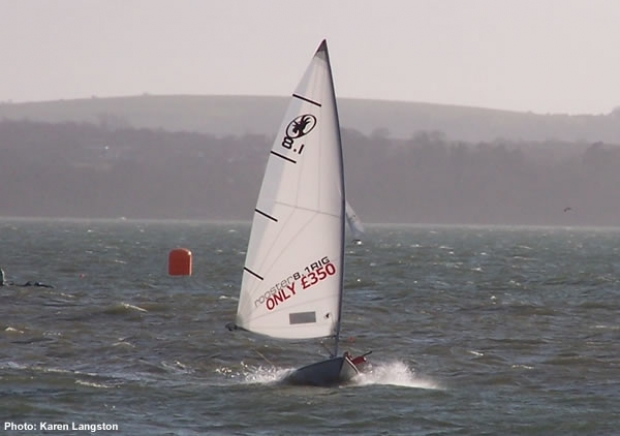
New rig for the Laser
Friday March 16th 2007, Author: Toby Heppell, Location: United Kingdom
Widely considered as one of the most popular small boats in the world, the Laser has been providing close racing to thousands of sailors for many years now. The boat is an Olympic class for men and more recently the smaller rigged Laser Radial has been introduced to the Games for women. In addition to Standard and Radial rigs there is also a Laser 4.7. Many would think three rigs for one hull is quite enough but Steve Cockerill of Rooster sailing has recently announced his intention to manufacture a new, bigger 8.1sqm sail.
What Cockerill has done is simply to create a bigger sail for the Laser hull, meaning anyone with a Laser can buy a new bottom section and sail for £350 and have a Rooster 8.1. Originally he conceived of the idea after a friend complained that following a full summer of keelboat sailing he liked to sail his Laser over the winter. However, age and the weight that comes with it were preventing him being competitive in the boat. He could not justify a new boat for his limited winter sailing so was stuck in a class he did not suit. “The problem is he gets more and more tired of sailing it because he is basically 105kg. So he goes out in 35 knots and has a great time but anything under 20 knots he is a bit bored, and in under 15 he is very bored and under ten he is incredibly bored,” explains Cockerill.

With his friend in mind, and presumably others who may be suffering from many of the same issues, Cockerill set about adapting the Laser rig to suit a heavier breed of sailor. Essentially the rig is simply a larger version of the Standard Laser rig, measuring 8.1 square metres as opposed to the 7.06 square meter Standard. On closer inspection, though, it is not simply the size of the rig that has changed. The sail design itself is different from that of the Laser, and has been designed from scratch by Rooster. Principally the cut of the sail has changed as well as a number of pet peeves Cockerill had with the normal Laser sails. For example the top of the luff tube had been reinforced where they are prone to ripping due to high Cunningham loads.
Actually manufacturing sails for various Laser classes is not something new for Rooster. The company have been making training – not class legal as they come from a different company but otherwise identical – sails for the Laser, Laser Radial and Laser 4.7 for many years now. The sails are manufactured in China, and Roosters sail makers liase with the Chinese manufacturers and perform control checks.
Along with the totally redesigned sail, Rooster has brought out an entirely new, slightly bigger mast. To be specific only the lower part of the mast is bigger, the top section remains the same as with all standard Lasers. Rooster will sell the longer lower mast but it will not be so tightly controlled as many Laser parts. “I am going to say to people ‘if you live in Iceland, for example, and you can source some ten gauge Aluminium tube, chop it off at 3.6m long and put a gooseneck in the right places and as far as I am concerned that is a Rooster 8.1 lower mast,” Cockerill explains. “It will have to be within a specified tolerance so people do not go and do something silly.” This attitude leaves Cockerill with the advantage of being able to get global distributors easily. If someone wanted to be a distributor in New Zealand all they would have to do is source the correct alloy tube and get Rooster 8.1 sails shipped to them direct from the factory. “The key thing is that we make sure they sell it at a reasonable price because we want people to go sailing not to be thinking about their pockets,” he concludes.
As well as allowing people to source their own mast materials there are a number of other novel aspects of the Rooster 8.1 class. The Class Association will be free to join and will be run largely through e-mail. “As long as you have an e-mail address you will be a member for life as long as you have the rig, or maybe even if they sell the rig,” Cockerill confirms.
When we first heard about the Rooster 8.1 we had a number of questions that popped straight to mind. The first of these questions was; how does Laser feel about the project? “There are two answers to that question,” explains Cockerill. “The Laser Class Association is a different body to the builders. The builders I have had a number of different feedbacks from in the last few weeks. The official feedback I have to date is they have not seen it or tested it so there is no comment. As a Laser sailor I am sure in clubs where the Laser is a strong established fleet the sailors will find it a distraction from their fleet racing and will probably be a little negative towards it. I think if you find some fleets where they race as handicap sailors amongst many different types of boat they will probably find it a good thing.”
Cockerill adds he will be speaking to the Laser Class Association soon to discuss the Rooster 8.1 with them. He thinks there will probably be a bit of hesitation from them but he does not honestly think there will be any particular problems. In fact there may be more Lasers sold as a result of many secondhand boats suddenly being sold as people buy them to convert them into Rooster 8.1s.
This lack of a tie up with Laser has some pretty serious drawbacks, we feel. Firstly as anyone who has ever attempted to purchase a Laser will know it is not possible to buy one without a rig. This effectively means anyone wishing to buy a Rooster 8.1 has to buy an entire rig they do not want or a secondhand boat. “I think everyone should have at least two rigs anyway,” counters Cockerill. “I would love a 4.7 for the really, really windy days. I sail a Radial all the time in major competitions and the Standard in Masters competitions. I think every big bloke will probably have a Laser Standard as well for when it is really blowing. I can’t see why you would not want to do that.”

Not being able to buy a boat and rig combination does flag up another potential issue - that of boat and sail numbering. As ever, though, Cockerill has a solution for this as well. “It is a really simple system. If you are the first person to buy a rig then your association number is number one. You sail with number one on your sail for the rest of your life. If you are the seventh person to buy an 8.1 sail then you sail with number seven for the rest of your life. No matter what hull you have or whatever you do in life you are always that number in the Rooster 8.1 class.” He goes on to explain the plan is to have a British number one for the first rig sold here, a German number one for the first rig sold there, an American number one for the first rig sold there etc. Being a numbered member of the Rooster Class Association for life does mean that every time a sail is sold on the numbers will have to be changed but that happens if sails are sold on ordinary boats anyway.
Another of the major concerns we had regarding a new, bigger, more powerful rig being put on the Laser was the increased load it may generate on the mast foot. Here Cockerill is a little less certain than he is about some of the other potential problems discussed, though he is still confident in the product. “If a 95kg guy goes sailing in 40 knots and the wind hits the sail suddenly the boat will fall over. It does not matter if the sail is 4.7m 5.7m a standard Laser rig or an 8.1, it falls over. The amount of leverage the sailor can produce for that boat is the weight of the sailor. On that basis I do not think the rig loads are going to increase because it depends how big the sailor is,” he says. Cockerill points out a little known clause in the Laser class rules allowing the boat to be sailed by two people. Two people in a standard Laser going out sailing in 30 knots would probably put as much if not more load on the mast foot as one 95kg person in 30 knots with an 8.1 rig up.

Although this may be true there are two issues that still need to be answered here. First, and most importantly, it may well be true the load on the mast step is insignificant due to the leverage of the sailor but this is only true on points of sail where the sailor is acting as the counterweight to the power. For example this will not be the case when the boat is going dead downwind. “I actually felt the loads were smaller on the 8.1 going downwind,” counters Cockerill. When I was out in 20 knots recently my boat was planning and so was not being stuck by every wave. I feel this reduces the loads and doesn’t increase them. The power is there but the loads are reduced. Admittedly the power required to get you on to the plane is more but once you are there they decrease.”
The other clear issue is because this is not a Laser product they presumably will not take responsibility for any breakages of the mast foot. “There is an element that if someone has a brand new boat and they used one of our rigs on it then they are probably going to invalidate their warranty. Laser have asked whether I am going to replace mast steps if they break and I say ‘no’ but then they do not either if the boat is over three years old,” Cockerill concludes.
It seems most likely the sort of sailor who is going to buy the Rooster 8.1 is a person who already owns a Laser and is looking at a cheap upgrade. At £350 this new rig certainly seems to fit the bill, though we continue to hold some reservations about how the boat will hold up both physically and politically. Still 17 have already been sold and time will tell.
Most Read
Most Commented
Comments
Businesses

Pro businesses
-
France
-
-
United Kingdom
-
United Kingdom
Editor's choice
Member blogs
-
 Ned Collier Wakefield: MOD70 round BarbadosWell that was intense. 12 hard fought for seconds for the win. In idyllic conditions, Tony Lawsons MOD ...
 -
 Mini Transat leg 2 reportThe second leg of the Mini Transat started on 31st October, just over a month after ...
 -
Leg 1 reportI’ve been working towards the Mini Transat now for three years. In 2013 I was part ...
Business blogs
-
 The Island Sailing Club in Cowes, Isle of Wight, is delighted that Prince Michael of Kent ...
 -
Peta Stuart-Hunt chats with the 25 year-old British solo sailor Lizzy Foreman before she sets sail ...
-
The 2015 Student Yachting World Cup (SYWoC), an ISAF-recognised event hosted and run by students for ...
Editor's Choice
All time favourites...
-
 Three legs down into Ian Walker’s
 -
 Winning all but two races at
 -
 For the first time in its
Latest Comments
Add a comment - Members log in