
Another look around
Wednesday March 7th 2007, Author: Toby Heppell/JamesBoyd/Holt, Location: United Kingdom
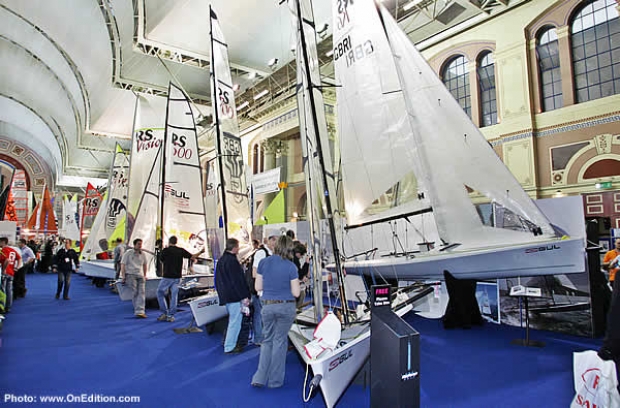
Following our look at some of the top end high performance boats at this weekend's Dinghy Sailing Show in London, today we take a look at some of the other features of the show.
Canoes:
The International Canoe Class seemed to be one of the few at the Dinghy Sailing Show not celebrating a birthday, but since they are more than 100 years old - who’s counting? This year for example the Europeans/Nationals for the unique sliding seat class are being held in Scotland at Loch Lomond Sailing Club. This began life as Clyde Canoe Club 134 years ago and is still one of the few clubs to own an International Canoe.
The canoe class at present is in a state of flux. AC boats (fitted with a kite) have now consolidated, however their performance is obviously outstripping that of the standard, non-spinnaker IC, and to bring more parity to the performance of the two boats a new generation of DCs is in development (the D…) As the class’ Andy Biden puts it: “It’s the age old one. You have to look after members interest and that is about looking after their investment. You can’t kill off a section of the class instantly, you have got to give them some longevity. And in Europe the AC in most countries is the boat to have, but you can take the kite off and sail it as an IC.”

The DCs vary from the standard IC in having a beam that can be as narrow at 750mm (generally Canoes are just over 1m wide) and an all-up weight excluding sails of 50kg (as opposed to 83kg). A technical challenge with the beam is that it also narrows the shroud base and outrigger or any device that locally widens the shroud base (like Open 60 style deck spreaders!) is obviously banned.
The first real test of how the DCs perform relative to the ICs and ACs will be seen for the first time in anger at the Europeans. “At the moment they are not beating the standard boat basically because the standard boat is good all round and it is well developed. So time will tell,” says Biden.
It is estimated that changing from the old style IC hull to the new DC one will generate a 4% performance improvement. As ever the IC is fast upwind but doesn’t have enough sail area compared to modern boats, or the AC, downwind so reducing hydrodynamic drag through having a slimmer hull combined with a dramatic weight saving may allow DC sailors to sail better angles downwind.
Many of the new boats are being fitted with uni-rigs, since American Steve Clark tried it at the Worlds two years ago (below). Clark’s attempts at the Worlds did not produce the best results, despite him having an illegally tall mast, but it was generally considered that he hadn’t spent enough time developing the boat. Clark is now believed to be working on a second generation boat called the Chapter which will have two sails.

Despite going through a transitional period the Canoe class is in the ascent. At last year’s Nationals at Oldswater they had 35 boats and this year in Loch Lomond they expect 40. In addition to the five DCs there is one new AC and another new IC in build – so seven new boats are expected at this year’s Europeans.
Biden says that many people are returning to the Canoe class and the roster includes former class Chairman Perhem Harding. “Most of them are people who have been in the class and like just trying new ideas. When you look at the people who sail these, there are lot of physics teachers - it appeals to people who like working with their hands. There’s something to play with and they all want a go at making it better.” Among the existing class sailors several who have recently been racing ACs have reverted to IC this season to prepare for the forthcoming World Championship to be held on 2 January in Australia.
Around 10 DCs are expected at the Worlds, when some decisions are likely to be made about whether or not the DC takes over from the IC as the de facto International Canoe. “We’ll put them on the race track with the standard ICs. And by nature of the fact that the IC fits the rules for the DC that means they instantly qualify for world championship status. So someone might get two gold medals around their neck…” says Biden .
Endeavour:
After a very successful Endeavour Trophy Regatta in October 2006, Holt announced at the Dinghy Sailing Show they will continue to support this exclusive regatta as title sponsor for a third year in October 2007. Topper will also continue to provide the Topaz Xenon once again. New sponsors for 2007 include leading clothing manufacturer Henri Lloyd and rope manufacturer English Braids. Sail TV will be covering the action over the weekend with TheDailySail providing detailed reports.
2007 will see the Endeavour Trophy enter its 46th regatta. The event is hosted by the Royal Corinthian Yacht Club and it’s origins stem back to a J Class regatta in 1934. This regatta required amateur sailors to pitch in and race Endeavour against Rainbow to which one of the crew was Beecher Moore (one of the partners and founders of Holt). One of the RCYC members thought up the regatta idea of inviting the top racers – the national champions to race each other and see who really was the best. Beecher provided the trophy – a recently acquired model of the Endeavour, and so the Regatta was justly named.
Because the regatta is invitation only to UK national dinghy racing champions of their class, it brings top quality racing and is coupled with a fleet of one design racing dinghies straight out of the packet so that all competitors are equally matched in dinghy and must outwit each other with tactics. For the first time ever the 2007 the event will be allowing five wild card entries. Open to the very best International sailors confirmation of who these will be are to be announced nearer the event.
Catamarans:
The Tornado stand featured the Graham Eeles Tornado designed and built last year (see our article here.) Although the boat on the stand was not new, there is a new Eeles Tornado currently in the process of being built. Top British Tornado sailors, Leigh Macmillan and Will Howden have been working closely with Eeles on the new boat which has now had a few minor changes following a year of testing on the Olympic circuit. The new boat is planned to be launched later this year in time to do some training and testing in Palma before the start of the combined Princess Sofia Trophy and Tornado European Championships.
Although there was no new boat on the Tornado stand Howden explained there are some potential changes in the class this year. Specifically members of the class association are soon to vote on a proposed minimum weight limit of 135kg. The limit, to be brought in before the 2008 Olympic Games, is designed to ensure fair racing at the famously low wind venue, Qingdao. “In light winds in the Tornado someone sailing single handed is able to sail the boat just as well as two people sailing one, they will just go about a knot and a half quicker upwind and loads quicker downwind,” explains Howden. It is illegal to sail singlehanded in the Tornado but the worry for the class is countries with a loose selection process could select their best helm with a ten year old crew that weighs just five stone and give themselves a huge boat speed advantage and make a mockery of Tornado sailing in the process.

Over on the F18 stand there was a new catamaran being displayed, the Nacra Infusion. The Infusion is being sailed this season by Hugh Styles at various F18 regattas and a number of long distance cat races such as the Round Texel race. We spoke to Styles some weeks ago about his new ride (here) and he has since gone on to take fourth place at the F18 World Championship in Australia. Although we had already seen pictures of the boat the Dinghy Show represented the first opportunity we had to see this machine in the flesh. The boat itself looks extremely pretty, we think, and with Styles at the helm this season looks likely to achieve many more solid results. Could this become the next big thing in F18 sailing?
And finally:
Last year we looked at the Mirror who were just in the process of switching from their classic gaff rig to a much more modern Bermudan rig (see last years piece here.) this year has seen yet another change in the class. Although when we spoke to the class last year they were considering a change to a centre mainsheet system the change has now been officially adopted by the class. It seems after many year of relatively slow but steady progress this class has suddenly gone through some drastic changes, bringing the boat right up to date but keeping many of the characteristics that make it such a popular class, particularly with junior sailors and girls in the UK.
Most Read
Most Commented
Comments
Businesses

Pro businesses
-
Netherlands
-
United Kingdom
-
France
-
France
Editor's choice
Member blogs
-
 Ned Collier Wakefield: MOD70 round BarbadosWell that was intense. 12 hard fought for seconds for the win. In idyllic conditions, Tony Lawsons MOD ...
 -
 Mini Transat leg 2 reportThe second leg of the Mini Transat started on 31st October, just over a month after ...
 -
Leg 1 reportI’ve been working towards the Mini Transat now for three years. In 2013 I was part ...
Business blogs
-
 The Island Sailing Club in Cowes, Isle of Wight, is delighted that Prince Michael of Kent ...
 -
Peta Stuart-Hunt chats with the 25 year-old British solo sailor Lizzy Foreman before she sets sail ...
-
The 2015 Student Yachting World Cup (SYWoC), an ISAF-recognised event hosted and run by students for ...
Editor's Choice
All time favourites...
-
 Three legs down into Ian Walker’s
 -
 Winning all but two races at
 -
 For the first time in its
Latest Comments
Add a comment - Members log in