
Moths turn pro?
Wednesday January 31st 2007, Author: Toby Heppell, Location: United Kingdom
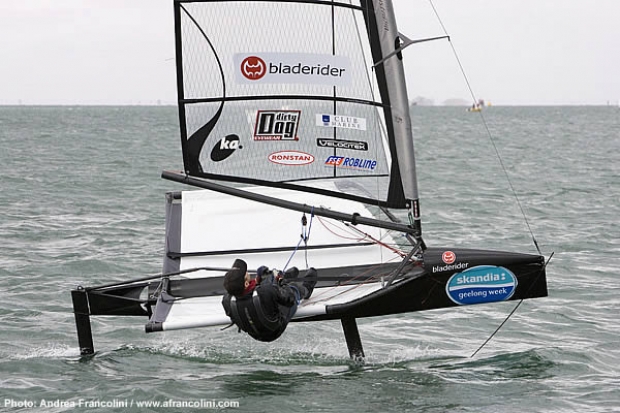
Last year Andrew McDougall, of ka sails, announced his intention to begin mass producing what he called a Bladerider Moth. The boat was to be built as both a part of the International Moth Class and with the possibility of becoming a one design class in its own right. Since this announcement there has been talk of the boat becoming a possible new Olympic class, ex -Moth World Champion, Rohan Veal, has begun to work full time for the company – now called Bladerider International - and the first few boats are now ready to roll out world wide.
December just gone saw the first major test of the Bladerider Moth as Rohan Veal hit the water in his newly delivered boat for the Australian Championships. Veal took victory in the Championship and for the most part in his normal style blitzed the competition, winning seven out of ten races. This certainly seems to indicate a good start for the boat though it is worth considering Veal has been blitzing the rest of the Australian fleet on foils for a long time now. Veal says the most important thing about the win was the potential the Bladerider shows. “I sailed the national titles in [my new Bladerider] as it was shipped and basically made a few small adjustments to it. We were really just experimenting during the regatta and much of the sailing I did was wrong, completely wrong, but I was still winning races by fairly large distances. I feel this is a sign of some of the potential there. If we can get it right the thing will just go ballistic,” he says.

Since the boats have been delivered Veal and McDougall have been working on a few little tweaky things they felt needed improving. They are both keen to point out these are in no way major changes just little things that are personal preference. “It is all about getting the thing into production at the moment,” explains McDougall. “There are certainly things we have been playing with but they are peripheral things like wands and mechanisms. We have not changed anything on the wings, rigs, sail or foils. We made a few minor adjustments when we went from fibreglass moulds to steel ones but that was nearly four months ago. Really it has just been mechanisms and making sure we are able to build it properly. Having said that getting the mechanisms right makes a huge difference.”
Currently Veal and McDougall are experimenting with the way the flaps on the centreplate foil, and the rudder, move in order to get the maximum efficiency out of the boat with the minimal work when up and ‘flying’. Much of the testing they have been doing in these areas is for relatively mundane things but things that need to be tested, adapted and adjusted all the same. “Like the tiller mechanism, where we have been trying to work out how to make things smoother,” says McDougal by way of an example. “We have also been trying to work out what is the ratio of angle change in the rudder relative to the amount of turns that you make with the tiller extension. Trying to optimise it for both up and downwind and trying to get it so that it is reasonably easy to turn, so you can turn it when the extension is at right angles to the tiller is a tricky one.”
The worm screws used to control the angle of attack of the foil flaps or - uniquely on the Bladerider - the angle of the entire rudder is one development area. “The screw mechanism, which is used to adjust the rudder, is quite interesting. We have been looking at using faster and slower screws,” Veal explains. The various screws obviously have different effects on what the boat is like to sail. A particularly slow screw makes the tiller easy to turn and gives you very finite adjustment but also means you will have to rotate the tiller more. The flipside with a fast screw you can adjust the angle rapidly but you have to fight it constantly as the gearing is not as high and the adjustment potentially too abrupt. “I used a very fast screw in the national titles and that was too fast and so too hard to turn. Recently we have been using really slow screws on the boats but they are too slow so there is a compromise to be made there,” continues Veal.
They have also been researching the materials to use for the universal tiller extension joint and have come upon a suitable product that is really strong and flexible enough for the job. This allows the Bladerider sailor easy control of the foils from any position on the boat.

Although the class outside of Moth events will be a one design, there will be some room for experimentation along the lines of what is currently being carried out by Veal and McDougall. As well as allowing people some freedom in playing with the worm screw and gearing mechanisms people may also be allowed to play around with the wand. This is yet another area of experimentation the team have been working on over the last few months. “Basically you have this piece of fibreglass that trails in the water off the front of the boat. You can change the stiffness of that and you can change the angle or the taper. This taper has a direct affect on the angle the wand hits the water so that it either flicks out one way or another. That actually changes the whole dynamic of the thing. You can also change the amount the actual main flap moves,” says McDougall.
Beyond simply working on the boat there is something else a lot of work is going into: actual sailing. “I now have a full time coach for myself and Andrew [McDougall] - Lex Bertrand - and he has coached plenty of champs before. So he is the man and he is going to help push us to victory,” explains Veal. This is an interesting development as this will make Veal and MacDougall, to our knowledge, the only professional Moth sailors at present (Simon Payne took a year out to master Moth sailing). This seems to signal the change from the Moth being a popular boat sailed by keen amateur boat builders and younger sailors into a full blown pro sailor’s boat. This coupled with a number of Olympic sailors who are purchasing boats may well see the class changing even more than it already has, although Veal thinks there is definitely still a place for the keen amateur. “At the moment there are some people who have already bought one; these are really the early adopters. I would say half of them have already been racing Moths or high performance dinghies. The other half tend to be successful business men that want another toy.”
Veal taking on a full time coach is less of a surprise given the Bladerider is yet to prove itself on the international stage. Granted he took victory at the Australian National Titles but the real proof of how quick the boat is will come at the World Championship this summer in Lake Garda. A great many people will be looking at the performance of Veal and some of the earlier Bladerider adopters before making the decision about whether to buy a boat or not. It would, of course, be a fantastic marketing boost for the boat to take the first World Championship it competes in. “I think the move of getting a pro coach behind Rohan is going to make a huge difference. Trying to balance the business side with the sailing can be very difficult and this should help focus him. I think it will also open everyone’s eyes as to how you really become a champion. Not just someone that is good enough to win but someone who is a proper champ,” enthuses MacDougall.

The question is whether all this training will be enough to be able to secure victory at the Worlds in what is effectively a brand new untested boat. “Our theory is that we let [the English] win a sailing regatta and the cricket once every ten years or so just to keep you interested but then we get it back and keep it for another ten years,” Veal jokes, adding on a more serious note. “I learned a lot last year in Denmark, not necessarily what to do but more what not to do. I made a lot of silly mistakes and in preparation I got sick. Simon [Payne] sailed a flawless regatta so all my mistakes really let me down. I said to Lex [Bertrand] this time around I do not want to do anything that will ruin my chances so that is what we are working on.”
Although the performance of the Bladerider at the World Championship is a big issue, Veal does not believe this will be as great as one might think. ”There is pressure to win but we seem to be getting on top of it so far,” he comments. “The worlds result will only have an effect on people buying boats in the Moth class if they want to race in the Moth fleet. If they want to go foiling and have fun in a [one design] class then we should be able to get a boat to them in a week. I think that is a different matter entirely.”
A lot of work is going into producing a proper functioning one design class. So far Veal and MacDougall say they have no solid plans but they will definitely be looking at having some sort of Bladerider Grand Prix series. They are in dialogue with the people who run the X-Games in the US – a sort of Olympics for extreme sports and rad young dudes. “We have been talking with a number of countries about where this is likely to go. I am not necessarily talking about Olympics, although Goran [Petersson, ISAF President] sounds very supportive. When I speak to him he is always very upbeat about it. There is the issue of the ISAF Council but we will worry about all that if it gets to that stage,” Veal says.
There is clearly a long way to go for the Bladerider if it is going to become a widely sailed one design class of its own. If it does make it then it will be all the better for the sport we think - certainly foiling boats at the x-games might do a bit to encourage non-sailing youths to get involved in our sport. However, for the time being with only a few out on the water it is simply an International Moth and in our view to sell a lot of them it will need to prove itself in Italy this May/June.
Most Read
Most Commented
Comments
Businesses

Pro businesses
Editor's choice
Member blogs
-
 Ned Collier Wakefield: MOD70 round BarbadosWell that was intense. 12 hard fought for seconds for the win. In idyllic conditions, Tony Lawsons MOD ...
 -
 Mini Transat leg 2 reportThe second leg of the Mini Transat started on 31st October, just over a month after ...
 -
Leg 1 reportI’ve been working towards the Mini Transat now for three years. In 2013 I was part ...
Business blogs
-
 The Island Sailing Club in Cowes, Isle of Wight, is delighted that Prince Michael of Kent ...
 -
Peta Stuart-Hunt chats with the 25 year-old British solo sailor Lizzy Foreman before she sets sail ...
-
The 2015 Student Yachting World Cup (SYWoC), an ISAF-recognised event hosted and run by students for ...
Editor's Choice
All time favourites...
-
 Three legs down into Ian Walker’s
 -
 Winning all but two races at
 -
 For the first time in its
Latest Comments
Add a comment - Members log in