
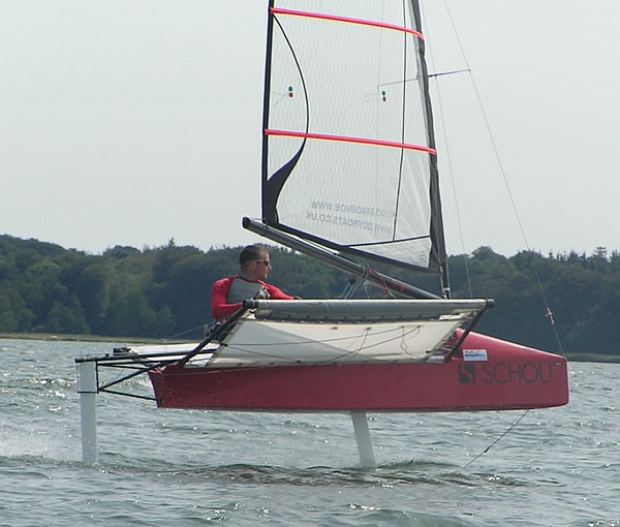
Youngest of the pack
Friday September 15th 2006, Author: Toby Heppell, Location: United Kingdom
Adam May and Simon Payne are arguably the biggest Moth names on the UK scene at the moment but they are by no means leagues ahead of the rest of the competition. Hot on their heels are a number of up-coming younger sailors who are pushing for top spots at both National and International events. Top of this list of relative youngsters is Sam Pascoe the UK’s new Moth National Champion.
Pascoe had a fairly normal start to sailing, ascending through the RYA youth squads during his childhood. He first started sailing Optimists from a young age and stayed in the class until 2001 when he moved into the 420. Here, he spent the first year helming a boat before switching to crewing for another two years. Following these three years of 420 sailing he left youth sailing altogether and bought an RS600 for a season, before graduating up to a 49er after a year.
He never really took the 49er that seriously, as Pascoe puts it: “We weren’t really aiming at the Olympics or anything. It was more for fun really.” It was at this time he started getting into Moth sailing and bought one so he was not always crewing but could helm too. This was in the early part of 2004 when the ‘foiling revolution’ had not yet taken hold, though it was literally just a few months away.
When the Moth class in the UK did start to embrace foiling Pascoe was in a perfect position to try out this radical new pastime and was one of the first sailors in the UK to purchase a set of foils from Moth builder Linton Jenkins. It was not long before a new boat designed to foil was needed so in Christmas 2004 he bought Graham Vials’ boat, a Mistress, which had been launched in July.
As one might imagine it was, and still is, not easy just to jump into Moth and to go foiling. This was particularly the case in those early days when there were very few people out on the water to train with or race against. “The biggest challenge was, and still is, trying to turn the corners,” Pascoe explains.”The gybes were an absolute nightmare until we had done them loads and loads. The other problem is largely the set up of the boat. I took it back to Southampton too quickly when really I should have stayed at Weymouth [where both May and Payne were sailing]. So I had it set up all wrong for quite a long time,”
Evidently set up can be somewhat of a tricky game for a Moth particularly when there is nobody around to show you what to do or offer advice. “When I was having all those problems with it I ended up taking the boat down to Weymouth and Si Payne had a go in it and sorted that boat out for me. It turned out the rudder was tucked too far underneath the boat so whenever it got up on the foils it would just stick its nose straight back down again,” he says.
Heading back to Weymouth for tips or advice started to become a normal event and over the course of the subsequent months Portland Harbour has become a kind of ‘Moth central’. Pascoe says the biggest problem in those early days was the whole experience being so new it was hard to know what the boat should feel like and so it was very difficult to set it up properly yourself. “It is a little bit weird because once you have sailed one that is sorted and set up, you know how it feels so it is really easy to set them up after that. You really just need someone who knows the feeling of it and then, hopefully, they will set it up for you almost perfectly,” he comments.
Happily, finding people to sail against is no longer a problem for Pascoe as he now lives, works and sails in Weymouth. Conveniently he is now employed in Weymouth, by Linton Jenkins’ company Full Force Boats, who are the UK leaders in foiling Moths. “I now help [Jenkins] build [Moths] so I am involved quite a bit in the new design of them and all the tweaking that goes on with them. It certainly makes life fun,” Pascoe says excitedly.
Pascoe’s work at Full Force Boats is not just restricted to building Moths; he is involved with most of the different projects being worked on there. Interestingly he brings up a project, we reported on at the start of this year ( article here), which had been rumoured to have come to a halt. “I am also involved in the foiling RS600 which should be going into production soon,” he says. As many who read our previous article will know, Jenkins, when we last spoke to him, was working on building a foil package that could be retro-fitted to an RS600, making a fast foiling trapeze boat for heavier sailors.

Part of the reason there were rumours about the project had come to a halt was the sight of a slightly dishevelled looking RS600 outside Full Force Boats, which looked as though it was not being used for anything much. “It is Andy Rice’s old RS600 outside the shed which is 650 [the first RS600 was number 600 so this would be the 50th to be built] so it is pretty old which is why it looks a bit scrappy. We are really busy at the moment just trying to get Moths out the door but when all that quietens down then we can get back to that project, which will be exciting,” Pascoe confirms.
Back in the high octane world of the foiling Moth, 2006 has been a very successful year for Pascoe. He came sixth at the World Championship in Denmark, a position he is relatively pleased with. ”I was fifth up to the last day and then the wind went light. I am pretty big for the Moth so I really struggled in those conditions. I’m 80kg so I am right at the top weight limit,” he explains.
There was much talk after the World Championships of Rohan Veal doing what he dubbed ‘gacking’ upwind, where instead of tacking upwind in marginal foiling conditions he gybes and then hardens up, keeping the boats on the foils. Pascoe does not think there is much future in this technique although he is impressed with Veal’s innovation. “It only really pays when it is a struggle to get onto foils after a tack. [Veal] did not seem to get it to work properly. Personally I think foiling tacks will come in the future. Both Si [Payne] and Rohan [Veal] have done one each but as yet neither has been able to reproduce it. We need to give it a few more years, but I am pretty sure at some point we might be able to reproduce it regularly,” he comments.
Any disappointment with his World Championship result was soon put out of Pascoe’s mind, following his victory at the UK Moth Nationals. Although happy with his result the turnout at the event was a bit of a let down. “We have about 15 boats just on the south coast but the event was in Scotland so very few of those turned up. In the end we only got 11 boats to the championship.” This is something Pascoe is determined will not happen again. Now, as well as sailing and building Moths he has also agreed to take over the running of the fixtures for the UK. It is unsurprising, then, next years National Championships are to be held in Weymouth. “Next year some of the Aussie boats are thinking about coming over so we might get about 30 which would be really, really good,” he says.
There are a number of different things that may or may not happen down the line for the Moth fleet in the UK. Pascoe says they would like to get a UK sailmaker onboard to start trying to rival the Australian Ka sails’ dominance marketing the class. This is not set to happen anytime soon as, he says, there are currently only about 15 boats a year being built and sold in the UK; not a very profitable prospect for a sailmaker. Along these lines there is also the Bladerider production Moth soon to go into mass production in China ( see article here.) Pascoe is intrigued by this project, if a little dubious. “Someone I know has just gone to work for the Bladerider people so we will wait and see what happens. I am not sure there are actually 1000 people out there who can and or want to sail a foiling Moth in the world, so it will be interesting to see how they go.”
Pascoe’s view is that Moth development is slowing down at present. There are still small things to be tweaked, the designs are being constantly looked at and refined but that is not really where the major speed advantage lies currently. “We are all just working on boat-handling and set up and not worrying too much about coming up with loads of different ideas. We will probably just let everyone settle down and get up to pace but there will be some new ideas in the future I am sure,” he concludes.
Most Read
Most Commented
Comments
Businesses


Pro businesses
-
-
United Kingdom
-
-
Netherlands
Editor's choice
Member blogs
-
 Ned Collier Wakefield: MOD70 round BarbadosWell that was intense. 12 hard fought for seconds for the win. In idyllic conditions, Tony Lawsons MOD ...
 -
 Mini Transat leg 2 reportThe second leg of the Mini Transat started on 31st October, just over a month after ...
 -
Leg 1 reportI’ve been working towards the Mini Transat now for three years. In 2013 I was part ...
Business blogs
-
 The Island Sailing Club in Cowes, Isle of Wight, is delighted that Prince Michael of Kent ...
 -
Peta Stuart-Hunt chats with the 25 year-old British solo sailor Lizzy Foreman before she sets sail ...
-
The 2015 Student Yachting World Cup (SYWoC), an ISAF-recognised event hosted and run by students for ...
Editor's Choice
All time favourites...
-
 Three legs down into Ian Walker’s
 -
 Winning all but two races at
 -
 For the first time in its
Latest Comments
Add a comment - Members log in