
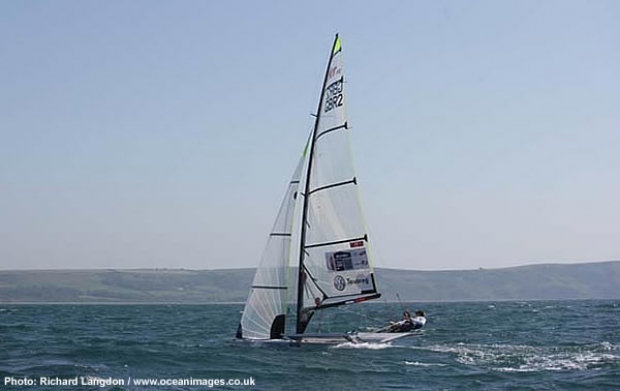
New age skiff rigs
Typically this sort of rig has a number of fixed spreaders (two sets in the case of the 49er, three for the 18) and a fixed forestay. This fixed forestay and spreaders are what make adjustment very tricky on the water. The key with these rigs is to spend your time on the shore experimenting with what effects what and working out settings accordingly. For the purposes of this article we will focus on a twin spreader, fixed forestay rig.
Where, on many other types of boat, mast rake is a very important factor, due to the un-adjustable nature of the forestay, mast rake as a whole is not something you are able to adjust on a boat with a mast set-up like this. However, the effects of mast rake, such as moving the centre of effort aft and reducing drag (as discussed in the last rig article here) can be achieved through inducing mast bend. Mast bend is, in turn, achieved by creating more tension in the shrouds, forcing the spreaders to push forward and the mast to bend.
The primary or main shrouds control the basic power from the rig. As with any shrouds going through a set of spreaders they have two primary uses. The first thing they do is control side to side movement. The second and most important thing they control is the bend of the mast in the middle section. The more bend introduced to this middle section of the mast, effectively the flatter the mainsail will become, which serves to de-power the rig. On most boats these shrouds, along with the forestay, will be carrying the most tension and are responsible for most of the work in holding the mast up. On the most basic level as the wind increases so too should the tension being carried by the main shrouds, to increase mast bend and reduce power.
The cap shrouds are used to control the very top of the mast. As with the main shrouds they perform more than one function. Again their job is to stop side to side flexing of the mast and, again, like the main shrouds, they are used to induce bend in the mast, although this time in the top section. Finally a very important job for the caps is to prevent the mast from inverting, when going downwind with the spinnaker up. In many of the high performance skiffs where we find this type of rig the spinnakers are masthead, which puts a great deal of forword load in the top of the mast, so the role of the cap shrouds is very important indeed.
When first setting up one of these masts the cap shrouds are one of the harder parts things to get used to. Our instinct as sailors is to induce more and more bend in the mast as well as rake as the wind increases. However, the newer rigs are designed to automatically respond to gusts. This means as the wind increases the tension on the cap shrouds needs to be decreased to allow the top of the mast to bend on its own and de-power the boat. The tricky part of all this is, as mentioned above, the cap shrouds are also there to stop the tip of the mast going over the bow when the spinnaker is up. Consequently you must be very careful about how far you let your cap shrouds off. Too far and the mast might break downwind; not far enough and the mast will not be free to react in the gusts leaving you overpowered and slow upwind.
The lowers control the bottom part of the mast and unlike the caps and the main shrouds do not run through a set of spreaders, rather they go straight from the chainplates to the mast. Perhaps the most crude or simple of the rig control devices the lowers primary purpose is to control mast bend at the base of the mast.
Lowers largely do the job of a mast puller or ram on a more traditional rig where more tension on the lowers creates less mast bend, enabling the boat to point higher. It does this by controlling the amount of power in the rig and is also critical to boat speed. Basically this is very simple to get to grips with. A very straight mast will let you point a bit higher, whereas a much more bent mast will not allow you to point as high but will make the main fuller, increasing power when pointing lower.
When setting up a rig like this it is very important to keep in mind that any adjustment on each of the three wires has an effect on the other two.For example, if you pull more tension on the lowers - thus reducing low down mast bend - it will increase the amount of cap tension significantly and also the amount of shroud tension slightly less significantly. This makes adjusting this set-up a surprisingly complex business as each wire must be used to achieve the desired tension even if only one wire needs to be adjusted initially.

It is worth spending some time onshore working out exactly how big the effect of each wire is on the other wires. Basically the effects are as follows but the amount of effect will vary from boat to boat. If the shrouds are pulled on the caps will lose some of their tension and the lowers will increase some tension. If the caps are pulled on then the shrouds will lose some tension and the lowers increase some tension. Finally, if the lowers are pulled on a hole then both the shrouds and caps will increase tension.
Generally these adjustments are made before heading out on the water although some boats (like the International 14) do have adjustable rigs. Because you must set your boat up for effectively the whole day before you head out on the water, sail controls become particularly important in this type of boat.
There are two particularly important controls with the skiff type rig: downhaul and kicker. Both controls not only affect the sails directly but can also be used to control some aspects of the mast.
The kicker, vang or gnav can be seen as the boat’s accelerator or break depending on how it is used. As most boats with a rig like this have a very big roach on the main too much kicker will see the leech tighten up and stall the airflow over the sail. Also if the kicker is over trimmed it causes over-bend in the mast where the mainsail is inducing more mast bend than luff curve, which in turn results in inconsistent pressure in the rig. If the vang is too eased the sail will twist off dramatically, with little leech tension and will leave you underpowered and wallowing.

Downwind the vang is typically let off a long way, particularly for help with the bear-away. It is important to remember to hold enough tension in the leech through the vang to help the caps hold the mast up. It is also very easy to close he leech off here as the spinnaker is pulling the tip of the mast forward, tensioning the leech itself. Letting the vang all the way off for the bear away and then returning it about ¼ of the way to its upwind setting is a good but very coarse rule of thumb.
Cunningham is the key to on-the-water mast bend: the harder you pull on the Cunningham the more it pulls on the luff of the sail and the more mast bend it creates. Cunningham also pulls the flow of the sail forward by making it deeper nearer the mast. However, on a boat with a fully battened mainsail and a very flexible top mast this effect is reduced. As the tip of the mast is so flexible it is very easy to pull this control on too hard and over bend the mast, which will reduce the power in the rig significantly. The key to this control is to be sensitive. Downwind the Cunningham needs to be released to stop the track on the mast becoming too overloaded as the mast straightens due to the pull from the spinnaker.
Once on the water these rigs are easy to use with two main sail controls and automatic gust response doing some of the work for you. However, this does not mean they are in any way less time consuming than other boats. To make the boat go fast for you, you must spend time on the shore playing with settings, then go out and test them the same as every other type of boat. The main difference here is once you have decided on your setting for the training session or race day it can be very hard work to change. So choose carefully and make sure you are aware of what the weather is likely to do.
Businesses


Pro businesses
-
Netherlands
-
France
-
United Kingdom
-
Italy
Editor's choice
Member blogs
-
 Ned Collier Wakefield: MOD70 round BarbadosWell that was intense. 12 hard fought for seconds for the win. In idyllic conditions, Tony Lawsons MOD ...
 -
 Mini Transat leg 2 reportThe second leg of the Mini Transat started on 31st October, just over a month after ...
 -
Leg 1 reportI’ve been working towards the Mini Transat now for three years. In 2013 I was part ...
Business blogs
-
 The Island Sailing Club in Cowes, Isle of Wight, is delighted that Prince Michael of Kent ...
 -
Peta Stuart-Hunt chats with the 25 year-old British solo sailor Lizzy Foreman before she sets sail ...
-
The 2015 Student Yachting World Cup (SYWoC), an ISAF-recognised event hosted and run by students for ...
Editor's Choice
-
 Three legs down into Ian Walker’s
 -
 Winning all but two races at
 -
 For the first time in its
Latest Comments
Add a comment - Members log in