
Radical National 12s
Thursday February 16th 2006, Author: Toby Heppell, Location: United Kingdom
In last week’s
article we covered the progression of the National 12 from its birth in 1936 to the modern day boats. One of the major factors in keeping the class alive over such a long period of time has been the opportunity for builders to develop the boat. This is not something that has been lost over the years with both boat building companies and amateur boat builders continuing to develop and improve their designs.
Today if you want to get a new National 12 you have two basic options. You can buy an off the shelf boat from one of ten companies, the principle builders being Aardvark Technologies, Full Force Boats and Pinnell and Bax - most of these companies will vary certain aspects of their design to fit your needs. The other option is for you to build your own boat. As you can imagine the off the shelf boats contain few major innovations but are regularly tweaked and are very competitive. The home build market tends to contain some of the more wacky ideas being honed by amateur backyard builders.
We spoke to Mike Cooke of Aardvark Technologies about the Phil Morrison-designed Big Issue II all carbon boats that he is currently creating. Aardvark Technologies is Cooke’s boat building company which specialises in making boats and boat parts out of carbon fibre. When we last spoke to Cooke at the 2004 Dinghy Exhibition – article here – he had just finished building a boat with a canting rig mechanism on it. The rig can cant up to 10 degrees to windward or leeward and incorporates a crossbar arrangement to maintain shroud tension regardless of the direction the rig is pointing.
The last two years have seen Cooke building plenty of National 12s but making no major modifications. He says that he is not sure at the moment whether there were any major changes needed on the Big Issue II design. Cooke is busy with a pretty full order book for the time being. He points out is that while more and more people are buying fully carbon boats, interestingly there is no weight advantage in doing this as both wooden and carbon built hulls are coming out under the 78kg minimum weight limit for the class. The reason people are buying carbon is forward-looking. “At the moment the minimum weight is 78kg but as the class is a development class that could well change. If you have the money you might as well buy a carbon boat now with correctors in so it will still be competitive if the weight limit drops in a few years time,” he explains.
The canting rig concept is still in a semi-development stage with sails proving especially difficult to get right. Nevertheless Cooke is persevering with the idea and is working closely with Pinnell and Bax in this area with the hope of getting it right in the near future. As the rig is still in a development stage, people are not keen on putting them on their boats but Cooke believes it is only a matter of time until they get it right.
Below: Mike Cooke with his canting rig National 12
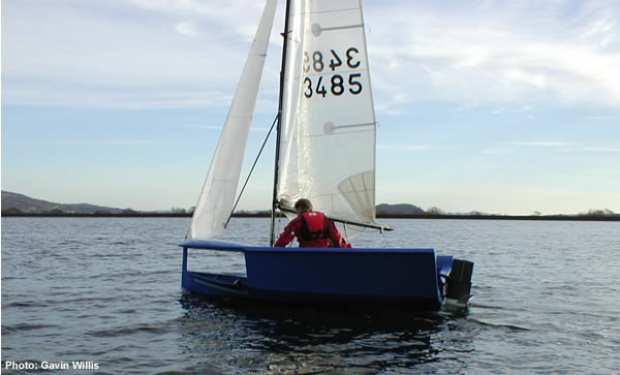
With boat building companies not developing hull shapes in any significant way, many of the radical designs are currently being made by home builders such as Gavin Willis. When he was younger Willis used to sail Merlin Rockets and also worked with Ian Holt – a radical Merlin Rocket designer. From here Willis developed a good idea of what Holt was trying to do with his design and, more importantly, why. Willis moved to the National 12 because he wanted a boat that he could sail with his kids but also allowed him to do the designing and the tinkering that keeps him happy. It is quite clear from talking to him that although he is competitive he enjoys the building and designing process as much as the actual racing, if not more.
Willis admits that he got a little carried away with his latest boat; “I put a lot of new developments in one design which is a classic mistake. What I should have done is try out each idea individually but I didn’t, so now I am unravelling it all.” This seems an understatement given that there are at least six radical ideas within his new design, some subsequently dumped, some still being worked on. Add to this the fact that he has never actually worked on any large project in carbon fibre and it seems amazing that there is any boat at all.
The first and most visually striking aspect of his new design is the large hole in the front of the boat (see below.) “When you are going to windward and you hit a wave you more or less hit a wall of water and you either go over it or through it. I was trying to get some of the water to go through the boat, but because of the weight of the water passing through the boat it just slowed it down. That idea got binned pretty quickly, it was one of those things that you dream up and some people have the balls to try it and some don't,” explains Willis.

The next idea that Willis had is a little less extreme than the hole in the bow idea. The concept is again to do with what happens when a boat hits a wave. As almost all National 12s are built to the maximum width of 2m allowed by the rules, they are affected a lot by waves because there is such a wide area for the wave to hit. Willis’ solution to this was to keep the boat 2m wide but also go to the maximum depth possible (see the comparison with a regular depth National 12 below.) “It looks really ugly but I don’t care how it looks, just how it goes,” he explains. “What I wanted to do was minimise the amount of boat going through the wave, without losing any of the power benefit that you get from being max width. If you imagine a boat going through a wave and that wave is a certain height then a tall boat that is the same width as a shallow boat is going to be narrower at the point that the wave is hitting. We effectively get to the same width but we get there by going at a different angle.”.

Along with having a hole in the front of his max depth boat Willis wanted to put as much buoyancy into the bow and stern of the boat as possible. This is a concept that he learned from Holt’s Merlin Rocket designs. Willis says that what Holt was doing with Merlins and what he tried to do with his National 12 was to put a large amount of buoyancy in both ends of the boat. The reason for this, Willis maintains, is that when you are in marginal planning conditions you are effectively sitting on a bow wave that is one boat length long. A boat with lots of buoyancy at each end seems to end up sitting on both ends, or to look at it another way - lifting its middle. “As the boat has so much buoyancy it looks more like a Moth than a National 12 for the first two or three feet, with a sharp radius on the corners and then they come up very square, it is really ugly but I don’t care so much about that,” he says.
 Another development to the boat that was actually born out of the hole in the bow idea but remained for a short time afterwards is the use of what can be best described as winglets on the bow (see left.) The original idea of this was to stop the boat from completely nose diving when it went through a wave. However they also had another use as he explains: “In an attempt to try and use as much of the bow wave as possible, I kept the winglets on the front of the boat.” He says that the idea was that these would act like little skis on the front of the boat helping pull the boat onto the plane by using the bow wave. ”What we found was that they are very quick running on flat water but they were no good in waves because they would prevent you from going up the back of a wave to let you surf down the other side. Also as soon as you were flat out planning the bow was up anyway so they became completely ineffectual. It was not too long after the hole was patched up that these came off. They were still good in flat water, marginal planning conditions but the loss in other conditions was not worth the gain.”
Next on Willis’ list of things to be experimented with was the rig. He says that his starting point was one basic well known piece of information; the slot is the engine of the boat. “It seems to me that the best way to make a boat go faster is to increase the amount of air that is dragged down through the slot. The only effective way I can see of doing this is to move the mast back a bit, so I moved the mast back from the usual position by about 200mm,” he explains. Originally Willis tried this with the regular sized jib - that had the advantage of being self tacking because there was no overlap - but it soon became clear that this was not working. “I found that the effect would either switch on or switch off and you would not get the air flow to attach on the leeward side of the sail. It was not until I put the larger jib on it, which is allowed by the rules as long as I reduce the main sail size - that it started to really move. At certain points it is very quick but I still have a fair bit of development to do,” he adds. This development concept, however, does not just stop there. As you might imagine if you simply move the mast back a long way and put a bigger jib on a boat it will severely affect the boat’s balance. But the solution for this is simple: you move the centre plate case forward and this should cancel out the mast movement and jib size increase. This is what Willis has done. “Because I have pushed the mast back, added a bigger jib and moved the centre board case a long way forward, the whole boat is now completely different to any other National 12,” he states.
 The final concept is one that is, uniquely, not something that just Willis has tried. It is, however, something that many others within the fleet have tried and then given up on: moveable International 14 style T-foils on his rudder, . Aside from the obvious bow up downwind or bow down upwind advantages he believes they have allowed him to change the hull shape even further. “The objective of using the foils on the rudder - and I am the only person that has persevered with that - is that I can have a light weather rounded transom with a low wetted surface area and still have the foils to help me ride on the bow wave in marginal planning”. As with many things though the foils are not quite to his liking yet and he is planning on building a new, bigger set very soon. The new foils will also have a twist grip adjustment built into the tiller extension as per the 14 arrangement. Willis says currently he does notice the difference in windy weather but would like to be able to feel the effect in slightly less windy conditions. We asked Willis if he was worried about the drag that these would cause in light weather when they were not working but he said he had already solved that problem. He has the rudder in a daggerboard-style case, and when the wind is too light for the T-foils to work he simply lifts the rudder up until they are out of the water, leaving a little bit of rudder down (you can just about make out the T-foils out of the water in the picture above.)
Willis says with retrospect there are a few things he would do differently on the boat but he is glad that he tried all the things that he tried. He still thinks that the boat has the potential to be very fast. In fact he thinks that most of the reason that it does not always go quick is down to sailor error now.
After 70 years of continuous innovation the fact that National 12 builders are still able to come up with radical ideas and concepts is a testament to both the design criteria and the builders. In truth massively radical ideas are rarely picked up by a whole fleet of boats but what they often do is pave the way for a smaller innovation to come along. This is where people like Willis come in. Although it is unlikely we will see a whole host of boats that are max depth we might see manufacturers such as Cooke thinking about it a bit more and supply deeper off the shelf hulls. This must surely be the appeal of the National 12: you can do any amount of building that you want, be as radical as you want but what it is really about is going and sailing against a whole host of boats that are slightly different, to see who can cross the finish line first, exactly how it was in 1936.
Most Read
Most Commented
Comments
Businesses

Pro businesses
-
-
United Kingdom
-
-
United Kingdom
Editor's choice
Member blogs
-
 Ned Collier Wakefield: MOD70 round BarbadosWell that was intense. 12 hard fought for seconds for the win. In idyllic conditions, Tony Lawsons MOD ...
 -
 Mini Transat leg 2 reportThe second leg of the Mini Transat started on 31st October, just over a month after ...
 -
Leg 1 reportI’ve been working towards the Mini Transat now for three years. In 2013 I was part ...
Business blogs
-
 The Island Sailing Club in Cowes, Isle of Wight, is delighted that Prince Michael of Kent ...
 -
Peta Stuart-Hunt chats with the 25 year-old British solo sailor Lizzy Foreman before she sets sail ...
-
The 2015 Student Yachting World Cup (SYWoC), an ISAF-recognised event hosted and run by students for ...
Editor's Choice
All time favourites...
-
 Three legs down into Ian Walker’s
 -
 Winning all but two races at
 -
 For the first time in its
Latest Comments
Add a comment - Members log in