
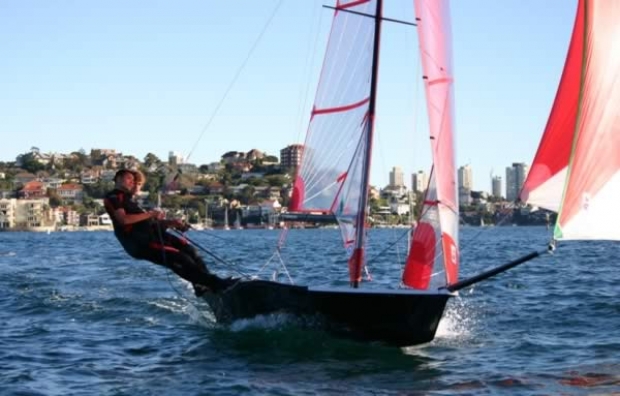
29erXX - the new women's Olympic boat?
Monday March 27th 2006, Author: Toby Heppell, Location: United Kingdom
ISAF have announced that in the spring of 2007 (probably early April but an actual date has yet to be confirmed) they will be holding an ‘Olympic Observation Trial.’ In the announcement ISAF says they are looking at the possibility of a women’s high performance multi-crewed dinghy for the Olympics in 2012. The decision to hold the trials has come about following a submission from the Danish Sailing Association (see
here)
The definition used in the paper of a ‘high performance dinghy’ is very broad; “the dinghy must be able to sail faster off the wind, than the wind.” This means, presumably, that almost any planning dinghy will be eligible for consideration. There are however some optional requirements which show us the sort of boat that ISAF are looking for. These optional extras are an asymmetric spinnaker and twin trapezes, and this changes things somewhat.
The ISAF release contains the fundamental criteria against which the boats will be evaluated and is as follows:
• High Performance – The dinghy must be able to sail faster off the wind than on the wind;
• Main Target – Female crews (average combined weight 120-140kgs)
• Safe – Easy to recover by the crew after capsizes and without any external help.
• Lowest cost as possible – The lightest hull weight possible, targeting a price of €14,500 (Euros), ex-works, ready to sail. Closed class rules.
• Optional Characteristics – Twin Trapeze. Asymmetric Spinnaker.
In addition, the class must have the unquestioned ability to meet the requirements of International Class status within a reasonable time, along with worldwide availability of materials and opportunity for construction.
Most recent trials have been held in Torbole, Lake Garda, Italy and in Quiberon, France. ISAF will consider these and other venues to host the observation trials in spring 2007.
The timing will allow due time for consideration of the outcome of the trials for further debate at the 2007 ISAF Annual Conference in Athens, Greece.
Presumably Lake Garda is the most likely option for the trials to take place. The northerly wind in the morning is usually around seven to ten knots and is replaced at around 1:00pm by a southerly thermal breeze which tend to be around the 20 knot mark. This also leaves a good hour in the middle of the day for off the water inspections and lunch. Presuming the trials will be much like the trials for the 49er (which took place at Garda) and the team of sailors and officials at the test event will spend a week sailing, racing, analysing, poking, prodding and generally examining the boats before formally giving their opinion. These will then be taken to ISAF for their Annual General Meeting on Athens in mid-2007.
ISAF are remaining tight lipped about exactly what their thoughts are on where a new boat would fit into the current Olympic classes situation. This is for a couple of reasons. Firstly the trials are still over a year away and they need to know whether the equipment they test is what they are looking for, so they cannot make any realistic judgements about whether they want to adopt a new boat yet. Secondly decisions on this kind of scale are often politically sensitive.

The reason for this trial is not to find a replacement boat for one of the current Olympic classes, it is rather a look at what could be available if ISAF were to do so. This seems reasonably likely be it now or in the near future. Dick Batt, ISAF Technical Committee Chairman, told us; “ISAF are very keen to keep the Olympic regatta modern, exciting and visually appealing. The area of women’s sailing is growing and becoming ever more important,”
Batt says that he thinks the criteria (above) that ISAF released gives a good idea of the sort of boat they are looking for and though it is early days they have made an effort to ensure the criteria is not too vague. As the observation trials are still a long way away it is not yet clear exactly which boats may attend or be looked at but there are apparently a number of manufacturers interested.
Looking at the criteria set out by ISAF it is hard not to be thinking of one particular boat for the spot: the 29erXX.
Long anticipated, the 29erXX has been on the tip of people’s tongues for at least a year and on the tips of others for a significantly longer time than that. There have been many rumours circulating about the boat, including but not limited to: The original 29er was going to be twin trapeze but the Bethwaites backed out, or that this is what the fabled 39er was going to be, or that it is a knee jerk reaction to ISAF looking at a female Olympic skiff. Whatever the reasons the boat is now here and ready to go for its potential Olympic spot.
Upwind the 29erXX has a sail area, according to Dave Hall Ovington Boats Sales Manager, of 15.69sqm. This compares to the 470’s 12.70sqm but downwind is where it gets interesting. The 29erXX has a big 21.33sqm spinnaker bringing its total sail area up to 37.02sqm against the 470’s 25.70sqm. Looking at these figures and knowing what we know about the 29er it is clear the 29erXX will be significantly quicker than the 470. Perhaps more importantly in terms of the Olympics the 29erXX looks more modern, fun and exciting. There are also easy comparisons for the untrained viewer to make between it and the 49er.
The 29erXX is unique in the 9er range as it is not a newly designed hull, rather a new rig on the standard 29er hull. Whether this is a good or a bad thing is endlessly debatable. There will certainly be some who argue putting a bigger rig on a boat that was not designed to have it is not a good thing. There will be others that argue this provides a good, relatively inexpensive, high performance boat for lightweights. Whatever the merits, or not, this does provide the 29erXX with one distinct advantage. ISAF have clearly stated that the boat must, “have the unquestioned ability to meet the requirements of International Class status within a reasonable time.” There are already so many 29ers in existence all with the potential to convert to the XX rig and this would already give it a substantial and rapid step in the right direction.
If we look at the rest of the criteria set out by ISAF it becomes clear the 29erXX would fit very neatly into this potential new Olympic spot. The boat will clearly fill the high performance category; in fact the standard 29er would fit the high performance category. Female or lightweight crews should be fine in the 29erXX - as Hall points out the average weight for the boat should be somewhere between 125-135kgs and this fits very comfortably into their prescribed weight limit. Presumably the 29er must have been deemed safe by ISAF for it to be declared an official youth class, so it is not too much of a leap to presume that the 29erXX will be deemed as safe. Although we currently do not have the pricing for the 29erXX Julian Bethwaite, the boats designer, initially said he though the boat would be priced at around about €9000 before tax. ie inside the required pricing range, and the boat will be a one design. As for the optional characteristics, the 29erXX fills both and certainly looks like the sort of package that ISAF are after.
Clearly we are not the only people to think that the 29erXX is a good candidate for the Olympic spot, but both the manufacturers and ISAF remain fairly reserved. “When you look at the criteria it [the 29erXX] does seem to tick all of the right boxes but we will have to wait and see,” comments Hall. When we asked Batt if he though that the 29erXX was a viable contender he gave us much the same answer, “The 29erXX clearly does fit the criteria and is probably one of the more developed boats that is available at the moment.” There are reasons for both of these people being fairly broad in their answers, Hall has to think about selling the boat if it does not become an Olympic class and Batt obviously cannot at this stage show any bias. Even so, their comments above do show they believe the 29erXX is a viable contender and because they are willing to comment on the boats chances at all at this stage must mean it is at least one of the front runners.

Although ISAF have said that they have not made any decisions on what boat the female skiff could replace the options are reasonably small. We have thought about this and think that the most likely course of action is to replace the women’s 470 with the new female skiff, make the 49er the men’s double handed class and then make the remaining 470 class an open class. This would also have the advantage of there being some male and female teams in the Olympics, as the 470 requires a very light helm and bigger crew. Sailors often talk about how good it is that men and women can compete against one another side-by-side surely it would be a good thing to showcase this at the highest level of the sport. These changes would leave the Olympic line-up as:
Laser men’s single handed dinghy
Laser Radial women’s single handed dinghy
Finn open single handed dinghy
49er men’s double handed dinghy
New high performance boat women’s double handed dinghy
470 open double handed boat
Yngling women’s keelboat
Star men’s keelboat
Tornado open catamaran
RS:X men’s and women’s windsurfer
Clearly the 29erXX would be a good candidate for the potential Olympic spot and would provide exciting high performance racing for the spectator. However, it is always difficult to accurately predict the selection of Olympic class boats, due to the amount of political wrangling involved. If the observation trials go well, if ISAF choose to have a new Olympic class, if nothing comes along that is significantly better and if I were a betting man; my money would be firmly on the 29erXX for 2012.
Most Read
Most Commented
Comments
Businesses

Pro businesses
Editor's choice
Member blogs
-
 Ned Collier Wakefield: MOD70 round BarbadosWell that was intense. 12 hard fought for seconds for the win. In idyllic conditions, Tony Lawsons MOD ...
 -
 Mini Transat leg 2 reportThe second leg of the Mini Transat started on 31st October, just over a month after ...
 -
Leg 1 reportI’ve been working towards the Mini Transat now for three years. In 2013 I was part ...
Business blogs
-
 The Island Sailing Club in Cowes, Isle of Wight, is delighted that Prince Michael of Kent ...
 -
Peta Stuart-Hunt chats with the 25 year-old British solo sailor Lizzy Foreman before she sets sail ...
-
The 2015 Student Yachting World Cup (SYWoC), an ISAF-recognised event hosted and run by students for ...
Editor's Choice
All time favourites...
-
 Three legs down into Ian Walker’s
 -
 Winning all but two races at
 -
 For the first time in its
Latest Comments
Add a comment - Members log in