
Mid-life makeover
Friday December 15th 2006, Author: Toby Heppell, Location: United Kingdom
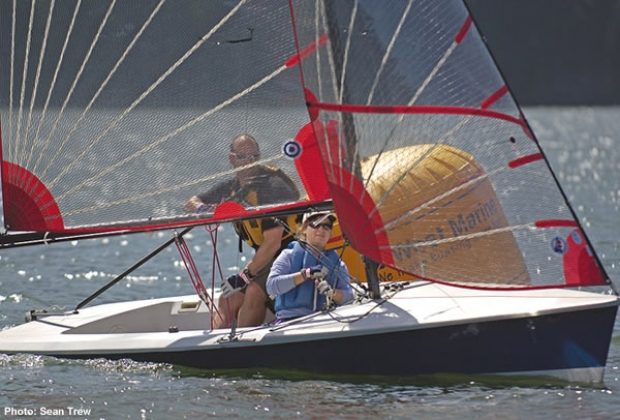
After a great deal of debate in previous years about how to liven their boat up, the Tasar class finally changed its rig this year. Some may say this change was long due with the class, particularly popular in Australasia, remaining largely unchanged since its birth in the 1970s. The new sails for the boat were officially unveiled at the London Boat Show earlier this year to a number of surprised looks.
One year on from this change, recently appointed UK Class Chairman, Pete Ellis, says they have seen a significant increase in numbers and they are looking forward to more people sailing the boats in the coming year.
One of the things that makes the Tasar stand out over other boats is its rotating mast. This is particularly unusual in small two man dinghies and the class were extremely keen to keep this remain as a part of the boat. Interestingly the boat's designer, Frank Bethwaite, is rumoured to have wanted to get rid of the rotating mast and go with a more fashionable, modern self de-powering skiff-style rig. However, the class overruled this on the basis that the boat was probably quicker with the current mast and it also maintained the Tasar character.
The new sails are different from the old ones but the trick of it is, they are not significantly faster than the previous Dacron incarnation. “At the UK National Championships this year the event was actually won by someone sailing with the old sails," comments Ellis. "He was an Australian guy who came over for the event and he is an ex-world champion so he is very quick. It does show that the old rigs can still be competitive though which is a really good thing,” .

Ellis adds that when sailing the boats with the new rig it is easy to feel as they are a little twitchier and more responsive. In a straight line, he says, it would be hard to find any major speed difference between the old or the new sails. However, as the new sails are see-through it makes sailing the boat and boat-handling a lot easier. “The crew is always playing the jib now because you can really easily see the leech, so it is easier to trim the sails. I think this ease of use is part of the reason we are seeing so many more people coming into the class. Currently a lot of the new people buying boats are parents who want to teach their children how to race or want to show them what a proper race-boat feels like".
The new sails for the Tasar are roughly the same size as the old ones but the jib is a little bigger and the main a little smaller. Although it is very quick for a boat of its size the Tasar now technically has smaller sails than a National 12, although official measurements do not reflect this. The N12 sails are measured by triangulation and this does not include their roach. If you lay the new Tasar sails on top of a suit of National 12 sails apparently you can see the 12 sails around the edge.
Of course one of the main concerns with changing a boat significantly is you risk alienating a significant portion of the fleet who cannot afford to buy a brand new suit of sails, but the Tasar fleet seem to have done well to avoid this. “The new sails are actually cheaper to buy than the old Dacron ones were. They are being made by the same people the 29er sails are - Neil Pryde and Ian McDiarmid - so we save some money on the manufacturing costs because sails are there being built all the time anyway,” says Ellis. In fact comparing the old sail prices and the new sail prices, the new, more modern, significantly better looking sails are nearly £120 cheaper, an impressive saving indeed.
In the UK particularly these new, cheaper sails have sold very well and the class is beginning to look very solid once again. “Over the last year there have been two batches imported from Australia and I think we have sold just about 60 suits,” confirms Ellis. 60 suits of sails is a significant number to many these days but it is perhaps all the more impressive in the Tasar where numbers were dropping at a significant rate. The new look boat definitely seems to have stemmed the flow of people leaving the class. In 2005 there were only 35 boats at the UK National Championship, this year there were 50.
This increase in UK sailors is not only something that has been seen on a national level but the class is also seeing more sailors than ever before going to the international events. The Tasar World Championship, normally dominated by the Australians is being held in Phucket, Thailand this year and a record number of UK boats will be attending. “We - the UK - have never had a boat in the top ten at a Tasar World Championship,” explains Ellis. “We have got some people this year who are good sailors and have been working really hard. As a team we are hoping for a couple of boats in the top ten and then we can build on that success next year”
 Part of the battle in having more people sailing the Tasar is to get them to the open meeting and get some properly competitive racing going on. Traditionally in the UK the class has been one sailed by those who want to race at club level, but are not completely comfortable with going away to events. Due to this over the last few years the class has seen the slow demise of its open meeting circuit until they were reduced to just joining in with regatta weeks already taking place at local sailing clubs. “This year we introduced an area championship scheme and that really seems to work. The idea is that we hold one area championship in each area of the UK and it gives all the people from that area a single date to try and get to. This way we are not trying to spread ourselves to thin,” Ellis comments. In theory these area championships are going to be used to ease people into an open meeting circuit bit by bit, but by only giving them two dates – their local area championship and the National Championship - they do not have to offer up a huge commitment.
With people being so reluctant to travel in the UK fleet some differences have had to be made at the National Championships. Where previously the class had a week long standard championship with one race each day they have now switched to a much more modern format. “We are going to try and keep the Nationals at about the same time each year. We have found that a long weekend in September is the best for our class. Many of our sailors have other local sailing commitments over the summer months and it is often hard for them to find a full week so by having a short National Championship in September we are able to include as many people as possible,” Ellis says. This seems to be a great idea and a three day championship with 50 boats is always going to be better than a seven day championship with significantly less.
One of the issues with the new rig, if it can be called an issue, is the lack of boats currently available on the secondhand market. “As the hulls last very well and a number of boats in the UK have not been sailed very hard it was easy to buy an old hull, stick a new rig on it and have a very competitive boat for not very much money,” explains Ellis. “Unfortunately many of those older boats have now been sold so we are really struggling to find enough boats to meet demand.” However, boats do occasionally pop up on the market and anyone wishing to purchase one or have a test sail of the new rig should contact Ellis through the UK class website, www.Tasar.org.uk.
Although popular in Australia and Japan for many years it seems the Tasar is finally finding its feet in the UK market. With a thriving international fleet out there just waiting to be challenged and a sexy new look this really could be a great boat for many sailors out there.
Most Read
Most Commented
Comments
Businesses

Pro businesses
-
Italy
-
Italy
-
United Kingdom
-
France
Editor's choice
Member blogs
-
 Ned Collier Wakefield: MOD70 round BarbadosWell that was intense. 12 hard fought for seconds for the win. In idyllic conditions, Tony Lawsons MOD ...
 -
 Mini Transat leg 2 reportThe second leg of the Mini Transat started on 31st October, just over a month after ...
 -
Leg 1 reportI’ve been working towards the Mini Transat now for three years. In 2013 I was part ...
Business blogs
-
 The Island Sailing Club in Cowes, Isle of Wight, is delighted that Prince Michael of Kent ...
 -
Peta Stuart-Hunt chats with the 25 year-old British solo sailor Lizzy Foreman before she sets sail ...
-
The 2015 Student Yachting World Cup (SYWoC), an ISAF-recognised event hosted and run by students for ...
Editor's Choice
All time favourites...
-
 Three legs down into Ian Walker’s
 -
 Winning all but two races at
 -
 For the first time in its
Latest Comments
Add a comment - Members log in