
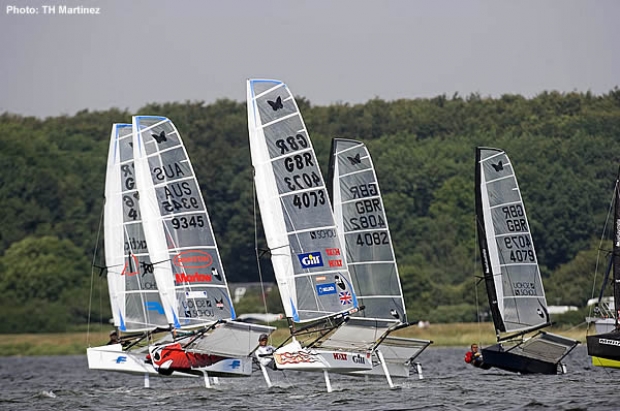
This year the foiling gybe, next year the foiling tack
Tuesday December 19th 2006, Author: James Boyd, Location: United Kingdom
As a special treat for readers (as well as ourselves) we visited Hayling Island Sailing Club recently to hook up with foiling Moth World Champion Simon Payne and UK National champion Sam Pascoe for a state of the nation about the world's most exciting dinghy class.
After a year out learning to foil his Moth, Simon Payne has returned to full time employment with Musto up in Essex, while Pascoe, the rising star, is now working at Linton Jenkins' Full Force Boats. Payne continues to sail an Australian Fastacraft Prowler, while Pascoe races the tarty red Mistress 'M3' (complete with BMW-liberated badge on its bow, as seen at the Dinghy Show).
Spotting the difference between the boats is becoming increasing difficult to a layman's eye. The Fastacraft has its wand (used to adjust the pitch of the lifting flap on the T-foil at the bottom of the daggerboard) mounted on the starboard side of the bow, while the new Mistress has it more 'symmetrically' recessed centrally beneath the bow. In addition, some tweaky work has gone into Pascoe's T-foils which are now slightly elliptical in shape with a small plate at either tip creating an end plate effect. This reduces the size of the foil, needed thereby reducing drag.
The World Champ's latest Prowler was new this year and also has upgraded foils. Compared to those on his old boat these are higher aspect and slightly curved. "The whole boat feels much smoother upwind," states Payne. "Undoubtedly they are perhaps better foils for doing 25 knots and in terms of winning races I think they are very good: You come out of the water a little earlier. I don’t have to bear away quite as heavily to get up on foils upwind and I think part of it is that."
With his new foils Payne reckons he can get airborne in as little as 6 knots of breeze. Whether this is best on the race course is debatable though when looking at VMG. The big angles necessary to sail to stay out of the water means that the overall result upwind or downwind is at best similar than it would be if one kept the boat in the water and sailed conventional angles, in moth foiling terms 'lowriding'.
Now that Moths are clocking peak speeds in the mid to high 20s (reports of a record 30+ knot boat speed, turned out to be false thanks to a GPS error), a lot is being asked of the foils to make them perform efficiently over a 6-25 knot range. Foiler Moth sailors are not yet turning up at regattas with a quiver of foils to suit conditions, although this can only be a few steps away. Instead the unwritten rule is that if they stick with whatever equipment they chose from the outset of a regatta, regardless of how light (or strong) conditions get.
While Payne says he is happy with his present foils, he thinks it much more likely people will turn up at regattas with different sized rigs. Particularly with the Worlds in Garda next year there is a good argument to change down from an 8sqm to a 7sqm sail. Aside from being better suited to stronger winds this will also reduce drag. "I think that is a safer bet than having smaller foils," says Payne. "Because even with small foils, the drag is still be there from the rig." Perhaps we will see a time when foil sizes are selected according to the weight of the sailor (ie heavier sailor requires more lift and therefore bigger foils to get airborne) while the size of sail are dictated by wind strength on any particular day.
While a majority of Moth sails are coming from KA in Australia, Payne has recently been trying a new sail made by Pinnell & Bax and has given it the thumbs up. "Right from the off it was on it. Other sails that we’ve used have not been quite there. This just needed one tweak and it was every bit as good. It is really good to have a UK sailmaker who can make these things. KA sails are very good and they make them in quantity and they are based in Australia so if we want to continue to be the best nation it is nice to have a UK sailmaker we can work with."
Once the basics of Moth sailing (ie keeping the boat upright) have been mastered, then winning seems to be down to a combination of who can remain foiling longest and who can sail upwind highest - and downwind the lowest. With the equipment now becoming fairly standardised this latter point is really down to technique, or as Payne puts it "channelling excess lift."
Hence we have the 'Veal heel' where Moth foilers sail upwind with the whole boat heeled over to weather much like a sailboard. The principle reason for this is provide lift to weather from the foil. "When the boat lifts out of the water, if it lifts too much, rather than dialling it down you heel it hard to windward and it gives you pointing ability. So you are changing the excess lift into windward push," explains Payne.
But the Veal heel is not always the right technique upwind. "It depends where you are getting your pointing ability from," Payne continues. "If you are getting it from the rig you need to keep it fairly flat. Above a certain wind strength it helps to just heel it and sheet in and manage pointing ability by how much the boat is heeled. That happens at about 10 knots. Below that you are keeping the boat fairly flat and sailing quite conventionally with everything barred up tight."
Pascoe says that in stronger winds sailing upwind can be a handful. "I was having problems last weekend trying to get into tacks because I didn’t have the weight to swing the rig down, because you had to be fully hiked right up until almost head to wind and then you had to be on the other side suddenly and if you go slowly you just stop and can’t back the jib or anything."
With two seasons now under his belt Payne reckons that his techniques haven't changed, but they have just become refined. "I am a little more economical with movement now having done so many foil miles. That means I am a little bit smoother in the boat. And it is a great time because when you develop so much experience foiling, and you are still physically able to do it, nothing is new and that’s a really good thing." Effectively sailing the boat becomes a fluid near unconscious process. Payne reckons his strengths on the race course are being able to sail higher and lower than most of the competition while he is not the fastest when it comes to straight line speed.
While the automatic altitude adjuster via the bow wand is what principally lifts the boat out, there is also a motor-cycle twist grip on the tiller to alter the pitch of the rudder T-foil and therefore the fore and aft inclination of the whole boat. In practice Payne gives the impression that hauling his 66kg around the boat has a much greater effect. Upwind he stands just aft of the foil, front leg tense to help drop the bow from time to time when required. Even downwind he tends to be reasonably far forward. "You have all these controls, but often it is a question of grabbing the front wing bar and shoving it down when nothing else is going to stop the boat popping out of the water."
The manoeuvre the higher ranks of the flying Moth sailors have been perfecting over the last two seasons has been the airborne gybe. Out on the water Pascoe seems to be the master of this, Payne being a little rusty. The secret in moderate to strong winds is to go through a gentle arc. "Basically you are trying to move against the centrifugal force of the boat trying to fall over," explains Payne. "It needs to be a leisurely arc because the foil doesn’t like changing direction very quickly otherwise you can get the centreboard cavitating. Also mainly when you see us gybing you are trying to get to the leeward mark so depth is as important as anything else. The boat will sail for quite a long time before you really need to gybe. Most people when they first start out are too worried about sheeting in on the other tack but you can be incredibly leisurely and do it nice and slowly. In the lighter stuff you need to tighten up your gybing quite a lot, so you do need to swing it around pretty hard to keep it on foils."
Aside from this it is a case of keeping the boat as flat as possible and managing height by moving ones bodyweight fore and aft. "As long as the boat is flat and you are crossing the boat evenly then that should be fine," claims Payne.
There are oddities to sailing deep on a Moth. There is the multihull phenomenon when in stronger wind strengths the apparent wind seems to flip around the front of the boat when gybing. Unique to the Moth is when crew and boom end up on the same side of the boat. "It's where the wind in the sail is less than the centrifugal force of the boat trying to fall over," explains Payne.
The manoeuvre that even the likes of Payne and Pascoe have yet to master is the airborne tack. Payne claims to have achieved this twice, but by accident. "If I knew how to do it I would do more!" quips Payne. "I think it was about keeping the boat flat and steering it through the tack. I didn’t do it quickly. I was going pretty quick and steered through it and was able to keep the boat dead flat and then get forward and crack the main on."
At the Worlds this year the wind strength was such in some races that Rohan Veal was gybing upwind in order to keep his boat in the air. However neither Payne nor Pascoe think this tactic fast. "Sometimes you can get on the foils and the breeze can stop, but because of your apparent you can stay on the foils and you know that if you tack you will drop off the foils. So if you gybe round you can stay on the foils. The issue is that you are very low and at that point you are way low. I am yet to be convinced."
While Fastacraft and Full Force remain the most popular foilers in the UK at present the new kid on the block is expected to arrive soon in the form of the Chinese-built production Bladerider. Rohan Veal, who is part of the organisation behind the new Moth foiler, is soon to take delivery of the first production boat and one is expected to be on display at the Dinghy Show this spring. Graham Vials has his name down for one as has former ABN AMRO Two skipper Sebbe Josse. "There is no reason why it shouldn’t be as quick as any other boat, but we don’t know," says Payne. "We haven’t really seen it sail. It has the same sort of wand system and you can control the foils. I understand it is a very stable boat from those who’ve sail it and that is a good thing, but stability doesn’t always mean speed as you know from fighter aircraft."
The other big name in British Olympic sailing to move into the class is Paul Brotherton who has bought himself a Prowler, like Payne, as his Christmas present. While the class is growing at a fair pace in the UK, according to Pascoe the German market is also buoyant with several of their secondhand foilers being sold there.
At Full Force Linton Jenkins is planning a small production run of retrofit foils for existing RS600s. Pascoe, being a slightly bigger lad, is going to focus on this after next year's Worlds in June and is being joined by eminent yachting journalist and 49er/International 14 sailor Andy Rice, and the Greenhalgh brothers.
Payne is not so convinced the Moth is just a featherweight's boat. "I’m sure you’ll see a break away Moth-typeboats made for big people, but Sam [Pascoe] is 6ft 1in and 80kg, so he is bigger than most and he can sail a Moth. I don’t think people should worry they are too big for a Moth because it is a small boat." At this point it starts coming down to wind strength, Pascoe winning when it gets heavy, the more spindley 60 something kiloers having the advantage when it gets lighter. "If it blows at Garda, Sam could be off," predicts Payne.
Check out of the latest Moth video tomorrow
Most Read
Most Commented
Comments
Businesses

Pro businesses
-
-
United Kingdom
-
-
Editor's choice
Member blogs
-
 Ned Collier Wakefield: MOD70 round BarbadosWell that was intense. 12 hard fought for seconds for the win. In idyllic conditions, Tony Lawsons MOD ...
 -
 Mini Transat leg 2 reportThe second leg of the Mini Transat started on 31st October, just over a month after ...
 -
Leg 1 reportI’ve been working towards the Mini Transat now for three years. In 2013 I was part ...
Business blogs
-
 The Island Sailing Club in Cowes, Isle of Wight, is delighted that Prince Michael of Kent ...
 -
Peta Stuart-Hunt chats with the 25 year-old British solo sailor Lizzy Foreman before she sets sail ...
-
The 2015 Student Yachting World Cup (SYWoC), an ISAF-recognised event hosted and run by students for ...
Editor's Choice
All time favourites...
-
 Three legs down into Ian Walker’s
 -
 Winning all but two races at
 -
 For the first time in its
Latest Comments
Add a comment - Members log in