
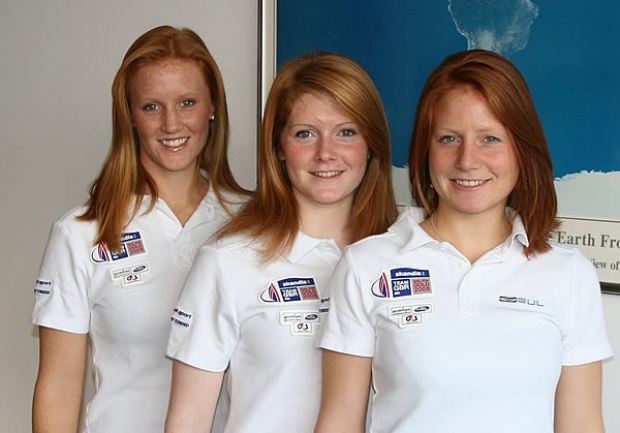
From left to right: Victoria Rawlinson (helm), Sue Monson (middle) and Emma Rawlinson (bow)
Hard work this winter
Tuesday December 19th 2006, Author: Victoria Rawlinson, Location: United Kingdom
Somewhere between a keelboat and a planing dinghy, the Yngling is a powerful boat and a challenge to sail in a breeze. We have spent the last few weeks trying to rise to this challenge!
Upwind, the crew spend 80% of the time under the water, which, in the bitter British winters, can be a chilly experience to say the least! It also puts the responsibility of tactics more on the shoulders of the helm, whose higher vantage point allows them a better picture of what’s going on up the track.
Despite being a displacement boat, the Yngling is very responsive and we have been working hard on using our body weight to help her through the waves. This brings in the physical side of heavy weather sailing – the loads through the boat are very high, requiring an enormous amount of strength, particularly from the middle person – the power house of the boat! In order to work the boat as hard in the last race of the regatta as the first, the whole team needs muscle strength, endurance and aerobic fitness.

Turning corners is all about forward planning, staying in control and taking one manoeuvre at a time – first the three of us work together, using our weight to bear the boat away. Only when that stage is safely completed do we start the hoist. It’s the bow’s job to keep the boat tidy – it’s incredible how quickly legs become tangled and halyards become knotted when the breeze is up!
Downwind, in the strong breeze, the boat comes alive! She picks herself up and charges over the waves like a planing dinghy – an exhilarating ride! Once the kite is set and the boat tidy Emma, as the bow, leaps over the sheets, the middle and the helm to balance precariously on the transom – what we call “riding rodeo”! From that position she can pump the main hard whilst keeping the bow out of the water. The loads on the kite sheets are so high that the middle, as trimmer, will barely be able to hold them, let alone trim. At this point, communication with the helm becomes vital to keep the kite filling and the boat working. The bow will communicate the pressure – if a gust is coming in the helm may need to take a higher angle to keep the boat steady and the trimmer will need to get the kite in before the gust hits or she’ll never be able to move it! The bow is backup for everything – if the guy, for example, needs moving it’s a two person job.

Gybing downwind is a tricky business in a breeze. As with all boats, the key is to pick your moment and be decisive. Pushing the pole out on the new gybe is a mission – again communication is key. When a lull comes the helm can take the boat lower, the trimmer can give an ease on the kite, and the bow may have a couple of seconds to get the pole onto the mast before the next gusts makes it impossible. This is one of the most critical moments downwind, when the boat is least stable and the crew may have their minds focused inside the boat. If we get caught the wrong side of a gust or wave, it is a race to blow the kite halyard and save us from the race destroying disaster of broaching. If the halyard is blown quickly, we can regain control and pick up our course downwind, rehoisting the spinnaker without too much trouble. The worst case scenario is that the boat gybes as she broaches to windward, the kite halyard isn’t blown and half the ocean fills the boat, in which case it takes three people with three buckets bailing at full speed to regain control!
Downwind, we try to push the boundaries every time we go out. We sail as close to the edge as possible, so when we’re in a regatta we can play it a bit safer, but we know we can cope if the breeze comes in hard! If you don’t push it hard in training and learn how to deal with a bad broach, then if it happened in a race it could mean game over. So we try to train hard to make racing easier!

Most Read
Most Commented
Comments
Businesses

Pro businesses
-
United Kingdom
-
United Kingdom
-
France
-
Editor's choice
Member blogs
-
 Ned Collier Wakefield: MOD70 round BarbadosWell that was intense. 12 hard fought for seconds for the win. In idyllic conditions, Tony Lawsons MOD ...
 -
 Mini Transat leg 2 reportThe second leg of the Mini Transat started on 31st October, just over a month after ...
 -
Leg 1 reportI’ve been working towards the Mini Transat now for three years. In 2013 I was part ...
Business blogs
-
 The Island Sailing Club in Cowes, Isle of Wight, is delighted that Prince Michael of Kent ...
 -
Peta Stuart-Hunt chats with the 25 year-old British solo sailor Lizzy Foreman before she sets sail ...
-
The 2015 Student Yachting World Cup (SYWoC), an ISAF-recognised event hosted and run by students for ...
Editor's Choice
All time favourites...
-
 Three legs down into Ian Walker’s
 -
 Winning all but two races at
 -
 For the first time in its
Latest Comments
Add a comment - Members log in