
New developments
Wednesday December 13th 2006, Author: Toby Heppell, Location: United Kingdom
In a small warehouse on the Isle of Wight there is a man busily working away to create some of the more interesting designs in a variety of classes. This year he has been working on one of the more exciting developments of recent years, the Development Canoe.
Andy Paterson has been building top quality foils and boats from his workshop on the Isle of Wight for 12 years. Originally he was know for building Cherubs and International Moths and was keen to be a part of the foiling revolution in the Moth Class. Sadly troubles with his back saw him out of the class in the vital few years of development and though he hopes to go back to building Moths he has yet to go back to the class.
In early 2006 Paterson became aware, through conversations with Steve Clarke, of the International Canoe class’ decision to consider a development of the class. The plan was to have several builders design new Canoes to a box rule and then make a final decision at the Worlds in winter 2007 on how the class should move forward. Paterson jumped at the chance of becoming a builder in a class undergoing a revolution and, as he had never been a part of the canoe scene, was able to look at the boat with fresh eyes. “The Canoe was starting to look a bit old and the people who were sailing it were, shall we say, a little older. I thought there was lot that could be done to make the boat more appealing,” he explains.
“There was some discussion early on by the class about whether they should allow the use of racks and a trapeze but it was decided that would put us up against boats like the Musto Skiff and the RS700, which would make for tough competition,” states Patterson. It would also seem unwise to go down this route as the canoe is now well know, certainly in the US and UK, for its sliding seat, it has become almost iconic over the years. Because of this Patterson’s new Canoe has many of the original features of the International Canoe. It is pointy at both the bow and stern and also still has the sliding seat for which the boat is famed.
The new canoe, however, does have a number of new features. “One of the first things I realised about the International Canoe is they are extremely complicated to sail. I realised the boat could be simplified significantly,” comments Patterson. Early he realised a part of the Canoes problem was that it had been overdeveloped over the years, the sliding seat moved fore an aft on a large, heavy carriage, there was a main and a jib, the rigging was heavy and so was the boat.
One of the first thing Paterson realised was there was no need for the jib on the boat. “The purpose of creating a development was to try and get the boats o go downwind quicker. The Canoe is very quick upwind but it is downwind when it starts to wallow a bit. I realised you could trade the jib for a slightly bigger, considerably more efficient mainsail and the boat performance would be greatly increased,” he explains.
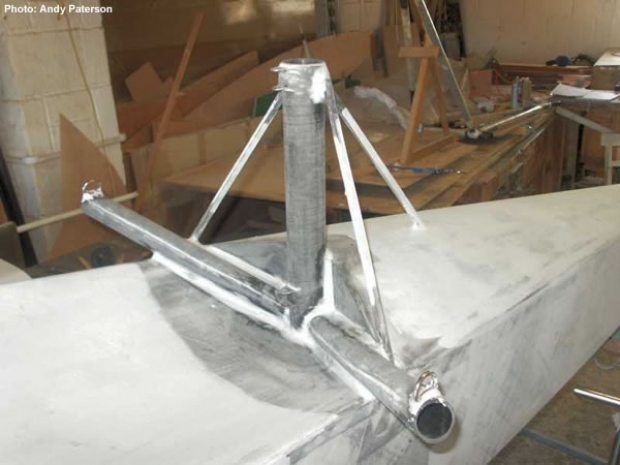
To this end he started trialling ideas for a free standing flexible mast. Initially this was tested during the early stage of the build by going out in an old canoe hull with a stiffened windsurfer mast on it to test the idea. “It became obvious quite quickly that the free standing mast was not going to work, it was just too flexible. Unfortunately by the time I made the decision to have shrouds the boat was already being build. Also, because I was aiming for a very narrow hull like the Moth the width of the boat at the mast was only 500mm,” Paterson says. The only remedy for this was to somehow try and increase the shroud-base width. This was done by adding what are effectively extensions out the side of the boat near the bottom to of the mast allowing the effective shroud base to be widened from 500 to 750mm, a substantial increase but still narrower than the current International Canoe.

With a single sail on the boat Paterson wanted it to be as efficient as possible and here once again he turned to the Moth for inspiration. “I decided to use the same camber induced mast sleeve sail the Moths use this creates a much more efficient sail allowing the boat to be significantly faster,” he says.
Another obvious difference when looking at the new Canoe is the actual shape of the hull, which is particularly obvious at the bow. “One of the problems the Canoe has is although the bow is very wide it is actually quite flat, this means downwind the boat is quite prone to nose-diving. I thought the boat clearly needed to be more of a wave piercing shape – as we discovered with the Moths is you have a taller bow that is designed to go through a wave when you hit a wave the boat does not stop and so does not pitch pole,” Paterson explains.
To counter the pitch pole effect of the boats the sliding seats on Canoes, have over the years been put on fore and aft sliding carriages, allowing the helm to move further aft downwind. However, when he started to design his canoe Paterson decided this was complicated, adding further ropes, tracks and pulleys and was heavy. “I decided that instead of having a big moving carriage, I would go without and counter the effect of the helm effectively sitting in the wrong position with an adjustable t-foil on the rudder,” he says. This system, however, proved to be difficult, with the t-foil creating too much drag, slowing the boat and not providing the right amount of lift to counter the sliding seat being in the wrong position. In the end Paterson had to concede and put a sliding carriage under the seat. He has kept the t-foils though and believes they will help with boat speed particularly when it is windy.
Perhaps the biggest issue for Paterson when looking at the International Canoe was the weight of it. “The current canoes are about 85kg,” he explains. “The one I have built weighs just about 50kg, which is very light for an International Canoe but not very light for a Moth.” Paterson did not elect to use any particularly new or fancy methods of construction; rather he stuck to carbon, foam sandwich.
As we see it a major problem for the Canoe is it seems to be breaking up into a series of sub-classes. Currently there is the International Canoe (IC) as we know it, the Asymmetric Canoe (AC), which has really taken of in the UK but is also developing a strong international following and now we have a Development Canoe (DC), with a small number of boats being build across the globe. Paterson does not believe this is as big a problem as it may seem. “The AC has really taken off and I think it is really its own class now. I think at the worlds if the decision is made to change to the Development Canoe the Asymmetric Canoes will have a bit of a re-think of their rules and change a few things like the minimum weight for example. The rest of the Canoe fleet will probably switch to Development Canoes at some point,” he concludes.
One final reason Paterson gives for switching to the Development Canoe is it could save people a lot of money. “At the moment a new International Canoe costs about £13,000 which is a lot of money. Because the new boats are not exactly one design then we should be able to build them for less money. I think I would be able to sell y design, ready to go for something around £9,000 which is a lot cheaper.”
It seems we will have to wait and see what decisions the Canoe class makes with regard to the Development Canoe. However, if they do chose to go down that route and perhaps even if they don’t we can expect to see a lot of Canoes with a lot of variations in them hitting the water soon.
Most Read
Most Commented
Comments
Businesses

Pro businesses
-
-
Italy
-
-
United Kingdom
Editor's choice
Member blogs
-
 Ned Collier Wakefield: MOD70 round BarbadosWell that was intense. 12 hard fought for seconds for the win. In idyllic conditions, Tony Lawsons MOD ...
 -
 Mini Transat leg 2 reportThe second leg of the Mini Transat started on 31st October, just over a month after ...
 -
Leg 1 reportI’ve been working towards the Mini Transat now for three years. In 2013 I was part ...
Business blogs
-
 The Island Sailing Club in Cowes, Isle of Wight, is delighted that Prince Michael of Kent ...
 -
Peta Stuart-Hunt chats with the 25 year-old British solo sailor Lizzy Foreman before she sets sail ...
-
The 2015 Student Yachting World Cup (SYWoC), an ISAF-recognised event hosted and run by students for ...
Editor's Choice
All time favourites...
-
 Three legs down into Ian Walker’s
 -
 Winning all but two races at
 -
 For the first time in its
Latest Comments
Add a comment - Members log in