
The Finn alternative?
Thursday November 9th 2006, Author: Toby Heppell, Location: United Kingdom
As large builders bring out more and more new single manufacturer one design classes to fill seemingly endless ’gaps in the market,’ so a reaction in the UK has been an increase in sailors returning to more traditional boats. Time and again recently we are told about older classes, where attendance and membership has increased dramatically over the last few years, both double and singlehanders alike.
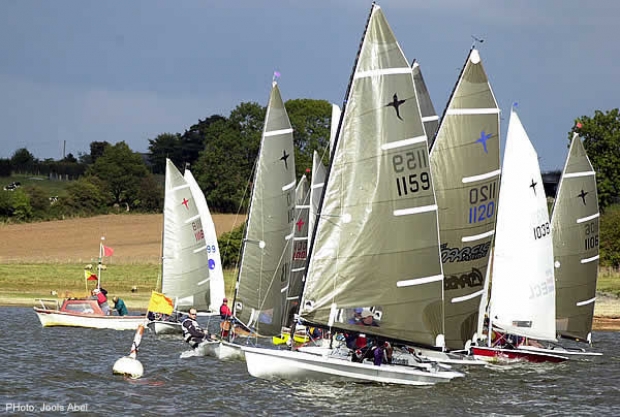
One such class is the Phantom: Designed in 1971 by Bryan Taylor and Paul Wright this is a heavyweight’s single-handed boat, sailed predominantly in the UK. In the 1970s it was conceived as a stitch and glue home build affair, much like the Mirror dinghy. The boat proved extremely popular in its first few years and it was not long before sail numbers had reached 250, with boats built largely in people’s homes.
However, after a short period of time these first Phantoms began to show some serious signs of wear and tear and it became clear the design, if not made incredibly well, was simply not up to the task of being sailed hard over a period of years.
In the 1980s Jeff Vanderbought, then working for Rondar, began to sail the boat and realised the potential of the Phantom even though at the time the numbers were dwindling, with a small number of professional builders turning out decent boats. Vanderbought took it on himself to design and make a set of moulds which would become the basic shape for fibreglass, Rondar, Phantom. “We launched the fibreglass version in 1992,” explains Vanderbought. “I spent a lot of time building the moulds and plugs for the boat back then but it took a number of years before we saw it on the market.”

Getting a boat to market is not the entire battle and the new Phantom was launched to a perhaps slightly unenthused crowd. “I remember when it was launched at the boat show it was exactly the same year the ISO came out. I remember this because both boats were going out the door at about the same price. The ISO seemed like a fast exciting, new boat and it probably made the Phantom look really rather expensive,” admits Vanderbought.
As time moved on sales slowly began to pick up and soon Vanderbought was building and refining, lighter, epoxy Phantoms at his own company Vandercraft. “Obviously as technology has moved on so have the boats, so the early ones in glass were nowhere near as stiff and light as the ones that are built in epoxy. We now have a very light, stiff, quick boat,” he explains.
Seemingly always going through some kind of change the Phantom class are about to switch builders once again. The moulds are being moved up north to Ovington Boats where the Phantom is to be built now. This move will help meet demand for new boats while Vandercraft will still be able to finish and fit out the hulls.
The move to Ovington Boats also coincides, rather handily, with big plans the Phantom class association have been making for the coming years. “Ideally we would like a European and then a worldwide Phantom class,” says Phantom sailor and committee member, Will Gulliver. “With Ovington taking over the building there are now a lot of discussions going on about the possibility of European builders or Ovington supplying to Europe”.
The class has already decided to hold its first European event next year but the details of exactly where are yet to be finalised. In reality a European event, at this stage, seems most likely to consist of group of UK-based Phantom sailors holding an event in a different country. “We will probably run that event in conjunction with another class. We have had a few offers from various classes that are going to France or similar who have asked us to come as well to make it more financially justifiable and I think this is a good way for us to start European events off. Following that some of us hope to go to Garda in 2008,” explains Gulliver
At this stage it seems the likelihood of the class taking off in Europe depends on a number of important factors. Firstly finding the right distributors or distribution method for Europe must be the most important thing for the class, after all people need to be able to buy the boat easily outside of the UK. Secondly, and here there is good and bad news, there is the issue of the competition. “We feel in the division of heavyweight single-handed sailing there really are only a couple of options: The Finn is clearly our big ‘rival,’ for want of a better expression, but we feel it caters more for the mega-fit Olympic sailor that is happy to go to the gym for five days a week. That is not exactly where the Phantom class is at this point in time. That is not to say there are not a number of young, fit Phantom sailors who sail the boat hard and go quick because of it, just that being the fittest person on the water is not necessarily a pre-requisite,” explains Gulliver.

It is clear the Phantom is always going to be measured up against the Finn and in a number of ways they are very similar boats. However, Gulliver insists despite their need for a heavier sailor - the average sailor’s weight at the nationals over the last couple of years has been in excess of 100kg - and their carbon mast the Phantom is actually similar to the Laser. “Really it is just a big Laser to be honest,” he comments. “The top four guys at the Nationals last year were all good Laser sailors ten years ago. One of the best Phantom sailors ever was Laurence Crispin who won the Laser Worlds back in 1985. It has got lots of bits of string on it, but in effect you set it up like a big Laser. The guy who won the nationals this year is only 89kg anyway. So that sort of dispels the rumours that you have to be big and fat. That sort of weight is only just out the top of the Laser weight range.”
The biggest difference between the Finn and Laser and the Phantom is, the Phantom has a stayed, adjustable rig, where both other boats are entirely un-stayed. This adjustment means the mast may be raked further and further back as the wind increases, which de-powers the rig significantly, allowing some of the lighter crews to stay in contention through a wider range of winds. “One of the reasons we have an adjustable forestay is to de-power the rig but also if you are going downwind you can let the tension off which in turn allows the boom to square off so you are able to run by the lee, with a stayed rig,” states Vanderbought. Of course the Finn with its numerous different mast designs is able to cater for a wide range of weights as well but the adjustable stayed rig solution certainly could appeal to a lot of sailors.
Although the Phantom was designed largely to sail on the sea, it is seen in the UK by many as an inland boat. “The Phantom has got quite a fat bow so as soon as that starts hitting waves then the boat tends to stop a little bit because of this many boats are now sailed on inland venues,” explains Gulliver. This speed inland could also be the source of another common preconception of the class. “People often say it is a great handicap boat, we have got a very light hull and a very light carbon rig combined with a big sail all of which actually makes it a great handicap boat. At club level I am sailing on a Portsmouth Yardstick, handicap of 990 or 980 which is about the same as a Fireball. If you get on flat water without waves and sail it quite hard then it is definitely sailable at that sort of speed,” he continues.

The class is currently putting a considerable amount of effort into attracting a slightly younger crowd to their events as well as exploring the European and World markets. “I think over the next five years we will be attracting younger people. Where traditionally we have attracted people in their 40s I think we will start to attract some slightly younger sailors, although there are certainly still older sailors out there who would enjoy the boat. We think there is quite a big chunk of the Laser masters circuit that we could take as well for example,” Gulliver says.
Whether or not the Phantom is able to break the World or European markets is a very big question mark. It seems there is a lot stacked against it and our immediate reaction is, it will be an uphill struggle. Having said this, the boat has already proved time and again it has what it takes to lure sailors back into it after significant slumps. But all this talk of overseas sales is beside the point - this year the class saw 79 boats attending their National Championship. This is more than many classes in the UK at the moment and it would seem if you want big fleet racing in a heavyweight, single handed boat you really need look no further.
Most Read
Most Commented
Comments
Businesses

Pro businesses
-
United Kingdom
-
United Kingdom
-
Italy
-
France
Editor's choice
Member blogs
-
 Ned Collier Wakefield: MOD70 round BarbadosWell that was intense. 12 hard fought for seconds for the win. In idyllic conditions, Tony Lawsons MOD ...
 -
 Mini Transat leg 2 reportThe second leg of the Mini Transat started on 31st October, just over a month after ...
 -
Leg 1 reportI’ve been working towards the Mini Transat now for three years. In 2013 I was part ...
Business blogs
-
 The Island Sailing Club in Cowes, Isle of Wight, is delighted that Prince Michael of Kent ...
 -
Peta Stuart-Hunt chats with the 25 year-old British solo sailor Lizzy Foreman before she sets sail ...
-
The 2015 Student Yachting World Cup (SYWoC), an ISAF-recognised event hosted and run by students for ...
Editor's Choice
All time favourites...
-
 Three legs down into Ian Walker’s
 -
 Winning all but two races at
 -
 For the first time in its
Latest Comments
Add a comment - Members log in