
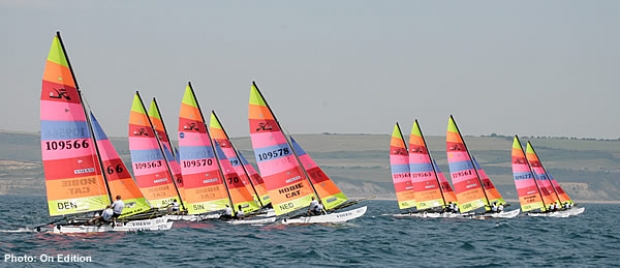
Where was Weymouth's wind?
Tuesday August 8th 2006, Author: Toby Heppell, Location: United Kingdom
Bright hot sunshine and beautiful blue skies marked the Youth World Championship and 49er European Championship at the future Olympic venue, the Weymouth and Portland National Sailing Academy. These were to be the first major tests of the venue and with hundreds of competitors at both events they would truly see how the venue coped under pressure.
The £7m centre which began operations two years ago - is the pride and joy of the RYA. Funding has come from a multitude of organisations including the South West Regional Development Agency, Sport England, the RYA and numerous other partnerships and donations. The purpose-built centre - complete bar one more slipway, providing the ability to launch almost all Olympic classes at once – for some time has been home to the elite Skandia Team GBR who train most days on the waters of Portland Harbour and Weymouth Bay.

Shortly before competitors began arriving for the Youth World Championship, it seemed the weather was going to treat everyone to a fine display of hot temperatures and solid sea breezes. Unfortunately this was inaccurate and for the most part races were sailed in light and patchy breeze, largely due to the hot weather. “The problem is the week was so hot – the hottest July ever recorded in Britain – the computer models got it wrong. They rely on past data to make predictions about what will happen. In this instance they had so little data to go on; we ended up with very unreliable information about the wind. We thought most days would be west or south west with the sea breeze building on top of it but as it turns out this did not happen,” explains Rob Andrews, Director of this year’s Youth World Championship.
Following the Youth Worlds, the 49er Europeans had many of the same problems in the early part of their championship and even when the breeze did materialise in the second part of the week it was a very odd breeze ,particularly local to Portland leaving competitors racing for whichever side of the course was closer to the island. Weymouth was not behaving itself.

WPNSA does have one big advantage when the weather becomes erratic: it’s reputation. “This week it has been difficult with the weather. I hear there are usually good wind conditions here. I believe it was chosen to be the national sailing academy because of the sailing conditions, so I think this week we were unlucky with the weather not with the venue,” comments Walter Bordeno, Coach and Technical Director to all Olympic classes for Brazil.
Beyond the uncontrollable weather, sailors and coaches seem impressed for the most part. What comes across regularly in conversation is in comparison with both the Olympic venues at Athens and Qingdao, Weymouth is significantly smaller. “I think Qingdao and Athens are both bigger than Weymouth but then they are both designed to be big marinas after the Olympics. This will not be a marina. This is good because it means this is a venue for small boat sailing first and everything else later,” says Bordeno.
These feelings about the size of the venue are reflected by many in attendance. “I think this is a very good multi-functional training centre. It is very compact but it offers everything a sailor and an athlete would need. It is really fantastic and I cannot think of venue that is more compact and functional than this one,” says German windsurfer coach, Deitrich Bakker, who adds that the German federation are considering a similar such facility.
Andrews believes the venue worked well for both events this summer. The RYA took a lot of feedback from competitors and by all accounts many said it was a good venue and with the future developments set to take place it will be a fantastic venue. One of the big improvements, Andrews believes, needs to be made is the marina area. This must be finished so it is easy to refuel boats on the water. The Youth Worlds did not thrown up anything they did not already know about the venue, but there is still work to be done there.
Obviously with the wind conditions recently there were some difficulty getting all the races in, particularly for the Youth Worlds. This was not helped by the prestige of the event and the necessary media coverage it involves. “I think ISAF have a different philosophy which to a certain extent is media-driven. They like to know what time you are going to start, where you are going to start etc to make it easy to cover. Whereas at the 49er events for example they went out and did as many races as they could, wherever they needed to,” comments Andrews. Because of this there were moments at the Youth World when there was no wind on the various course areas while there was some breeze elsewhere in the bay, but racing areas were not moved.

This is an issue that needs sorting out as it would not do to have wind on all but one course for the entire Olympics. This may not be a problem at all, however, provided the organisers take a leaf out of Sydney’s book. “In Sydney they rotated the boats around from course area to course area,” explains Bakker. “This was a good thing because some of the courses were very one-sided and it would be boring to just be doing the same thing over and over. Here it is a very challenging and difficult place for sailing because the areas are so different. Outside the harbour it is wavy with a lot of current so tactically it is tricky and you have to be more alert with your handling skills. Inside it is flatter but the wind can be trickier so it is less about handling and more about looking at the big picture. For these reasons I think it would be good to rotate the fleets between different courses but I do not know if that is what they will do yet.”
Rotating courses in this way means the venue will need to be particularly good at getting boats on and off the water. This will be significantly improved when the new slipway is built. This will extend across the entire frontage of WPNSA and further to the south, giving a vast launch area. This, in conjunction with the pontoons, should enable all Olympic classes to come and go effectively at any moment. “I think it is very clear the slipway is an issue, particularly with classes that have flights. At the moment it is quite a tricky and delayed process and really needs to be sorted,” confirms Andrews.
The Youth Worlds is a particularly good trial of the venue for the Olympic sailing in 2012 and how it will be run, as there is one boat from each country and a limited amount of classes. However, as Andrews explains, although the Olympics is very big it is not the biggest event the venue will have to cope with. “These have been two big events and the Olympics will obviously be a big event, but in terms of sheer numbers the pre-Olympics and potentially Sail for Gold - Britain’s new Olympic classes event the RYA hopes will become ISAF Grade 1 - will be significantly bigger. I think we will use Sail for Gold as the vehicle to take sailing to the public as well as the major tester for WPNSA,” he says.
At the recent events the RYA was very keen to try out some additional systems. For example in the main hanger, they kept a running projection of the latest results and were updating them regularly. We saw this system in use and thought it worked well, allowing all competitors to easily see exactly who was where.
Andrews is particularly excited about future ideas in particular GPS/tracking technology. “I am really excited about this at the moment. It is something we are working hard on. Potentially it would mean there never has to be a general recall because we know if a boat is over the line or not. That in turn means we can run much closer to schedule. It also means people can hook into it all over the world and watch sailing in a different way. Finally I think it could really help people to understand our sport. In much the same way the cricket uses a graphic for ball trajectory we could give people realistic representations of what boats might do or did do and why,” he enthuses.
It seems likely the Sail for Gold regatta will gain a high status with Olympic sailors from all over the world coming to race from WPNSA with many also turning out for the pre-Olympics. It remains to be seen how the venue will cope under these even greater pressures but most seem convinced at this early stage everything is looking good at this increasingly important sailing venue.
Most Read
Most Commented
Comments
Businesses

Pro businesses
Editor's choice
Member blogs
-
 Ned Collier Wakefield: MOD70 round BarbadosWell that was intense. 12 hard fought for seconds for the win. In idyllic conditions, Tony Lawsons MOD ...
 -
 Mini Transat leg 2 reportThe second leg of the Mini Transat started on 31st October, just over a month after ...
 -
Leg 1 reportI’ve been working towards the Mini Transat now for three years. In 2013 I was part ...
Business blogs
-
 The Island Sailing Club in Cowes, Isle of Wight, is delighted that Prince Michael of Kent ...
 -
Peta Stuart-Hunt chats with the 25 year-old British solo sailor Lizzy Foreman before she sets sail ...
-
The 2015 Student Yachting World Cup (SYWoC), an ISAF-recognised event hosted and run by students for ...
Editor's Choice
All time favourites...
-
 Three legs down into Ian Walker’s
 -
 Winning all but two races at
 -
 For the first time in its
Latest Comments
Add a comment - Members log in