
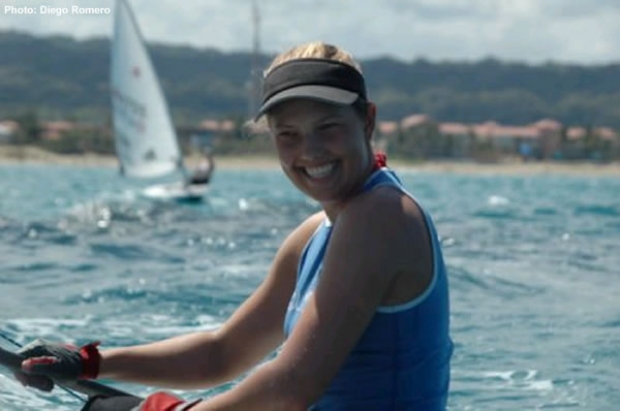
On the way to greatness?
Wednesday July 19th 2006, Author: Toby Heppell, Location: United Kingdom
Olympic class sailing rarely holds any major surprises - there are a number of sailors in every class who are favourite to win events and only occasionally is this form upset. It is rare, therefore, to hear a new name doing particularly well consistently. This was the case for us when Evi Van Acker started popping up at the front of the Laser Radial fleet regularly this year.
Unusually 20 year old Van Acker does not come from a family with many roots in sailing. When her brother was younger he was affected by a medical complaint that prevented him from doing any sports involving running or standing for any long periods of time. It was this complaint that lead Van Acker’s mother to enrol her brother in a sailing school on a lake she passed on her daily commute to work. Being a typical younger sibling Evi Van Acker wanted to do what her brother was doing and it was not long before she was enrolled in the same sailing school herself.
From these beginnings racing began to slip into the equation with Van Acker becoming more competitive over time. “I guess I was competing pretty early on, probably at about eight or nine. I was mostly racing on the weekend at that time,” she explains.
Only a couple of years after she started racing Van Acker was selected for her first major event, the 1997 Optimist European Championship. From here she became a regular face on the International Optimist scene qualifying for and taking victory in the next European Championship in Croatia in 1998. However, this victory represented the peak of her achievement in the Optimist class as the following year she only managed a disappointing eighth place at the Europeans.
At this stage the still young Van Acker had another couple of years left sailing the Optimist but decided to change class as many of her older friends were starting to sail the Europe.
Success in this class, however, remained elusive for some time. “My main problem at the start of my Europe sailing was, I was still studying full time. All my spare time was going to sailing but it was not enough. I managed to get into the top 20 in the world and was getting some top 15 results, but I never made the top five or anything really impressive,” she says. “Mostly this is because I never really had the time to devote to my sailing.”
Van Acker did manage to qualify her country for the Athens Olympics in 2004 and beat her primary domestic competition at the World Championship in the previous year but at just 17 with little experience and very few top results it was decided by her National Authority not to send her to the event. This potentially devastating decision does not seem to have had too much effect on her. She says she was just preparing herself for another four years of sailing the Europe when the Laser Radial was announced as the new women’s Olympic Boat.
Upon hearing the news of the Radial being accepted Van Acker was devastated and made a very big decision. “At first I was really unhappy about the change to the Laser Radial; in fact I did not even sail for about nine months. I just did not want to sail the boat: I though it was so ugly. I decided I would go and do something different so I took up rowing. I said to myself that if I ever felt like sailing again then I can just go out and get myself a boat and start to train.”

By this stage in her life Van Acker had moved onto higher education and was studying at Amsterdam University. In May 2005 the moment came and she decided to get a boat and compete in Holland Olympic Regatta [formerly SPA] largely because of its close proximity to her university. She managed to put together a respectable series and came away with 13th place overall - very impressive for someone who has hardly ever sailed the boat and has not sailed at all in nine months.
Although the result was respectable and she still clearly still had a passion for sailing, devoting large amounts of time to sailing the Radial was still not something Van Acker was prepared to do. Following the event she spent almost no time sailing over the summer. It was not until she learned the Laser Radial World Championships were going to be held in Brazil she stepped back into a boat. “When I heard where the Worlds were being held I really liked the idea of going there so I started training again,” she explains.
Clearly time away from sailing and her on-off attitude to the Radial had done little to dampen her natural talent as she managed to take home 16th place at the event after having sailed an estimated 20 days in the boat before the event.
This success along with a reignited passion for racing inspired Van Acker to take another big decision. “In January I decided I was going to devote a lot more of my time to sailing. I really wanted to focus more on the sailing because I was really enjoying it again. As I am at university I have the opportunity to take more time away from my studies. I started training really hard this winter during January, February and March and really put a lot of time, effort and energy into that training. I guess it paid off,” she says.
‘I guess it paid off’ is certainly one way of putting it as this year she seems to have hit the floor running and never looked back. While the whole world looks to Paige Railey (who has been having an inconsistent year) as the bench mark Radial sailor, Van Acker has been sneaking up picking up victories and top finishes everywhere. So far she has won the Princess Sofia, Holland Regatta and the Laser European Championship and come sixth at both the Miami OCR and Hyeres, just a few of her top results.
Interestingly Van Acker does not attribute her success this year to her hard training over the winter – although she acknowledges it helped. “I think one of the biggest factors in how well I have done this year was the break I took away from sailing,” she comments. “I had been sailing for four years in the Europe and I was really disappointed because I really did not want to sail the Radial. I think that the worst thing you can do sometimes is to go and sit in a boat and not enjoy it just because everyone else is and you feel you ought to. I was really happy that I went away and did something else for a year and then came back. I think it made me that much more competitive.”
With this in mind she is trying to schedule regular breaks into her training and racing regime to insure she does not get too bored again. For this season for example she has already declined the opportunity to go to the ISAF World Sailing Games. She has also decided she will not be attending the much talked about Olympic Test Event in Qingdao, so the World Championships (which begin the 28 July in Los Angeles) will be the last event of the season for her. “After the Worlds I am going to take a break and do some studying and then after a while I will begin to train again over the winter.” Clearly Van Acker believes taking time away from competitive sailing is important to do when you are getting tired. She says if she is too tired of competitive sailing she just does not get good results which in turn leaves her feeling disheartened.
The attitude she has to competitive sailing and her stop-start relationship with the sport makes it difficult for Van Acker to give many predictions about her future and exactly what she wants to do. Currently she is campaigning for a spot at the 2008 Olympics but is quick to point out success this year by no means guarantees a spot. She has also spent a little time this summer training in Weymouth with Skandia Team GBR member, Laura Baldwin, and says she likes the venue enough to consider trying for the 2012 Olympics. We will be watching Van Acker closely to see how she does at the World Championship, it is the last time we are likely to see her competitively sailing until next year when the Olympic qualifying gets underway.

Most Read
Most Commented
Comments
Businesses

Pro businesses
-
Italy
-
Italy
-
United Kingdom
-
France
Editor's choice
Member blogs
-
 Ned Collier Wakefield: MOD70 round BarbadosWell that was intense. 12 hard fought for seconds for the win. In idyllic conditions, Tony Lawsons MOD ...
 -
 Mini Transat leg 2 reportThe second leg of the Mini Transat started on 31st October, just over a month after ...
 -
Leg 1 reportI’ve been working towards the Mini Transat now for three years. In 2013 I was part ...
Business blogs
-
 The Island Sailing Club in Cowes, Isle of Wight, is delighted that Prince Michael of Kent ...
 -
Peta Stuart-Hunt chats with the 25 year-old British solo sailor Lizzy Foreman before she sets sail ...
-
The 2015 Student Yachting World Cup (SYWoC), an ISAF-recognised event hosted and run by students for ...
Editor's Choice
All time favourites...
-
 Three legs down into Ian Walker’s
 -
 Winning all but two races at
 -
 For the first time in its
Latest Comments
Add a comment - Members log in