
But does it mean anything?
Tuesday May 16th 2006, Author: Paul Brotherton, Location: none selected
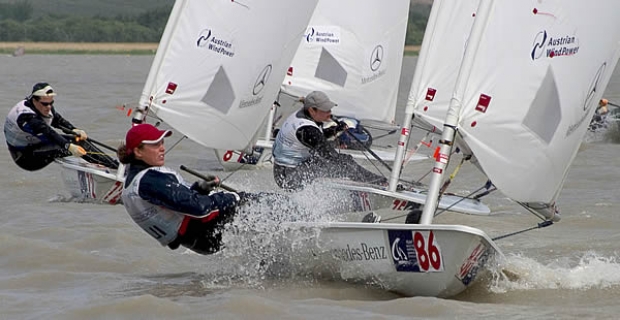
The finals of the World Sailing Games kicks off on Lake Neusiedl in Austria this morning.
This is the fourth time this event has been run as a flag ship of small boat sailing, following on from La Rochelle in 1994, Dubia in 1998 and Marseille in 2002. I have been involved in all four events in various guises and have seen the event from pretty every angle bar the organisation. In 1994 I was working as a supplier with Hyde Sails who supplied the 470 Class. In 1998, I sailed the J/22 with the greatly missed Glyn Charles and the can't be missed, Mark Covell and in 2002 I sailed with Simon Russell (Fumesy), Simon Nearn and Magnus Leask in the J/80. It was a way of relaxing away from the 49er programme I was involved in at the time. We brought back Britain's only medal and, in line with instruction from above, spent most of our evenings hiding form the 'real team' in order that we did not disturb them from their professional focus.
I find myself coaching at this event supporting the Austrian men and womens 470 teams. Both have missed out on the qualifying stages as they are ranked 3rd and 9th in the ISAF rankings and therefore were given automatic entry to the finals as all top 10 ranked boats have been. The double edged sword of this priviledge is clear to see.
ISAF's originally stated intention in 1994, was to simplify and clarify the term 'World Champion', at the same time as gathering together the greatest small boat sailors on the planet to compete on a level playing field. ISAF believed, at that time, that the media could not understand the miriad of classes and various Champions. Equally confusing, apparently was the class names. Exactly what does a 470 World Champion look like? (Skinny, hungry and unhappy for most of the time!) A mens double handed World Champion would be so much easier to promote and sell.
Equally important was that the event would be raced in supplied boats and equipment, eliminating that as part of the equation. This was no problem for the Laser and solved in the 470 Class by Nautivela supplying the boats. However, the other Olympic classes had a bigger challenge. As a consequence ISAF's lofty ambition was unfulfilled as the best Olympic sailors stayed away from the keel boat and catamaran classes and the Europe sailors did not fancy being shown round the bay by regular Laser Radial sailors.
This essentially remains the same in 2006. The event is not fully supported by all National federations and a quick glance down the entry list reveals that many of the top names are missing. "The event is not a focus for us," commented RYA Olympic Manager Stephen Park. "What we want to see is the World Tour take hold and become the focus outside of the Olympic Games. The current World Ranking system is meaningless in real terms, especially when measured against a Premiership league or some other genuine measurement of a seasons form.
“
The disciplines that appear to be pretty much topped up with talent are the Double Handed Men (read 470) the Single Handed Men (read Laser) and the team racing featuring the USA team that won the recent Wilson Trophy and the qualifying British teams. The Laser Radials are the only class to have all of their top 10 ranked sailors competing.
No doubt winning will not be easy in any discipline, the nature of the shifting winds on the lake, the worries about only having limited time to rig and tune your alloted boat and beating half of the best sailors on the planet still provides a remarkable challenge. It just doesn't grab the headlines or the limelight that it was originally intended to do.
Time for a re-think at the top, or should we be re-thinking about the top?
Most Read
Most Commented
Comments
Businesses

Pro businesses
-
United Kingdom
-
France
-
Italy
-
United Kingdom
Editor's choice
Member blogs
-
 Ned Collier Wakefield: MOD70 round BarbadosWell that was intense. 12 hard fought for seconds for the win. In idyllic conditions, Tony Lawsons MOD ...
 -
 Mini Transat leg 2 reportThe second leg of the Mini Transat started on 31st October, just over a month after ...
 -
Leg 1 reportI’ve been working towards the Mini Transat now for three years. In 2013 I was part ...
Business blogs
-
 The Island Sailing Club in Cowes, Isle of Wight, is delighted that Prince Michael of Kent ...
 -
Peta Stuart-Hunt chats with the 25 year-old British solo sailor Lizzy Foreman before she sets sail ...
-
The 2015 Student Yachting World Cup (SYWoC), an ISAF-recognised event hosted and run by students for ...
Editor's Choice
All time favourites...
-
 Three legs down into Ian Walker’s
 -
 Winning all but two races at
 -
 For the first time in its
Latest Comments
Add a comment - Members log in