
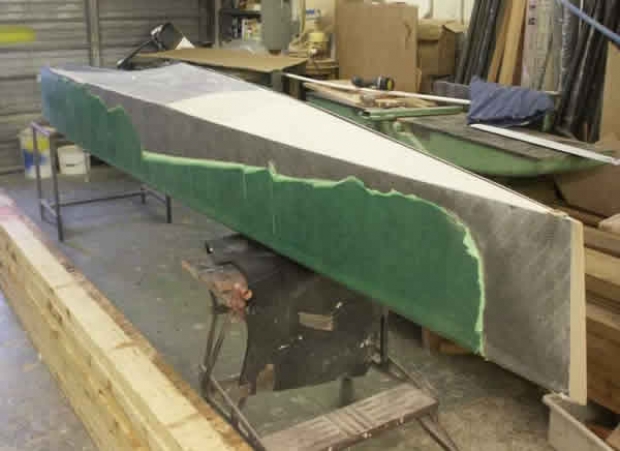
Andy Paterson's new Bloodaxe Canoe takes shape
International Canoes get turboed
Friday March 24th 2006, Author: James Boyd, Location: United Kingdom
While other dinghy development classes are investigating and in some cases employing lifting foils on their appendages, so the International Canoe class are looking at turboing their craft.
The Canoe - double-ended dinghy with sliding seat - divided in two in the late 1990s into what is now known as the AC featuring an asymmetric spinnaker and the original two sail IC which does not. In the UK at least this move has led to dwindling interest in the original IC and to liven things up American IC stalwart and guru Steve Clark at the end of last year proposed some modifications to the class rule. As opposed to adding an asymmetric Clark's proposal instead dramatically improves the efficency of the boat.
Back in 1972 the Canoe's hull shape was locked down effectively to a one design known as the Nethercott hull. Under Clark's proposals the IC's one design hull measurements should again be opened up into a box rule, confining maximum length to 5.2m, but reducing minimum Bmax from just over a metre to 750mm, but most significantly reducing minimum weight from just over 80kg to 50. Also mooted was the possibility of using racks and trapezes, but these don't seem to have found universal acceptance. If you want racks and trapezes buy a 14 or a 49er.
"We are trying to keep the other rules the same for the rest - the rig and the seat," says Canoe technical officiando, Andy Biden. The idea is to allow the IC to maintain its character and identity - hugely long, pointed at both ends and with its characteristic sliding seat.
Clark's proposal seems to have been warmly received for the most part. Existing ICs can be retrofitted with an asymmetric kite turning them into competitive ACs with relative ease, thereby maintaining their value, leaving room for the new generation of turboed ICs on a diet.
Encouragingly prototype versions of the new International Canoe are under way on both sides of the Atlantic in preparation for official class trials. Clark is on the verge of sailing his new IC, Wonk, in Florida, while in Cowes Andy Paterson of Bloodaxe Boats fame has his interpretation in build with a deck soon to be put on.
Paterson is known for his Axeman Moths - he maintains he was the first to try foiling them - and is a living legend in the Cherub class. The former he started in the 1980s. "I was making the Moths taller and narrower and that gave a big speed advantage and all the Moths look that shape now," he says. His Cherub designs - in which he has won the Nationals five out of the last six times - have a similar tall razor-sharp bow. "Going to minimum width and making the sides vertical makes them better for wave piercing," he says.
Conversely Steve Clark's Wonk (below) appears to have little by way of bow.

Paterson says he was inspired by the gauntlet thrown down by Clark. In addition to having a tall narrow bow, the nose on Paterson's Canoe appears to be Dreadnought, with reserve angle. Building down to 50kg from 80kg is also far from a struggle he maintains. "Traditionalists seem to be worried about making it too weak and I am worried about where I am going to put all the corrector weight!"
Like the Moths, construction is in carbon fibre and foam and Paterson believes he could churn a boat out at 40kg. He is also planning to fit a Moth-style, mainsail only, unarig to his new boat, helping to reduce boat weight and cost further.
The new Bloodaxe IC Paterson expects to be on the water in time for Weston Sailing Club's open meeting in June.
While the move to turbo the IC seems to be one in the right direction, obviously such wholescale changes take a while to get incorporated and trials must be carried out to ensure it meets the demands of the class. "It has to be quicker than a new boat but it has also got to be at least as sailable," confirms Andy Biden. "There is no point in having a lightweight flier that is good in a Force 1-3 and no one can stay on top of it. So it has to be a good all-rounder. And hopefully it will come out a bit cheaper..."
Most Read
Most Commented
Comments
Businesses
Pro businesses
-
Netherlands
-
Italy
-
United Kingdom
-
Editor's choice
Member blogs
-
 Ned Collier Wakefield: MOD70 round BarbadosWell that was intense. 12 hard fought for seconds for the win. In idyllic conditions, Tony Lawsons MOD ...
 -
 Mini Transat leg 2 reportThe second leg of the Mini Transat started on 31st October, just over a month after ...
 -
Leg 1 reportI’ve been working towards the Mini Transat now for three years. In 2013 I was part ...
Business blogs
-
 The Island Sailing Club in Cowes, Isle of Wight, is delighted that Prince Michael of Kent ...
 -
Peta Stuart-Hunt chats with the 25 year-old British solo sailor Lizzy Foreman before she sets sail ...
-
The 2015 Student Yachting World Cup (SYWoC), an ISAF-recognised event hosted and run by students for ...
Editor's Choice
All time favourites...
-
 Three legs down into Ian Walker’s
 -
 Winning all but two races at
 -
 For the first time in its
Latest Comments
Add a comment - Members log in