
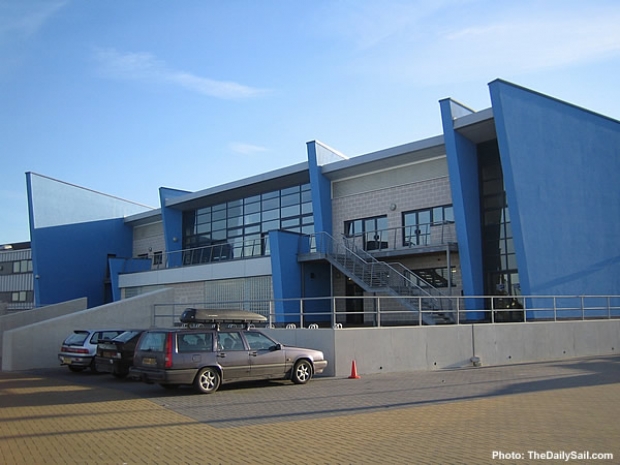
Blue wall thinking
Monday March 13th 2006, Author: Andy Nicholson/Toby Heppell, Location: United Kingdom
Standing tall and with chests out, we could only be at the British Olympic sailing team’s ‘homeground’ at Weymouth and Portland National Sailing Academy. TheDailySail was invited in February down to the effective Wembley Stadium of Skandia Team GBR along with other fellow sailing media colleagues to get an under-the-skin look at proceedings at the home of Britain’s most successful Olympic sport.
WPNSA is not the exclusive domain of the RYA, but it feels like it. The building drips in RYA Olympic speak and its roast beef in the sandwiches. Still, everyone is welcome to the sailing venue for the 2012 Olympic Games.
“If a French 49er sailor came to the academy,” says RYA Olympic Sailing Team Manger Stephen Park, “paid their money for the day they would be free to use all the facilities, there is no way that we – the RYA – could stop them.”
Park is well up on the local movements in the housing market and knows of two other national teams who have visited the Dorset seaside town to look for their own facilities.
This October will see a flood of overseas Olympic talent come into town with the Sail for Gold Regatta from 13-15 October. Initially an ISAF grade two event, the RYA hopes this will become an ISAF grade one event for 2007 and thereafter– a lot like Weymouth Olympic Week for those that remember.
In the last 18 months team GBR have been working hard on their corporate sponsorship programme culminating in the signing of long term savings group Skandia as their first ever title sponsor. The Lottery funding that the team receives, however, still remains their main source of income and it very clear that they rely heavily on this resource.
On the 18 August there will be the first chance for Skandia Team GBR to compete against the rest of the world at the 2008 Olympic sailing venue, Qingdao. This opportunity comes in the form of the first of two Olympic test events. Two representatives from each class will be taken to the event by the RYA with the current exception of the Star class. Only the team of Ian Percy and Steve Mitchel have proved themselves to be of sufficient international standard, however Park does point out that this is only the current situation which may change if someone else proves themselves to be good enough to attend, presumably Andy Beadsworth is being watched for this spot.
This year should also see the return of some names that have been taking time away from Olympic sailing as the team begins to wind up to the Olympics. Perhaps most notable in their absence in the last year have been 470 Olympic silver medallists, Nick Rogers and Joe Glanfield and it will be interesting to see how they fair against Miami OCR winners Nic Asher and Elliot Willis who had a great season last year and seem to be very much in the ascendance.
The training camp that we were invited to was run over a four day stretch and included Transitional Squad, Olympic Development Squad, and a sprinkling of fully made up Team GBR sailors. Over the course of the camp sailors attend a number of training sessions and tutorials combined with on the water exercises. While this is almost daily for the fully professional sailors who are based in the area, it remains an opportunity for the up and coming to spend some ‘quality time’ at Weymouth.
It also brings together many of the key staff in the performance side of the team and we were given time with Pete Cunningham (RYA Physiologist), Peter Bentley (RYA Technical Specialist) and Ben Chell (RYA Sport Psychologist). After which we come away fully impressed about not just what support the sailors get, but also how sailing, as part of the British Olympic Team is on a par, if not higher, than most other sports.

Cunningham, while strapping on heart rate monitors to Yachting World’s Matt Sheahan (above), takes us through the concept of RYA ‘gold standards’ in physiology for each boat and position that the sailor is training for.
For example a 49er helms gold standard would be different to a 49er crew which in turn would be different to a 470 helm. In addition to this the standard is not a fixed set of values and they may occasionally change. Cunningham gave three examples of their gold standard changing: “As it is a new class we are still making the final tweaks to what we think the RS:X gold standard will be. Also the 49er has recently got rid of weight equalisation so their standard has changed slightly. Sometimes an individual will change a gold standard, when Ian Percy started sailing the Star he treated it a lot more like a dinghy so he really pumps downwind which requires a great deal more power in the upper body so now we expect more from a Star helm.”
Physical attainment is high on the RYA’s list of ‘must haves’ for all sailors. Even if you can’t figure out the next shift like Ben Ainslie, there is no reason for you not to be able to hike as hard – otherwise, how are ever going to beat him? It is taken seriously and each sailor on the team signs up to contract, if you miss your training goals three times in a row then it’s a discussion about other career opportunities.
While Sheehan worked on setting a new gold standard in the Journalist class, Cunningham gave some insight into the technology now being used and the levels that the athletes (his word) work to.

There are six heart rate zones of increasing intensity so sailors are measured according to the amount of time they train in each zone. The team do not view anything as an exercise session until the sailor is working at 65% (zone 1) of their maximum heart rate (although each sailor is taken through a series of scientific tests to accurately determine their maximum heart rate a rough rule of thumb to determine your own maximum heart rate is 220 minus you age.)
All exercise data is recorded and sent to the RYA for evaluation, again this sending of information is stipulated in their contract. Although the data for each zone is not available outside of the RYA Cunningham does mention that a 49er crew will regularly have to train at 85 percent of maximum heart rate and an RS:X sailor at 90. The gold standard of all gold standards goes to the RS:X sailors. Nick Dempsey is incredibly fit. He is the only team member that gets to go to Cyprus with the British Cycling Team.
Recent developments in the heart rate monitors have meant that the team are now able to go out on the water and use the equipment via telemetry. This means that Cunningham can go out on the water during training and monitor how hard individuals are working during training sessions.
Through UK Sport, the RYA has developed a close relationship with the GBR Olympic Cycling Squad and the GBR Olympic Rowing Squad in terms of knowledge sharing. These three teams regularly exchange data, ideas and technological advances as well as training with one another.
No more visible is this collaboration than in the embodied of Skandia Team GBR’s new White Van - the domain of Steve Evans – RYA Performance Analyst - and Peter Bentley – RYA Technical Specialist.
Bristling with a roof top satellite dish and a side awning, inside Bentley (a former journalist) was about to get a grilling. The dish is for broadband internet (an altogether cheaper way to support every one on the team while abroad). The White Van will also be a mobile video debrief centre, provide a place to analyse data (exactly what data is top secret) and – presumably - other secret functions.
Bentley says that a very important aspect of what they do is speaking to other sports and comparing ideas. He says that UK Sport is absolutely essential for what they do and that all they have to do is pick up a phone and they have access to whatever data they need. Amongst the other sports that the RYA are working with is the English Rugby squad who according to Bentley lead the field in Performance Analysis (think microchips in shoes). Additionally they have a joint project coming up between themselves, Olympic Canoeing, and Olympic Rowing which is apparently something that none of them could afford to do alone (one would assume it involves water).

Bentley (above) is extremely tight lipped about any specific details, avoiding eye contact with anyone. Along with these partnerships he will not go into any detail on another of the RYA’s relationships with the Scottish Institute of Sport only saying: “The lessons we learnt in their presence for just a few weeks saved us about thee years in development.”
Sailors react to this technology in a very predictable way says Bentley and this reaction is the same in all sports. “First there is excitement when the new equipment first arrives, then there is disappointment when inevitably more work needs to be done on it and the sailors don’t see instant results. From there you get two groups, people that will not bother and people that remain enthusiastic.”

Electronics, carbon fibre...and gaffer tape
Our final specialist of the day was the RYA Sport Psychologist Ben Chell. He later let on that he was somewhat nervous about speaking to a room of us, but to be fair we were equally nervous of his piercing gaze and thoughtfully spoken words.
Something that Chell is currently having a hard look at is the introduction of the Medal Race format and the additional stress that this will bring to the athletes – trying to even out the peaks and the troughs of emotion.
Chell will go out on the water and run ‘stress management sessions’ with the coaches and sailors. “It is impossible to replicate Olympic pressure,” he says, “but we can do as much as possible to make frustrating situations more normal which makes them less stressful for the sailors.”
Interestingly, although he is there to support sailors and help them his actual employer is the RYA, who task him with making their sailors more efficient. This could potentially represent a problem for Chell as the sailor’s personal needs and winning medals do not always go hand in hand. Chell manages the ‘doctor patient’ relationship carefully. All the sailors are aware that he will openly discuss what is said on a regular basis with their coach - but anything said in confidence about personal issues remains private.
Presumably as a sport psychologist Chell must play some part in, perhaps the slightly uglier job, of psyching out the opposition. When asked about this he would not comment on any specifics. “I can tell you that it is something we do, but I am not sure it would be wise for me to go into any specific details,” he comments.
British Olympic sailing has without question become a fully professional sport. Drawing comparisons to the team say from 10 years ago is the equivalent of an FA Cup fourth round tie between Canvey Island and Portsmouth FC – four football leagues separate them.
Looking in, it is easy to say that all of this is achievable with large amounts of cash. However that is unfair. Money has been hard fought for, carefully spent and it has been ‘well invested’. Those investments delivered medals and that is the currency of Olympic sport.
One gets the distinct impression that the RYA a pretty much there when it comes to writing the book about ‘how to win medals’. Looking at the recent success and the strength of the current team Park agrees that Team GBR are definitely going through a “golden patch.”
A lot of focus for the team is on meeting the ‘gold standards’ in each class, really before you even pick up a tiller extension and head onto the water. For the younger sailors this is a daunting task. Many of the sailors could be waiting in the wings and never get the chance to step up to the Olympic stage simply because their more well known team mate remains ahead of them. Does this system then stifle creativity?
The RYA goal for the Beijing Olympics is stated as 30% of the available medals, the same as it was in Athens. “These goals are what part of our funding from UK Sport is based on,” comments Park. “We could make a higher estimate and get more money but then if we did not meet those goals we would lose a lot of money for the next Olympic cycle. We think 30% is a realistic, achievable goal.”
Come London 2012 however, one would imagine this medal tally goal to be set higher. With six years still to go WPNSA already feels like an RYA fortress – a significant advantage that will come with the increased pressure of not only being the top sailing nation, but also the most successful British Olympic sport competing on home waters.
Most Read
Most Commented
Comments
Businesses

Pro businesses
-
Netherlands
-
United Kingdom
-
Italy
-
Editor's choice
Member blogs
-
 Ned Collier Wakefield: MOD70 round BarbadosWell that was intense. 12 hard fought for seconds for the win. In idyllic conditions, Tony Lawsons MOD ...
 -
 Mini Transat leg 2 reportThe second leg of the Mini Transat started on 31st October, just over a month after ...
 -
Leg 1 reportI’ve been working towards the Mini Transat now for three years. In 2013 I was part ...
Business blogs
-
 The Island Sailing Club in Cowes, Isle of Wight, is delighted that Prince Michael of Kent ...
 -
Peta Stuart-Hunt chats with the 25 year-old British solo sailor Lizzy Foreman before she sets sail ...
-
The 2015 Student Yachting World Cup (SYWoC), an ISAF-recognised event hosted and run by students for ...
Editor's Choice
All time favourites...
-
 Three legs down into Ian Walker’s
 -
 Winning all but two races at
 -
 For the first time in its
Latest Comments
Add a comment - Members log in