
Merlin Rockets
Tuesday February 28th 2006, Author: Toby Heppell, Location: United Kingdom
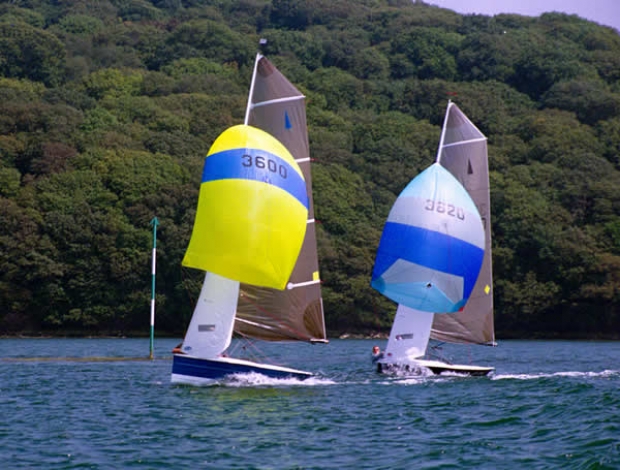
The Merlin Rocket is well know for being one of the UK’s biggest development classes but with fibreglass boats now making up the majority of new boats built, is the class still developing?
Dave Winder, who’s company Winder Boats have been building Merlin Rockets since 1976, maintains that although hull shape is critical the Merlin is really quite stable now design-wise, with only small differences between hulls. Winder bought their original mould from Ovington Boats. This was originally John Turner’s mould for a boat that he designed with Ian Holt called Canterbury Tales many years ago. This had a good basic shape to start with but was slightly tweaked by Winder.
“You have to make sure that everything is in the right place: the two most position critical things are the mast position and the centre plate case position,” says Winder. “Then obviously you have to make sure that the whole boat is stiff and light.”
The major changes to the Merlin in recent years have been more to do with the introduction of new materials. For example Winder Merlin Rockets are made from epoxy foam sandwich, vacuum bagged and baked in an oven. They use carbon fibre in the decks and in some of the internal mouldings. “The rules don’t allow us to use it in the hull itself but we can use it in other areas where we need to,” says Winder.
Graham Williamson, UK Merlin Rocket Class Chairman, attributes the small amount of hull development over recent years to pass exploration into the extremes of width and shape. “We know what does not work and we are now down to small modifications of a few millimetres here and there which really does not change anything fundamentally. You only have to go to an event to see that some of the boats on the water are seven, eight or nine years old are still reasonably competitive and are almost as quick as the newer fibreglass ones.”
What hull shape modifications there have been over recent years are limited to glass hulls, states Williamson: “People are flattening the rocker here and there and trying to drop the bow or the transom a little bit. There is also a little bit of experimentation with the centreboard position, but really the differences are less than the tolerances on a new Enterprise or any of the home-built one designs. At this stage it is very much all down to personal preference: you get people that are doing something radical but what we now call ‘radical’ is to everyone else ‘not very noticeable’.”
Looking back, the number of different Merlin Rocket designs over the years has been vast, but today it is still the 1980s designs performing best at the very top end of the class. Williamson explains this is partly due to the immense success of models from one or two particular designers who have dominated Merlin Rocket thinking for the past 20 years or so. The designs of Phil Morrison were immensely successful and dominated results sheets from 1972 until 1988 winning all the National Championships through this period unchallenged. Literally hundreds of boats have been built to his designs and his NSM2 and NSM4 models are the back-bone of the modern class and form the base for most boats around today, although many feature small, subtle differences. “The NSM2 and NSM4 designs are still both very popular, especially with the heavyweight crews,” continues Williamson. “They both have very full sections under the mast and in the bilge near the stern to carry more weight. The NSM4 is quite similar to the NSM2 but it is flatter, quicker to plane and very wide to give extra power. As such it requires a slightly lighter sailor. The design is basically an NSM2 flared out above the waterline, with slightly flatter forward underwater sections.”
In recent years designs by Ian Holt have seen a slight upturn in popularity but numbers are small compared to the Morrisons. Ian Holt’s Merlin Rocket designs, such as the Canterbury Tales model Winder builds, were very radical when they first came out partly due to Holt’s design philosophy. “Ian Holt looked at the Merlin Rocket from an entirely new perspective - he did not want to start from someone else’s design he wanted to start from scratch by himself,” explains ex-Holt co-worker Gavin Willis, himself now one of the most extreme National 12 designers. Due to Holt’s radical approach, when his first boats came out they were not well received and it was only when he came up with his fourth design that he got a boat commissioned. However these days the Canterbury Tales and the Riders on the Storm designs are both widely used at the top end of the fleet for lightweight teams and heavyweight teams respectively.
 While there may have been little change in hull design over recent years, there have been other changes within the class. The biggest to come to the Merlin Rocket in recent years is - predictably - the change to carbon masts. “We have been experimenting with carbon rigs over the last seven or so years, since they became more popular,” explains Williamson. The class has principally two suppliers: Super Spar (left) and Chipstow. “The Super Spar is pretty bullet proof and not too expensive but is relatively heavy as carbon spars go. The guys with real ambition and who want to win big events are all going for the hand-built Chipstow mast. These are really very, very light - they weigh about 3.6kg for the bare tube.”
New carbon spars are a fraction of the weight compared to old aluminium M3 or M1 masts. Overall the weight of a modern rig is roughly 50% lighter than an equivalent rig ten years ago. “This makes a huge difference when you are sailing in waves or a bit of a chop,” says Williamson. In addition there is still a fair amount of experimentation into mast bend/mainsail characteristics.
Sails in the Merlin Rocket class have undergone change in recent years but this has only been in reaction to the change to carbon masts. Beyond that there has been little change aside from the small tweaks sailmakers are constantly introducing.
With an off-the-shelf glass hull based on a 15-20 year old design and a reasonably standardised rig, the class has moved on from the old days when it was full of people building boats or having new ideas to adapt rigs. We put it to Winder that the class seems to have lost a lot of its back garden tinkering sailors. “I do know that some people, like Pat Blake, are always playing around with their mast, particularly changing the lay-up of the carbon masts to alter bend characteristics,” he comments. “That option is there, but to be honest the majority of the fleet just plug for the standard set-up and use that. The die hard Merlin sailor who likes developing and tinkering all the time is really being fazed out of the fleet. As a class we are attracting people into it because it is quite stable in terms of rig development and hull development. Obviously if you spend £1,600 on a mast you do not want it to be obsolete a few months down the line.”
The more you examine the Merlin Rocket class today, the more obvious it becomes how little development is currently underway in the class. There often seems to be someone tinkering with some aspect of the boat, but with little success. Williamson cites this example: “While we have managed to keep the foils pretty standard, actually David [Winder] has been experimenting with board size, particularly lower aspect ratio ones. I think for the lighter guys in a bit of chop there could be a bit of an advantage there but it has not yet proved to be groundbreaking. Some days Dave will put it in and say ‘that is great’ but other days he will say ‘I couldn’t point anywhere near the others’. You only have to change the angle of the board by two or three degrees and that will significantly change the exposed surface area: it is all relatively minor tweaking at the fringes as opposed to anything really significant.”
So with the class going through few major changes at the moment what sort of development does the future hold for the Merlin Rocket? Williamson gives his view: “Our policy as a committee has been to try and eliminate major changes for a period of time so that people who are buying a new boat will get one that is competitive for a number of years. A prime consideration is to make sure people know if they have a six or seven year old boat they can still be competitive while if someone gets a 15 year old boat they can still be competitive at club level. I think that will continue for the next couple of years, but that is not to say that we do not have ideas for things we want to change, it’s just that those changes will come fairly slowly. You only have to look at our class website to see there is a sizeable proportion of the class wishing to see weight reduction bearing in mind the amount of weight the new boat is carrying around. But it is not on the agenda to go ahead with this because there are still a number of very competitive boats not carrying around extra lead.”
However, a few ideas are being experimented with. Winder described some of the ideas he has had: “Because the top batten on the Merlin is very important we have done some development work on making it more adjustable. This should give us more control of the way the sail opens up in gusts. We have been messing with this over the last couple of years but we have not actually found the time to go very far with it. That is something that I would like to spend a bit of time on over the winter. The other thing I would like to do, with this flexible mast not being particularly controllable, is to try an adjustable spreader system led into the boat so that I can alter bend characteristics through the spreaders. At the moment we don’t really play with the spreaders all that much. They are the only real developments that we are doing.”
 As ever in development classes there remains disagreement on what is the right course of action when it comes to the spreaders. “With the spreaders what is more important is to keep the geometry consistent when you rake the rig,” Williamson maintains. “Because we have very adjustable rig settings you only have to change you rake by an inch or so to affect your spreader settings quite significantly. So that has more or less taken away the need to be millimetre perfect on the spreader settings. Also the boats are beginning to be full of rope, I don't think that leading anymore controlls into the boat is a good idea.”
Sailors seem to be reacting very positively to this slowed development period with the class showing very impressive growth. This year’s week-long UK National Championship saw 76 boats turning out at Hayling Island SC. “From a builder’s point of view the class really seems to be going from strength to strength,” concludes Winder. “In 2005 we built close to twice as many boats as we did in 2004 and we already have ten more orders this year.”
Williamson succinctly sums up the state of the class: “We get a lot of focus on us because we are a development class and people think that there is always a change waiting in the wings but in fact we are as standard as many of the one design classes.”
At present it seems the average modern Merlin Rocket sailor wants little change. The committee have noticed this and reacted by clamping down on current designs and rules. In many ways this is disappointing because the reason the Merlin Rocket is such a nice boat and is still around after all these years is exactly because of its ability to adapt and evolve. Having said this, 76 boats at a National Championship is a very impressive number particularly these days with so many more classes and smaller fleets as a result. Perhaps slowing the boat’s evolution down to a virtual standstill is a good idea, because if people in the future start to lose interest in the boat the class can always open up the development floodgates again.
Most Read
Most Commented
Comments
Businesses

Pro businesses
-
Italy
-
United Kingdom
-
Italy
-
Editor's choice
Member blogs
-
 Ned Collier Wakefield: MOD70 round BarbadosWell that was intense. 12 hard fought for seconds for the win. In idyllic conditions, Tony Lawsons MOD ...
 -
 Mini Transat leg 2 reportThe second leg of the Mini Transat started on 31st October, just over a month after ...
 -
Leg 1 reportI’ve been working towards the Mini Transat now for three years. In 2013 I was part ...
Business blogs
-
 The Island Sailing Club in Cowes, Isle of Wight, is delighted that Prince Michael of Kent ...
 -
Peta Stuart-Hunt chats with the 25 year-old British solo sailor Lizzy Foreman before she sets sail ...
-
The 2015 Student Yachting World Cup (SYWoC), an ISAF-recognised event hosted and run by students for ...
Editor's Choice
All time favourites...
-
 Three legs down into Ian Walker’s
 -
 Winning all but two races at
 -
 For the first time in its
Latest Comments
Add a comment - Members log in