
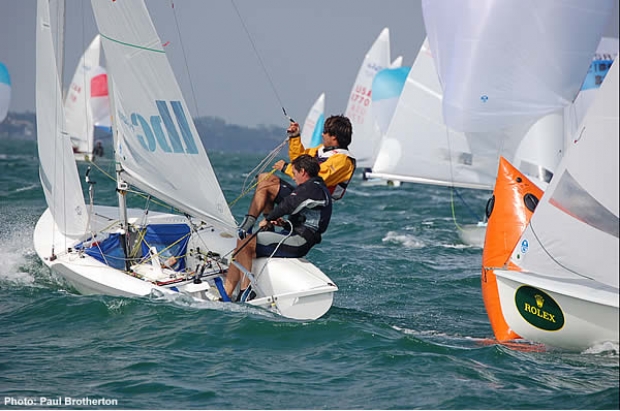
Fantastic venue
Thursday January 26th 2006, Author: Paul Brotherton, Location: United Kingdom
25 degrees, 15 knots of wind and flat water is a tempting prospect for many small boat sailors in January. European based training and sailing is a hit and miss affair over the winter. Days populated with no wind and freezing temperatures follow days with mild temperatures and possible 30-knot squalls. It is not a surprise to see some of the top European Teams come to compete in the Miami OCR.
However, with the exception of the Star, the Miami OCR does not enjoy the Class sizes that the European based ISAF Grade 1 events do. Which is a shame. The staple diet of Palma, Hyeres, Spa and Kiel does little to show sailing off at its best. A good week one year in Palma is followed the next year by no wind.
Normally Hyeres is blighted by the mistral and even catching up on boat work is impossible, as your toolbox has been blown down the dinghy park. Spa and Kiel, well, sorry, for me, they just mean rain.
Of course there is just the mild threat of a hurricane in Florida but to my memory no OCR week has been lost to one. That said, the evidence of Katrina is clear to see, 20 or 30 beached keel and motor boats, some beached, some parked, as in, they actually got blown to the middle of the park.
It seems the major reason for avoiding Miami is cost. But, as any seasoned campaigner will tell you the true cost is time. In my week so far with my team, we have sailed every day and have been productive for every hour from eight till five. That’s good solid eight-hour days of training, (we do stop for an hour at lunch for those that are counting their fingers.)
Compare a week of that to the experience last year of some teams who shipped boats off to Palma for January and February. A big high pressure sat in the Atlantic and the whole of Spain was treated to icy Northerlies for the best part of eight weeks. Sailing at all was nearly impossible and the time frame for being effective reduced to no more than two hours of sailing time.
Yes it would have been less expensive financially than coming to Miami but the cost per hour or cost per gain would stack well for Miami.
If you can find someone prepared to house you for the time you are in Florida the cost base reduces enormously. Medals are a good currency as is the Queens English. I am staying in a hotel, not sure what that says?
Once on the water all the effort is worth it. When the breeze is from the South and West the wind is stable and makes for great tuning. When the wind is from the North and East the wind is shifty and unpredictable which makes for great race training. Furthermore the OCR regatta itself is well organized, with experienced race teams who take pride in doing a good job.
Day threes racing was held in a shifty but pleasantly warm Northerly. In spite of the unpredictable nature of the shifts and the seemingly random pressure increases the leader boards have stayed pretty consistent. From my coaching perspective this helps to highlight that even on the days when success seems based on nothing more than good fortune, it’s the hard working, best boat handlers who can stay fluid when it doesn't go their way that always end up better than average and often increase their leads.
My theory will be tested over the remainder of the regatta, as the wind is forecast to stay from the North, a North wind that still allows you to feel your fingers at the end of a long day in January

Most Read
Most Commented
Comments
Businesses

Pro businesses
-
-
Netherlands
-
United Kingdom
-
Editor's choice
Member blogs
-
 Ned Collier Wakefield: MOD70 round BarbadosWell that was intense. 12 hard fought for seconds for the win. In idyllic conditions, Tony Lawsons MOD ...
 -
 Mini Transat leg 2 reportThe second leg of the Mini Transat started on 31st October, just over a month after ...
 -
Leg 1 reportI’ve been working towards the Mini Transat now for three years. In 2013 I was part ...
Business blogs
-
 The Island Sailing Club in Cowes, Isle of Wight, is delighted that Prince Michael of Kent ...
 -
Peta Stuart-Hunt chats with the 25 year-old British solo sailor Lizzy Foreman before she sets sail ...
-
The 2015 Student Yachting World Cup (SYWoC), an ISAF-recognised event hosted and run by students for ...
Editor's Choice
All time favourites...
-
 Three legs down into Ian Walker’s
 -
 Winning all but two races at
 -
 For the first time in its
Latest Comments
Add a comment - Members log in