
From monohull to multihull
Wednesday November 23rd 2005, Author: James Boyd, Location: none selected
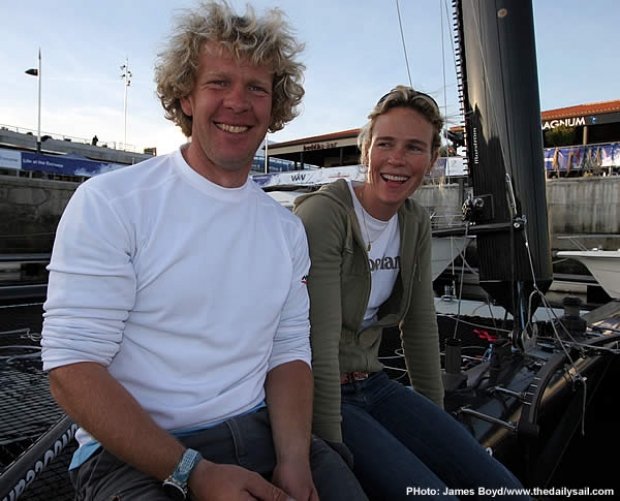
One of the most interesting partnerships in Olympic sailing at present is that of Sebastien Godefroid and Carolijn Brouwer, the only mixed crew with Olympic pretentions actively campaigning a Tornado.
The couple, who are best described as continental Europe's answer to the McDonalds - Godefroid even has the same curly blond crop as Neal, both have enviable sailing records. Brouwer, 32, was a well known Europe campaigner, who when she stepped out of the Laser Radial into the women's Olympic singlehanded in 1996 was all but unbeatable in her first season winning SPA, Hyeres as well as the World Championships. She followed this up with another Worlds win in the Europe in 1998 and won ISAF Sailor of the Year in 1998. Oddly she ended up representing the Netherlands in the 470 in Sydney where she finished 13th. For Athens she again returned to the Europe being a regular top placer in the class, but finishing a disappointing 19th. In the middle of her last Olympic campaign she took time out to be part of Lisa McDonald's Amer Sport Too crew in the last Volvo Ocean Race.
Godefroid's name is even more closely association with the Finn which he has campaigned over the last three Olympic cycles, winning silver in Atlanta in 1996, the Europeans in 1998 and being the last sailor to win the Finn Gold Cup (in 2001) prior to Ben Ainslie moving in to dominate the class. Like his other half, Godefroid has also had experience of big boats having been crew on Jean-Luc Nelias's ORMA 60 trimaran Belgacom.
Brouwer and Godefroid have now been sailing the Tornado for almost a year having only had their first taste of small cat sailing a year ago at the glamorous Aruba Heineken Catamaran Regatta. Becoming hooked on the cat format caused them to move into the Tornado for last year's Palamos Christmas Race.
"We are rookies in the business," admits Brouwer. "But it is so much fun and so exciting, especially after Athens. Neither of us had a particularly good result there but my result was even worse and I said either I quit sailing for a year and do something completely different or I will sail, but I want to do something completely different. And before you know it this cat sailing came up..."
Their results in the Tornado have been lacklustre this year compared to what both these seasoned Olympic veterans are used to - including a 25th at the Europeans, a 28th at the Worlds in La Rochelle and a seventh at Kiel Week. However Brouwer says this is understandable given it is their first season in a very different boat. "The basics are the same, sailing-wise, but the rest...it is like you have to learn how to sail again...going from one hull to two hulls, to singlehanded to doublehanded and hiking to trapezing."
Despite having sailed the somewhat larger and faster Belgacom, the F18 a year ago in Aruba was the first occasion Godefroid had stepped into a beach cat. "Quite an important difference is the apparent wind," says the Belgium after some brief contemplation. "We seem to struggle in the light to medium. I think that is because when it is too windy it is like a monohull - when you have got too much power you just ease, you try to keep as much as you can handle. But with the light to medium sometimes you have got to go for apparent wind and go lower than you really want to go just to get that apparent and then just sailing normally again. And that is something you don’t have in a monohull, at least in the monohulls we were sailing. So it is obvious we were struggling with that - to know when you have to go for the good angles and when to go for the good speed. That is very difficult for us to get it right and that is where we are losing a lot at this stage."
On the cat Brouwer helms while the Finn sailor-sized Godefroid obviously crews. "We wouldn’t be able to do it the other way round," says Brouwer. "In the Formula 18s you see a lot of the guys helming and the girls crewing. But I wouldn’t be able to do the crew job on a Tornado - it is too physical. And I am quite a light helm compared to the other guys so I can have a little heavier crew..."
One regular criticism of the Tornado and cat racing in general is that it is not as competitive simply because manoeuvres are usually a lot more costly than they are in a monohull. Brouwer refutes this. "Obviously you cannot tack on every five degree wind shift so your playing field is a lot different. A lot of people say there is no tactics to cat sailing, it is boring because you just go one side and that is it, but it is actually quite tactical - it is just different and that is one of the things we have to get used to. Sometimes we tack or we gybe too much. You have to know that in a certain breeze it costs too much to tack or gybe, so you have got to base your tactics and your strategy on that."
"I think you have got to look much more forward in a cat," says her crew. "In the Finn for example you want to go to the right - fine, you take off to the right, if you’re not completely sure you make a little tack and you reposition yourself. Whereas in the Tornado you have really got to look forward and say 'I am going to the right' and if you see there that it is wrong, you have got to be really sure it is wrong to go to the left otherwise you just say 'at this stage it is wrong, but if I tack now I will lose anyway and it might come good if I continue'. So you just have to look much more forward.
"There are so many possibilities in between in a monohull that as soon as you don’t get it completely right you just do something else and try again, whereas once you make a choice in a Tornado, it is quite definite. You have got to stick with it or have a really good reason to go against it. And you realise that tacks are really expensive, but on the other hand when it is really shifty sailing against the shift is also very expensive, so then you have got to know whether the shift is worth going for it or not and it is really difficult to figure out when to tack when not and got to go for a corner."
The speed of the Tornado, compared to the Finn and Europe, has also been something of an eye opener. This is obviously the principle attraction of the catamaran. Godefroid continues: "When you come at a gate at the downwind mark with the genniker on we are doing 20-25 knots and you are coming in at an angle or 90 degrees and there are just boats everywhere. In the beginning we were just so overwhelmed that at every the downwind mark or gate we were losing heaps because we were trying to avoid one boat and in the meantime got in the way of another one. So you have to get used to making quick decisions and right decisions."
Downwind the sailing is also more tactical as you are gybing and having to sail bigger angles says Brouwer.
The two-hulled format has also taken some getting used to. On the one hand it is stable platform, but this greatly reduces the effect of dynamic crew weight movement. "You cannot pump your boat," says Brouwer. "You have got your sails and your rudders and you have to sit still. You do weight displacement - forward, back, in, out - but it is not like you can pump the boat or rock the boat like a 49er..."
"Not that we ever pump or rock the boat of course, because that's illegal!" wades in Godefroid. "Anyway if you get stuck in a monohull with no wind there is a way out of there, but if you get stuck in a multihull with no wind, there is absolutely nothing you can do other than wait and look around and maybe try to get it pointing in the right direction, but it is basically impossible to go anywhere when there is no wind. In a Laser you tack two times and off you go."
For Brouwer and Godefroid the move into the Tornado and cats generally is bold move as within the monohull Olympic fraternity they are considered out on a limb, like the sailboarders. "Before, to be honest, I didn’t have a clue about what was happening in the cat world," admits Godefroid. "The cat world seemed to be out of normal competition sailing and I think it still is. It was a beach world. They live on the beach and they have their own little funny games and it wasn’t really part of high competition sailing."
Brouwer agrees: "We always used to call them the beach boys."
Now they are part of the flipflop-wearing beach community they are seeing that getting a good result in this type of racing is in fact pretty tough. "The competition is rising in the Formula 18 and in the Tornado I think it has always been pretty high," says Godefroid. "The problem with the Tornado is that if you sail a Laser, once somebody gets really good there is a chance they go through to the Finn and then after they go through to the Star. But in the Tornado if you look at the top guys they are all in there for 15-25 years."
Mitch Booth, for example, has been campaigning a Tornado for 30 years... "And they don't leave because there’s nothing else after it and it is a fun boat and you can survive pretty well even if physically you are not in top shape," Godefroid continues. "So even if you get older there is no reason to stop - it stays a fun boat and experience is really important, so they all stay in there and it is really hard for young people to get in there and make a breakthrough."
At present the duo have French Tornado virtuoso Yves Loday as their crew and this week are training in Marseille. One issue of their Olympic campaign they will have to deal with is the fact that Brouwer is Dutch while Godefroid is Belgium. With 'Dutch' duo Mitch Booth and Herbert Dercksen planning on yet another Olympic campaign, Brouwer is understandably trying to get a Belgium passport.
But this is not all... tomorrow Brouwer and Godefroid talk about the Volvo Extreme 40 class, they are also sailing...read part two of this interview here
Most Read
Most Commented
Comments
Businesses


Pro businesses
Editor's choice
Member blogs
-
 Ned Collier Wakefield: MOD70 round BarbadosWell that was intense. 12 hard fought for seconds for the win. In idyllic conditions, Tony Lawsons MOD ...
 -
 Mini Transat leg 2 reportThe second leg of the Mini Transat started on 31st October, just over a month after ...
 -
Leg 1 reportI’ve been working towards the Mini Transat now for three years. In 2013 I was part ...
Business blogs
-
 The Island Sailing Club in Cowes, Isle of Wight, is delighted that Prince Michael of Kent ...
 -
Peta Stuart-Hunt chats with the 25 year-old British solo sailor Lizzy Foreman before she sets sail ...
-
The 2015 Student Yachting World Cup (SYWoC), an ISAF-recognised event hosted and run by students for ...
Editor's Choice
All time favourites...
-
 Three legs down into Ian Walker’s
 -
 Winning all but two races at
 -
 For the first time in its
Latest Comments
Add a comment - Members log in