
Winning over the IOC
Wednesday July 6th 2005, Author: James Boyd, Location: United Kingdom
1246 BST today will see the announcement of the successful venue for the 2012 Olympics. Yesterday afternoon bookmakers Ladbrokes had the odds for Paris 4:9 while London was trailing at 9:4, followed by Madrid - a late riser - at 7:1.
The outcome of this announcement will have huge bearing on the future of sailing in whichever nation succeeds. "I think it would open up a huge range of opportunities right across the board for recreational competitive sailing," agrees John Derbyshire, the RYA's Racing Manager, of the prospects of the UK bid coming out on top. "We'd be looking to introduce an Olympic classes regatta in the UK in the lead up to the test events that we'd want to run in 2010 and 2011 before the Games in 2012. We'd really want to develop expertese among race officials, young sailors, sailors of all ages really to try and grow the sport. We think the whole sport will benefit from having the Games here. We're just rolling out the on-board program which aims at getting 50,000 youngesters into the sport to have a taster and we would hope to retain a significant percentage of those, and any high profile initiative like the Games is going to encourage more people to take up sailing."
As the US and Spanish sailing teams proved at Barcelona and Savannah, hosting the Olympic sailing can certainly benefit the medal prospects of the home sailing team. There are other benefits too, says Derbyshire: "It would certainly mean you don't have to spend as much money to go training around the world when the venue you want to go sailing in is on your doorstep. That means you can redistribute significant amounts of your funding. You have still got to go abroad to World and European championships to test yourself against the best of the rest."
It should also raise the standard of the home team. "I think you'll find most sailors believe that winning a medal on home soil is something that they'd really really like to do because they know that their profile and the significance of it to their family and friends is much greater."
This is not only true of Team GBR's present talented crop of Olympic sailors. Winning an Olympic bid now will provide a great incentive for up-and-coming sailors. Those in their late teens would really have something to shoot for. "It is only seven years away, so for people who are only 19 it is not outside of the realms possibility that they will be there," says Derbyshire. "Even today's Oppie sailors, if you look at the Saxton boys, they are 15 this year and in seven years time they will be older than Ben was when he won his first medal."
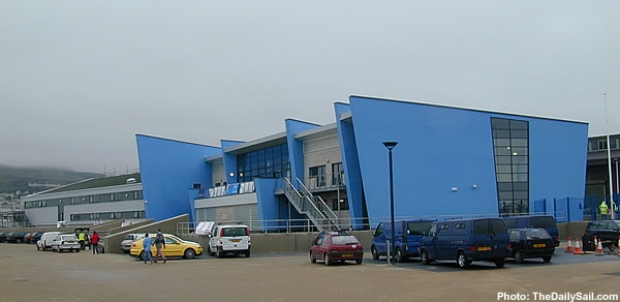
If the British bid proves successful then the Olympic sailing event will of course be staged at an enlarged version of the new Weymouth and Portland Sailing Academy. The recent Lottery-funded development at the Academy has been carried out with a view to it becoming a possible Olympic sailing venue, meeting the requirements laid down in a 'venue specification document' ISAF send out to prospective Olympic sailing venues.
Looking back at past Olympic sailing venues, the WPSA facility differs in it being purpose-built for the job. "The venues are most of the time constructed with an eye on post-Olympic use," says Jerome Pels, ISAF's Director of Sailing. "If you look at Athens, the problem was the venue was far too big, because they wanted a marina to hold 1,000 yachts. The scale of that was not part of our requirements, whereas if you look at the Sydney venue it was very very small - just 200m wide and 800m wide."
“There isn’t any doubt that this is the best sailing place," Craig Reedie, Chairman of the British Olympic Association told thedailysail.com. “The evaluation committee did not visit Weymouth but one of the committee members is the (ex) President of ISAF. I actually showed him a copy of the Weymouth video done by the students while traveling on the bus in London visiting some sites. He was sitting next to Shirley Robertson and Paul [Henderson] is perfectly well aware of the qualities of Weymouth Bay. It is not an issue.
“Then the real plus was that two days after the Evalution Commission report was announced, we officially opened a centre like this [WPSA]. And in that are there a two huge pluses - we have the best sailing team in the world bar none, and the sailors deserve a place like this and to have a set up like this which can be used as a base for an Olympic Regatta...we are ringing all the right bells."
Being able to set up four or five 1.5 mile diameter courses ideally in less than 50m of water off the coast is relatively straightforward and that is the easy part. Shoreside facilities must cater for 400 competitors, 280 assorted dinghies and keelboats, plus around 2,000 extra personnel including a large number handling security, 50 ISAF officials (judges, measurers, race officers), around 200-300 other on-the-water personnel in around 100 motor boats and RIBs. The venue needs not only to be able to house these kind of numbers comfortably, but must have suitable launch facilities in terms of ramps and cranes, plus showers and dressing rooms and catering to service those involved. Then there are additional and larger groups such as the media, the host broadcaster who have their own demands for shoreside space.
"In fact the venue needs to hold double the number of competitors because during the test events sometimes we sail with more competitors," says Jerome Pels.
While ISAF have their document outlining the vital statistics and quality of the venue it is down to those who run the venue, the national authority and the bid team to work out how their specific venue should be developed to cater for the Olympic sailing event. In the case of Weymouth, the Weymouth & Portland Sailing Academy worked alongside the RYA and the British Olympic Association and the UK's London 2012 team.
John Derbyshire describes some of the changes at the WPSA were the London bid successful: "There are two ramps scheduled to be there, one at either side of the venue. If we win the Games bid, the whole of the bit in the middle will become an additional temporary launching ramp, so there would be something like 500m of launching ramp, so you can launch your boat at any time without ever having to wait for anyone else. Leave your trolley at the high water mark and it will be there when you come back."
If the Olympic sailing event comes the WPSA, its site has the ability to expand into Osprey Quay, where RNAS Portland, a former centre of naval helicopter operation, was situated up until 1999. "We have to work with the Region Development Agency who own the land, to make sure there is provision built in whereby anyone who acquires some land whether it is the marina or whatever, they are required to vacate for the period of the games and a period either side of it."
The Weymouth site will be bigger than Sydney but smaller than Athens. "It will not be like the venues in Korea or Athens which were just enormous," says Derbyshire. "What you see right there right now is pretty much the venue. What will happen is that security and catering will significantly overlay on that. Accommodation will be provided by two cruise liners - one for the officials and one for the competitors - that will be moored towards Portland Island. And I imagine there will be restricted access to the island of Portland along Chisel Beach and a secure channel from the cruise ships to allow the athletes to walk or cycle to the venue."
The WPSA is purpose-built for the job of hosting Olympic sailing - and this cannot be said of other recent Olympic venues. "Some of the venues were ideal for marinas, but not purpose-built for an Olympic venue," says Derbyshire. "And then you get the other extreme such as Rushcutters Bay which left no legacy. It was just a park before we started, they knocked a bricks out and made some ramps but at the end of it put it all back and a few years later no one would know the Games had ever been there. That seems a pity. So I think our is a modest site and it is appropriate to the needs of the sport as an Olympic sport and also as a nation going forwards."
So if London and Paris are the two most likely contenders to win the 2012 bid, how does Derbyshire think the Weymouth and La Rochelle sailing facilities stack up against one another?
"La Rochelle is a venue we know well," he says. "The Tornados have just held their Worlds there and we had the ISAF World Sailing Games there about eight years or so ago - and that was in mid-summer. The challenge will be to get decent sailing winds if we get a high pressure situation, because there can be strong currents and very little wind. It is that much further south so it can get quite windless in the middle of the day. But the shoreside facilities - it is a big area, the site already exists and it has plenty of land around it to allow the Olympic overlay. From the point of view of our sailors access from Southampton airport to La Rochelle is very good so it would be very easy to set up a training venue - in travel time it doesn't take much longer to go to La Rochelle from Southampton than it does to Weymouth."
And who will be the successful bid? "I think people are genuinely saying it is too close to call because it is too close to close. You have got to think that having a history of bidding before, which Paris has is an advantage. They will be better known to the IOC members, but on the other hand the head of their bid team is in Paris because he has a court case against him. So it is very hard to read. I suppose when you are involved in sport it is hard to understand how IOC members haven't been thoroughly briefed and why some can still be persuaded. You would have thought they would have looked at the bids and the documents and been lobbied up til now and would have a pretty firm idea of where they would prefer to go. But that is human nature I guess and that is what makes it exciting.
"I think we have a really good chance. For me the one difference is - people say ''we last held the games in 1948 and Paris held them before that.' The difference is that we didn't bid to hold the Games in 1948 - we were asked because it was post-War. So we've never bid to hold the Games. And Paris have done and for me that is quite important because I like to think a lot of the IOC people are quite historical about it - making the Games work around the world.
Craig Reedie adds: “La Rochelle is further away from Paris than Weymouth is from London. All I have seen is the plans, I haven’t been to La Rochelle, but I am sure their plans are perfectly competent. But this is better sailing and certainly the land facilities are fabulous."
But Derbyshire has the last word: "I think this is a real one-off window of opportunity because I don't believe the site in northeast London will survive for a second bid. I think developers will build on it and if it doesn't happen this time - it won't be in our lifetime. So keep your fingers crossed."
See our interview with London 2012 CEO Keith Mills - here
To see the layout of the La Rochelle venue - click here
Most Read
Most Commented
Comments
Businesses


Pro businesses
-
France
-
France
-
-
United Kingdom
Editor's choice
Member blogs
-
 Ned Collier Wakefield: MOD70 round BarbadosWell that was intense. 12 hard fought for seconds for the win. In idyllic conditions, Tony Lawsons MOD ...
 -
 Mini Transat leg 2 reportThe second leg of the Mini Transat started on 31st October, just over a month after ...
 -
Leg 1 reportI’ve been working towards the Mini Transat now for three years. In 2013 I was part ...
Business blogs
-
 The Island Sailing Club in Cowes, Isle of Wight, is delighted that Prince Michael of Kent ...
 -
Peta Stuart-Hunt chats with the 25 year-old British solo sailor Lizzy Foreman before she sets sail ...
-
The 2015 Student Yachting World Cup (SYWoC), an ISAF-recognised event hosted and run by students for ...
Editor's Choice
All time favourites...
-
 Three legs down into Ian Walker’s
 -
 Winning all but two races at
 -
 For the first time in its
Latest Comments
Add a comment - Members log in