
More grand finale gripes
Thursday August 18th 2005, Author: Toby Heppell, Location: none selected
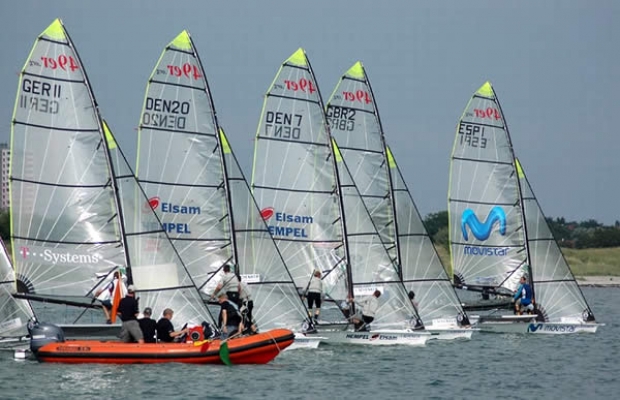
ISAF introduced the 'grand finale' at championships, where the top boats are invited to sail a 'sudden death' play-off to decide the winner, with the best intention of creating a spectacle and, with fewer boats, something to be more easily understood by the general non-sailing public. But at the 49er Europeans Championship last week in Denmark, the grand final was once again more of a grand fiasco.
The newly crowned European Champions, Chris Draper and Simon Hiscocks have been very vocal about their dislike of the current ‘grand finale’ concept but ironically they gained the most from it in Denmark, where they won the event due - in part - to this system.
Conversely Stevie Morrison and Ben Rhodes who up until the ‘grand finale’ were leading the European Championship comfortably, ended up being knocked out early on in the finale series leaving them in seventh overall. “Obviously we are very disappointed about how we did, but we knew from the start of the event that it was going to be a grand finale, so there is no point grumbling about it,” Morrson told thedailysail.
Speaking to both Hiscocks and Morrison it is clear that they do not believe that the system used at the European Championship was a fair way of deciding who the new champion should be.
Hiscocks maintains the current system is based on the assumption that spectators do not want to understand a point scoring system but would rather have it simplified to the point where the boat that wins the last race is the boat that wins the event, and that this may not be the best solution. Both he and Morrison also make the point that the new format of racing does not necessarily make sailing a good spectator sport.
“I was speaking with Simon about it and we think that sailing is maybe not a television sport, but it could be a great internet sport," says Morrison. "If you were putting GPS on boats and you had a mark rounding feed through a website then people in their offices could get live updates at mark roundings and things like that.” He adds: “There was four or five knots of wind on Sunday afternoon and it was not exactly eye catching stuff, but that is what sailing is often like. If you put it on the internet and have live feeds and trackers people might actually follow it. I just don’t really think Chris and Simon or whoever are going to be the next David Beckham. They can be very good sailors and very good sportsmen but it will never have that audience. You are not going to have 50,000 people turn up and watch an event no matter what.”
Hiscocks, however does not think that the grand finale format is a total write-off: “I have to say it was pretty exciting. There were a lot of people watching. Granted most of them were the other competitors but the other competitors never normally watch the races so it must have looked good. There were also people out on boats watching and there was lots of shouting and cheering and stuff.”
Hiscocks does also point out that the format is still in experimental stage. “I think that the current format just needs a little bit more thought and we need to actually try more systems. At the moment there are lots of experiments, but they are all based around one idea and that idea is that the winner of the last race will be the winner overall. I think we need to try some different formats that still keep the excitement and the interest but don’t necessarily have a 'last boat left wins' situation.
So what can be done? It is widely felt that a spectacle at the end of major events would be good for sailing and make it more visually exciting for the non-sailing spectator, but this surely should not be done in a way that undermines the week of competition that has gone before it.
Hiscocks says that he has a few ideas about a compromise: “One idea I had was that rather than run one grand final you do it several times. For example when Stevie got knocked out he scored a seventh place so he would get a seventh from that round and say we won, we get a first. Then you go into the next finale and those are effectively race scores so you keep those points. So say in the next one we finish seventh and Stevie gets a first, then we would be equal and going into the last race it would be a sail off. You don’t get that last race winner is the overall winner but you do get a short race spectacle and an easy to understand knockout system. It is a compromise."
At the moment Hiscock maintains the final is being tagged onto the end of the competition but the number of races in the 'grand finale' needs to be proportional to the number of races the entire fleet sails - perhaps even more.
Morrison is also not without ideas for a solution. He suggests carrying some points over from the qualifying series. “You should give a bit more precedent to the qualifying round,” he explains. “If you take the top five boats and give first place three points, second place two points, third place one point and the last two have no points, then you say it is the first boat to five points. That way you still have the winner wins the last race but the people that have done well in the qualifying series get a bit of benefit for that.”
The upshot of this is there needs to be more experimentation and thought put into these systems. There needs to be a way of making sailing more accessible but also keeping it fair for the competitors. Both Hiscocks and Morrison seem to think that the current ‘grand finale’ system does not work, but they both also accept that there is some room for change in racing formats.
What are your views on the Grand Finale concept? Any better suggestions? Is it really needed? Email us here .
Read Ian Walker's about the Grand Finale at Hyeres here .
Most Read
Most Commented
Comments
Businesses
Pro businesses
-
United Kingdom
-
-
France
-
Editor's choice
Member blogs
-
 Ned Collier Wakefield: MOD70 round BarbadosWell that was intense. 12 hard fought for seconds for the win. In idyllic conditions, Tony Lawsons MOD ...
 -
 Mini Transat leg 2 reportThe second leg of the Mini Transat started on 31st October, just over a month after ...
 -
Leg 1 reportI’ve been working towards the Mini Transat now for three years. In 2013 I was part ...
Business blogs
-
 The Island Sailing Club in Cowes, Isle of Wight, is delighted that Prince Michael of Kent ...
 -
Peta Stuart-Hunt chats with the 25 year-old British solo sailor Lizzy Foreman before she sets sail ...
-
The 2015 Student Yachting World Cup (SYWoC), an ISAF-recognised event hosted and run by students for ...
Editor's Choice
All time favourites...
-
 Three legs down into Ian Walker’s
 -
 Winning all but two races at
 -
 For the first time in its
Latest Comments
Add a comment - Members log in