
Veal schpiel
Wednesday March 9th 2005, Author: James Boyd, Location: Australasia
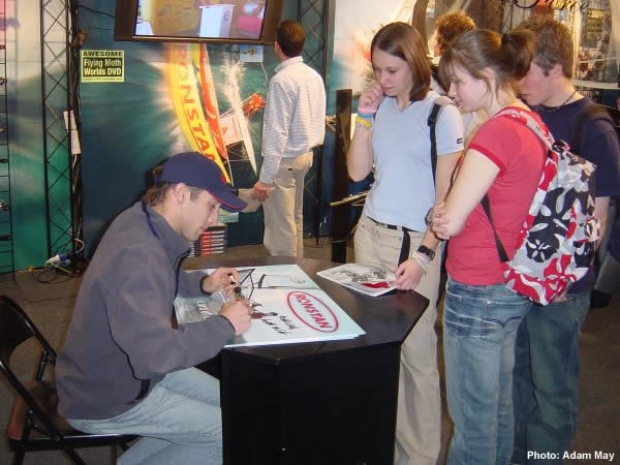
An interesting observation made at last weekend's Dinghy Show was that the one person the nippers were really clamouring to get autographs from - more so even than Team GBR's esteemed medallists - was Moth World Champion, Australian Rohan Veal, the man in the poster of the flying boat and who courtesy of Ronstan had jetted into Alexandra Palace like some Neighbours star.
Being fully in favour of fame and role models within our sport, thedailysail made a B-line for the lanky Aussie who one fellow Moth sailor described as "being about a year ahead of us" in terms of his foiling skills.
When we meet him, Veal admits he is stunned by the enthusiasm for his Moth foiling at the Dinghy Show. "This show is crazy. It is funny I get more recognition here than I do at home." Despite Melbourne being home to many of Australia's top sailors including the new International 14 World champion Lindsay Irwin, sailing there gets very little coverage outside of the specialist press. Saying this Veal was recently voted Sportsman of the Year by a panel of local newspapers and the awards ceremony for this he took the opportunity to push both the Moth and sailing in general.
As with Adam May and Linton Jenkins, Veal is keen to entice people into our sport's latest artform - foiling on a Moth. While May is closely associated with his The Mistress design, so Veal has a similar arrangement with Perth, WA builder Fastacraft and their Prowler design in which he has won the last World Championship and Aussie Nationals. He has sold the boat he sailed at the Worlds to an Italian to help build the fledgling but rapidly expanding Lake Garda fleet and the boat he plans to take to Garda for this year's Europeans has already been sold too, despite at present it still being in the form of a roll of carbon and a full tin of epoxy. "In six months they [the Italians] have got six boats and that was more important than anything getting that fleet happening. We hope we’ll get all six at the Europeans and they’ll probably grow to 10 or 20 within a year or two."
The price tag to take the fast lane to foiling - buying what is effectively a new boat, sailed by the man himself - costs 17,000 Aus$ (just over £7,000) Veal says. "The good thing at the moment is that you can put foils on an existing boat and make money. That’s what we’ve found has happened a few times over. And if you buy a new boat you don’t lose money as long as you keep turning them over. And the guys at the top can afford to do that because we get a bit of gear sponsored and just keep turning them over and that keeps bringing new boats in the class and that’s probably the most important thing a class can do to keep growing."
In Australia Veal says the Moths' airborne ability has even attracted some older sailors back into the class. "Andrew McDougal in Melbourne has come back for the third time now and he’s got one of these and he’s absolutely loving it as it is easier on the knees. He’s 50 now and couldn’t sail a standard skiff, but he could easily sail one of these because you don’t sit in the boat as much, you don’t cramp your knees up, you are always on the wings and you are always hiking. And if you don’t want to hike it doesn’t matter because you just heel the boat to windward and you use the weight of the boat to actually balance the boat out. So in effect it is easier to sail."
Like May and Jenkins, Veal says they are not focussing on technical advancements with the gear at present, however he has put considerable work into developing techniques for foiling the Moth as epitomised by the 'Veal heel'. "It is a very aggressive heel of the boat and the rig to windward upwind - by up to 30 or 40 degrees at times. By doing that the rig is more efficient. You can push off the foils to climb upwind and you use the weight of the boat because once it is out of the water it is actually to windward, creating leverage. And when you heel it over harder you don’t have to hike as hard - you can sit in the boat and it is a lot easier. The trick to heel it over is to get it high and you have to sail it with only 20cm of foil in the water and that creates less drag and is faster."
The technique looks very similar to that employed by sailboarders. "It is exactly the same," confirms Veal. "The rig is much faster to sail that way and if you get hit by a gust all you are doing is going back to vertical not to leeward. If you heel a foil boat to leeward, the foils push you downwind and push you over so it is really best not to do it. So you always heel to windward. And the higher you get the more you can heel."
Upwind or reaching when the Moths get fully airborne it is most noticable on the Fastacraft Prowler that the vertical blade of the T-foil/centreboard is raked forward. "We did that to gain further distance between the centreboard and rudder to gain stability [fore and aft]. Also when you are sailing on an angle, air will hit the foil and can travel down, especially if it was vertical or raked backwards. So by doing it this way air can’t travel down and cavite the foil. We still have some cavitation problems but it is when you sail around power boats. When you sail through their turbulence, it is like flying through turbulence in a plane."
Downwind Veal says the technique he has learned is one of caution. "Just keep the boat balanced. I found in the Worlds our big advantage was not in knowing how to foil, it was knowing when not to foil, because a lot of the time people just think they want to fly the boat downwind in the waves but that is not the way to win. You have got to learn not to foil sometimes and keep it cool and play it safe.
"When it is flat water it is a different story but when there are waves you have to keep it safe and just know how far to push before you push too hard and go over. When there are big waves and a bit of wind you can easily depower the rig and if it is too unsafe you can just sheet everything on and it is just easy. It is easier to sail the boat now in any condition than it is ever has been ever before."
So what's the most wind he's been out in? "30 knots. I passed an A-Class and a Tornado downwind on a reach. I screamed past them. I was doing at least 25 knots. It was crazy - I was shit scared. It was a big squall that came through on a lake and flat water so I just pushed it as hard as I could. I didn’t have a GPS so I don’t know how fast I was going, but it was fast."
Aside from straight line techniques Veal has also been developing his skill in turning corners and over the last year has been able to perfect airborne gybes. "We are consistently gybing on the foils now and it doesn’t matter how much wind - just as long as you are foiling you can gybe on the foils, but the trick is to get the apparent wind up straight away and that is just practise."
The next step Veal says is learning how to tack on foils. "Tacking on the foils doesn’t mean you are completely airborne throughout the whole tack. It is more like right up to the eye of the wind you are still airborne and the back of the boat just touches the water and you are back up again straight away. So it is about keeping the boat out of the water as long as possible. And you can gain distance to windward by tacking on foils as well, but you can only do it in flat water I’ve found and there is a bit of a trick to doing that as well which I’m still trying to figure out."

While foiling is the latest expression of our sport and undoubtedly one future for it sure to grow rapidly, with the attractions of a quantum leap in performance and a new book of techniques to learn, it is perhaps this latter challenge that causes people to think twice before having a go at foiling. Veal says that foiling is easier than it was, but he is not worried about the level of skill required shying people away. "We are only going to get the best guys who have mastered the other classes who now want to step up to a Moth. We don’t need to advertise the boat, it sells itself. We’re not targeting 95% of sailors. We’re targeting the top 5%."
Although the optimum crew weight for foiling in a Moth is 70kg, the boat also offers a unique alternative to lead correctors in terms of broadening its appeal to sailors of different sizes. "We find we’re attracting people as light as 45kg up to 95kg and you can still sail them successfully. You just adapt the boat to your weight with bigger or smaller foils and a bigger or smaller rig and you are going to go just as fast as anyone else."
We are interested to get Veal's views on whether the Moth's foiling technology is something that could successfully scale up into bigger dinghies and even yachts. Already to date foils have been fitted to an International 14 and to a 49er with varying degrees of success. Veal points out the winglets you see on America's Cup bulbs but is uncertain of the merits of using the Moth's T-foil and wing rudder configuration on keel boats. "If the boat heels to leeward and it's got foils on, that must be a disadvantage as it is going to push it over more. Maybe they could put winged rudders on? Then you can make the bow narrower and finer and then you have got a fast upwind hull. Because the boats are bigger you can easily make the foil adjustable and therefore lift the transom upwind and downwind pull it down so that you don’t nosedive."
Aside from Moth sailing back at home, Veal is returning to Europe in early August for the Moth Europeans on Lake Garda and is also considering going up to Japan for their Nationals. "They have already got three or four boats and they want another four."
However at home the latest chapter in Veal's sailing career is about to unfold. He has been cajoled into buying a singlehanded A-Class catamaran by the World Champion in that class, Glenn Ashby. "I was always attracted to the class, but I just didn’t have the money or the time. Glenn sort of forced me to get one. It is the next challenge while the Moths are focussing on growing numbers and getting boats out there at this stage."
Veal's A-Class is a MkV with a Kevlar hull and the most current hull shape. "I’ve only sailed the boat twice so far, but the first race I sailed I won. That was a local fleet, just five of them, and I thought I would be so last, but what I have found is that there are skills from foiling and apparent wind sailing so similar to A-Class cat sailing it is not funny."
While it is hard to imagine in Europe, out on Melbourne's Port Philip Bay the A-Class fleet tends to average 25 boats in size and at the State titles this coming weekend Veal says they can expect to see 40-50 boats.
Having been at the leading edge of persuading the Moth class to accept foils, Veal says that he doesn't want to go through this again with another class, however he does believe the A-Class would benefit greatly from having wing rudders. "Just sailing the A-Class twice - I can’t believe how easy it is to nosedive. You don’t have to fly you just want to stop the pitching. If you do that it will make it safer and more enjoyable to do it. It is not going to add cost and make them obsolete, it is not going to make them faster because there is more drag. At present they have got a restriction against it but they are discussing it now."
As he points out all foils have the ability to act as hydrofoils - they do this whenever the boat heels - so at what point do you stop measuring it? He then gives us an inkling of where he wants his sailing to end up: "I would love to try it and if we can get it working then we can use those principles on C-Class cats and then look at the Little America’s Cup." Maybe Veal and some other of his new Melbourne-based cat sailor friends will take over Lindsay Cunningham's mantle and bring the Little America's Cup back to Melbourne.
Most Read
Most Commented
Comments
Businesses


Pro businesses
Editor's choice
Member blogs
-
 Ned Collier Wakefield: MOD70 round BarbadosWell that was intense. 12 hard fought for seconds for the win. In idyllic conditions, Tony Lawsons MOD ...
 -
 Mini Transat leg 2 reportThe second leg of the Mini Transat started on 31st October, just over a month after ...
 -
Leg 1 reportI’ve been working towards the Mini Transat now for three years. In 2013 I was part ...
Business blogs
-
 The Island Sailing Club in Cowes, Isle of Wight, is delighted that Prince Michael of Kent ...
 -
Peta Stuart-Hunt chats with the 25 year-old British solo sailor Lizzy Foreman before she sets sail ...
-
The 2015 Student Yachting World Cup (SYWoC), an ISAF-recognised event hosted and run by students for ...
Editor's Choice
All time favourites...
-
 Three legs down into Ian Walker’s
 -
 Winning all but two races at
 -
 For the first time in its
Latest Comments
Add a comment - Members log in