
Big bang
Wednesday December 14th 2005, Author: James Boyd, Location: Australasia
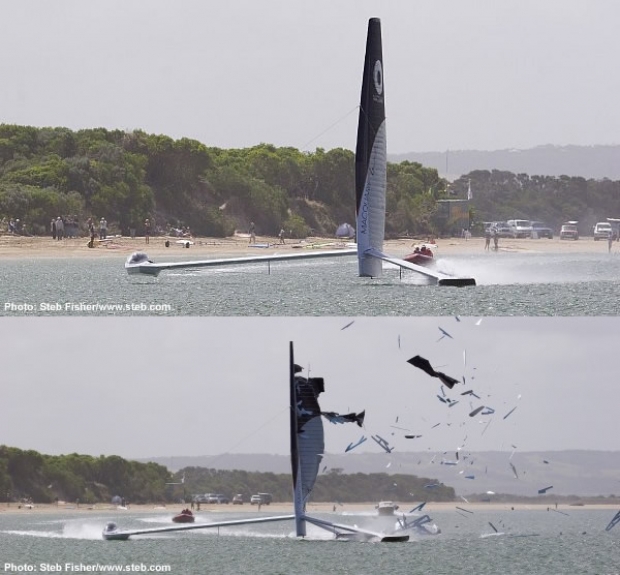
The Macquarie Speed Sailing Team were packing up their base in Australia's Sandy Point and heading back to Melbourne last night when we spoke to helmsman Tim Daddo about the dramatic explosion of their speed sailing vessel's rig late on Saturday afternoon (Aussie time).
Unfortunately this is the second time in the last 12 months that their extreme craft has seen fit to blow itself apart (read about the first incident here). Fortunately on this occasion it was only her asymmetric solid wingsail that exploded into a million pieces.
Over the last Australian winter the team have painstakingly rebuilt their craft, which essentially comprises two short planing windsurfer-type hulls to leeward, with added righting moment provided by the crew who ride shotgun 10m to weather with a solid wing sail in between. The team arrived back in Sandy Point in October but weren't ready to get the boat into the water until mid-November.
"We went out in very light winds - around 14 knots where we were peaking up to around 39 knots," says Daddo casually of their first sail this season. "The week prior to Saturday’s little disaster, we’d been out in very ordinary conditions with a maximum wind speed of about 18 knots and got over 45 knots peak speed and an average speed of just under 40 and we were obviously fairly confident in the way the boat had been behaving. Given it was the first time we’d been in the water since the major rebuild, we were quite happy to see everything was holding together and doing what it was meant to do."
They achieved 45 knots on Friday but this was just before dark and it was felt to be too risky to try another run that night. Saturday afternoon and the team were back out on the water, Daddo takes up the story: "Sandy Point is starting to become overwhelmed a little bit by growing sandhills and we started off well and truly in the lee of those but all things considered we were very happy with what had happened up to the stage where the wing exploded."
To achieve the present holy grail of speed sailing - breaking the 50 knot barrier - the team have set themselves target boat speeds for three gates down the course. "We were fractionally over two knots faster than our start target but we didn’t get a lot further than that unfortunately." Just 30m into the 500m run with the boat speed at 45.9 knots there was a loud bang down to leeward as the rig blew itself apart leaving a shower of carbon, Nomex and heat shrink plastic in its wake. "Given the way the boat was performing and that our top speeds aren’t reached normally before the 350m mark and the velocity trace was not going quite vertically but we had put on something like 14 knots in four seconds, all things were looking quite promising but nevertheless we didn’t make it so that it doesn’t count," says Daddo in surprisingly positive mood. He is convinced that had Macquarie Innovations not broken then they were well on track for a 50 knot average speed run. "I think everyone who saw the boat operating on Saturday were convinced we were less than 18 seconds away from being able to grab that. So we are pretty keen to continue, it is just a matter of working out when and where and all those sorts of things."
The main set-back for the team is one of time and Daddo reckons that it is unlikely they will be back having a pop at the 50 knot record this year. More perplexing is that at present the team are uncertain what broke and are in the process of investigating this. "There were probably three different components in the wing, a failure in any one of which could have caused the resultant explosion," continues Daddo. "But at this stage it is a bit early to say exactly what it was. The irony as such is that we have been building this type of wing for almost 20 years now on a variety of different craft and it is the first time we have ever experienced something like this. I don’t know if it was bad luck or something we hadn’t foreseen. One of the problems with these projects is that you are always stepping into grounds that have never been traveled before." The wing on Macquarie Innovations is a 'one-tack wonder', as asymmetric wing section, but the team led by Lindsay Cunningham have used similar construction techniques on their previous Yellow Pages Endeavour speed sailor that won the world speed record in 1993 and on previous C-Class catamarans (the team were holders of the Little America's Cup until it was won by Steve Clark's Cogito).
Daddo explains the construction of the rig: "The construction is centred around a Nomex carbon leading edge structure, which takes all the load and then the rest of the bits you see in the photos zinging through the air at various speeds is predominantly just foam and carbon with a heat shrink cloth on top of it. It is all exceptionally light weight. The whole wing weighs just over 50kg, so there is not much too it, but it is meant to be able to well and truly withstand those loads. So the perplexing thing from our point of view as far as the wing loads go, is it’s really no different loading in 14-18 knots of wind than it is in 20-22 knots of wind which we were in on Saturday. So it is a little unclear as to why it decided to fail then and hadn’t failed previously. It starts to indicate age fatigue issues which we are also worth investigating."
While from the outside little has changed between the Macquarie Innovations that blew up 12 months ago and the latest incarnation, Daddo says they have developed the boat considerably, with particularly focus on making it lighter but stronger. "We have made some significant changes to the structure and the key components. We had low tech plywood leeward hulls and we have now gone to carbon Nomex hulls. We went for a weight saving program this year and we have developed some customised carbon rigging, which might only be used in one other place in the world. So that is pretty leading edge from our point of view. In context our old stainless rigging used to weight a little over 7kg and it now weighs 1.1kg in carbon and it makes a big difference to how the boat behaves. Something as spidery as it looks, flexes around quite a bit and having the carbon on there has really locked everything in a lot more precisely, so we have better control over our control surfaces which has made a big difference to our performance."
We put it to Daddo that changing to carbon rigging and carbon/Nomex construction stiffens the structure but makes for greater susceptibility to shock loadings. "It is always a risk when you are doing high performance things. Nothing comes for free in this world and there are certain risks you take on board when you do go into hi-tech equipment. We are reasonably proud of our history in that this boat is engineered very carefully and that’s how we managed to get something able to do over three times the speed of the wind but it is not without risk and there are times when things go wrong and unfortunately when you are cutting everything very fine in terms of tolerances, when things get out of their design window, then this is the end result."
Thanks to the modifications they made they were consistently exceeding their VPPs. "We have obviously got a lot of theoretical data but the one advantage I think we have over everyone else in the world is that we are able to match that theoretic data up against real data from Yellow Pages Endeavour," continues Daddo. "So the data that we are gathering as we are sailing seems to be indicating that we are doing slightly better than what we would expect, so everything is looking as promising as it can be, but we are rapidly coming to the knowledge that this speed sailing caper requires far more than just a fast boat. You have to be a bit lucky and be at the right place at the right time."
However Daddo says he still finds it frustrating that Macquarie Innovations has yet to beat Yellow Pages Endeavour's speed record. Their first boat was built in 1992 and had achieved set a new world record within a year. Macquarie Innvoations was built in 1995 and still has yet to achieve its goal. "That is quite a rude awakening. And with the sailboard guys going quick as well, they are putting a lot of time and effort in their efforts, so the whole world of speed sailing is really becoming focused again which is fantastic to see from our point of view and is developing a lot of worldwide interest."
At present Paul Larsen's SailRocket campaign is to start trialling their new solid wing rig in the new year, while there are other active campaigns to break the 50 knot barrier in Sweden, Denmark and another in Australia. However the most promising seems to be the windsurfers with the present world record holder Finian Maynard currently in residence down at the trench in the south of France waiting for a suitable Mistral to blow through...
To read more about the technical side of Macquarie Innovation - click here
To read our interview with Finian Maynard - click here
Most Read
Most Commented
Comments
Businesses
Editor's choice
Member blogs
-
 Ned Collier Wakefield: MOD70 round BarbadosWell that was intense. 12 hard fought for seconds for the win. In idyllic conditions, Tony Lawsons MOD ...
 -
 Mini Transat leg 2 reportThe second leg of the Mini Transat started on 31st October, just over a month after ...
 -
Leg 1 reportI’ve been working towards the Mini Transat now for three years. In 2013 I was part ...
Business blogs
-
 The Island Sailing Club in Cowes, Isle of Wight, is delighted that Prince Michael of Kent ...
 -
Peta Stuart-Hunt chats with the 25 year-old British solo sailor Lizzy Foreman before she sets sail ...
-
The 2015 Student Yachting World Cup (SYWoC), an ISAF-recognised event hosted and run by students for ...
Editor's Choice
All time favourites...
-
 Three legs down into Ian Walker’s
 -
 Winning all but two races at
 -
 For the first time in its
Latest Comments
Add a comment - Members log in