
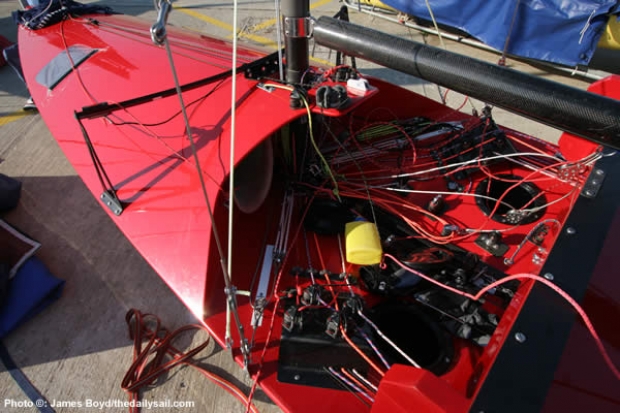
Under the bonnet
Friday August 19th 2005, Author: James Boyd, Location: United Kingdom
Aside from becoming the centre of Olympic sailing in the UK, the Weymouth & Portland Sailing Academy is also home to more eclectic breeds of dinghy from foiling Moths to Paul Larsen's
SailRocket. Over the last fortnight it played host to the triennial International Canoe World Championships.
For those unfamiliar with the class, the Canoes are singlehanders and thanks to their relatively narrow, shallow hulls driven by 10sqm of sail area, offer skiff-like performance. Their principle USP is that instead of a trapeze they gain stability by having an athwartships sliding seat that allows the helm to sit rather than hang up to weather. Many also like the class simply because it is a singlehander with a jib.
In the late 1990s a group in the UK led by Rob Michael of Razorback Boats took the significant step of adding an asymmetric spinnaker too and as a result this has divided the class between what are known as ICs, the original spinnaker-free boats, and ACs with the asymmetric. Competing at the World Championships were 26 ACs and 31 ICs.
Technically of the two classes in Weymouth only the ICs were competing for an official World Championship having adequate nationalities attending - Australia, France, GBR, Germany, Sweden and the USA. This is another unique aspect of the Canoes. While they race under ISAF and RYA rules, their governing body is the International Canoeing Federation rather than ISAF. Thus for a valid World Champion the Canoes only require competitors from six countries and three different continents to compete, whereas ISAF take the more stringent line of eight countries, three continents consistently over a five year period.
Builders
In the UK there are two principle builders - Razorback Boats in Emsworth and John Ellis based up in Stockton-on-Tees, Razorback being the more prolific. Robin Wood, who last week finished first the AC class at the Worlds, just one point ahead of the USA's Anders Petersson and having previously won three World Championship titles in the IC, sailed a Razorback, previously Rob Michael's own boat.
The hull of an International Canoe is effectively one design - 5.18m (17ft) long by 1.01m (3.3ft) wide with a number of measurement stations along the hull forming it's double-ender canoe shape.
C-Class champion and development class guru Steve Clark, who also runs Vanguard Boats in the US, is a strong advocate of the Canoe and in 1984 and 2002 was its World Champion. Clark introduced carbon fibre construction to the class in the early 1980s and now most seriously campaigned boats are constructed in carbon fibre/foam sandwich.
Today boats are regularly built down to minimum weight: 83.5kg for the ICs and 89.5kg for the ACs or below - both figures excluding sails. A maximum of 10kg lead correctors are allowed and many are hitting minimum weight.
"The weights haven’t really altered much since they were made out of wood," says builder sailor John Ellis. "The boats are not that much faster but they’re stiffer and they go better in that respect."
The biggest issue with building the boats is not so much the fore and aft bending but the torsional loads placed on the hull by the seat. Ellis says boats tend to be almost monocoque in construction save for a backbone that goes down the centre.
There is little variation in the hulls, but this appears not to be the case because Canoes come with an attractive variety of Porto Fino-style pastel paintjobs and there are all sorts of foredeck arrangements. The German boats in particular seem keen on having more of a windsurfer-style flat foredeck, while most others have some sort of raised foredeck to prevent waves excessively slushing the deck.
The seat
While the Canoe's sliding seat moves athwartships across the boat, what is less evident is that it can also move fore and aft. The carriage for the seat is mounted on a Holt Allen alloy track with stainless steel cars and PTFE inserts.

Spot the difference...

However when it comes to the sideways movement of the seat, instead of running across the boat on neatly whizzing ballbearings, the system is almost purposefully low-tech.
"They are usually a slack fit because we aren’t very good at making them!" jokes John Ellis. "In fact they are generally a slackish fit so that they won’t jam. It is like the pole in a bowsprit - they are always a lot smaller than the tube they come out of which makes them impossible to jam. But you are only talking about millimeters of play."
Thus instead of having a seat that is freewheeling and held in place with stoppers as one might imagine, the seat instead relies on the friction between the seat and its carriage. On some boats this friction is achieved simply by carbon fibre to carbon fibre, but normally the seat runs on Tufnol to prevent wear. Ah, Tufnol - that delightful brown material, made from epoxied, glued paper or fibreglass from which most of the deck hardware on your dad's boat was hewn when you was a lad.
As one might imagine a system relying on friction alone on a boat like this does not come without incident and most hardened Canoe sailors have their 'seat' story. "If you are on the end of the seat and you let the boat heel too far, it can lose its grip and all of a sudden the seat shoots through to the other side. It is like being buried at sea!" recounts John Ellis.
Under class rules the seat is allowed to protrude 2,04m (7ft) from the centreline of the hull. It's maximum width (fore and aft) is 500mm and its weight must be 9-12kg. Other than that anything goes.
One would imagine there to be moulds for the seats, but typically they are custom-built tailored for the owner's weight. Some come with cut-outs for footholds.
John Ellis says there are pros and cons of the seat. "It does have its advantages. You don’t get teabagged so much. If you get a sudden lull or the wind hits you from the other side, with a trapeze you are straight in the water, and the boat heels over towards you and you tend to swing out. With the seat, there is some bouyancy in it - not enough to support you if you are just sat there but for a few seconds it is enough to allow you to scramble in."
However Ellis says he has gone off the seat since making the change to the AC: "I used to like the seat and carriage on the standard two sail IC, but I sail an AC now with the spinnaker and I hate the seat. The carriage is always in the way, because you need to be moving backwards and forwards much more frequently. I would prefer racks or a trapeze. But that isn’t allowed."
For the Worlds Ellis changed his Canoe back to an IC - an operation that is fortunately relatively straightforward. He finished second behind Mark Goodchild aboard his Born to Be Even Wilder (the 'even' added after the boat originally had its asymmetric added).

Rudders and foils
The general characteristic of International Canoe foils is they are short. The daggerboard is limited in length to 1m below the hull.
Bigger variations are to be found in the rudder systems. A majority of rudders are slung beneath the hull but mounted in a box that can be lifted out of the boat - rudder and tiller as one.

Some boats have kick-up rudders, the most popular being where a neat cuboid is cut out inboard from the stern and hinged at its front end at the deck, allowing the rudder to be popped up. One German boat at the Worlds had a rotating cylinder between the hull and deck through which the foil fits in a cassette-system - this has previously been used on the Henderson 30 sportsboat in the Caribbean as well as Ellen MacArthur's Open 60 Kingfisher.

Others have a stern-hung rudder arrangement similar to an International 14, where a carbon sleeve attaches to the pintles and the rudder blade is simply inserted or lifted out from this sleeve. Mark Goodchild's IC World Championship winner Cunning Stunts has such as system the rudder stern-hung using an elaborate sculpture of carbon, Tufnol and steel pipe...

Moths and International 14s hitting the headlines over the last couple of years with their lateral foils, hasn't escaped the notice of the Canoe class and at the Worlds John Ellis had a 14-style T-foil system on one of his rudders, where the pitch of the T-foil was altered by moving the rudder system in its entirety - as on the Morrison 14s.
"The principle is that you sail to windward with your weight as far back as possible, which would normally sink the back of the boat and raise the bow," explains Ellis. "The bow does rise but the back end doesn’t sink, so the boat is sailing higher in the water and there is less water resistance, but then there is the drag of the foil. I am not sure whether it is paying off yet. I think because the seat doesn’t come back far enough to get the weight over it is the limiting factor. If we were allowed wings or racks where we could get the weight right at the back then it would really pay."

At the moment of course, racks are forbidden and there doesn't seem much chance of them being allowed, the Canoe's sliding seat being almost as much its defining feature as its double-endedness.
And the chances of some trying a Moth-style T-foil on the centreboard? "As yet no one has tried it," says the UK Class' Honorary Secretary Andy Biden, owner of a gleaming new Razorback. "The problem is that it sails flat and you are not going to get an advantage like you do on the Moth. And you’ve got to lift the whole length of the boat out."

Masts and sails
As ever with development classes where such items are relatively open, the mast and sail combinations are dictated largely by the weight of the crew.
"With carbon masts you can virtually pick a mast to suit your own weight and that is fairly important," says John Ellis. "There are lots of different combinations of masts and sails. People have stiff masts and flat sails and soft masts and full sails - all sorts."
In the UK, the principle carbon spar manufacturers for the class are Proctor and Super Spars, the latter normally rigged with lowers. Hyde Sails seems to be the most prolific sail maker in the class partly because Razorback's Rob Michael holds a concession for them. Noble Sails {who's logo is a bull with a line through it], formerly Orange Sails of 1999 Canoe World Champion Lester Noble, are also popular and tend to be slightly fuller than Hyde's.
"The ACs don’t need the sails with so much downwind fullness, because the spinnaker is so large in comparison with the rest," says John Ellis.
At the Worlds Robin Wood was using Hyde Sails on a Superspars mast. "They are conservative," says Wood of his sails. "They have got a roach on them, but not an excessive one. They are just well made and good quality. They use this Technora cloth which doesn’t stretch a lot, and it is fully batten as well so the longevity is good."
Interestingly there are a few top amateur sailors within the class, such as Colin Brown and Alan Powell, who prefer to make their own sails.
Moving the rig about
The Canoes are fitted with a variety of rig tensioning systems. Mark Goodchild's IC World Championship winner has a Highfield lever at the base of each shroud. Others prefer to tension their shrouds using a 2:1 purchase going back to a Harken Muscle box, while yet another option is a multiple cascade of blocks - typically 24:1 - heading back towards the mast step.
"I found that because I am a bit lighter, I like to use rake," says Robin Wood of his boat's set-up. "So I had an adjustable forestay on there anyway but I put adjustable shrouds on. The shrouds are only 8:1 and they are twinned together. On the conventional Canoes, we let the leeward shroud go to let the boom square off, but you do them individually in the IC. With the AC if you go out there and conditions are breezier than you thought, I am in a position where I can drop my rig back to suit and pull on the shrouds. For my lighter weight I find I have got to be on the right settings to get the best out of the boat."
When Wood got his present boat two years ago it had Fastpins on it, but it now has a cascade of blocks for the forestay and shrouds, using 3mm Vectran cord.

The asymmetric
With a narrow hull, a sliding seat, main, jib and a large asymmetric, which when flown more than triples the sail area, manoeuvring, hoists and drops are regularly hair-raising affairs.
As one might imagine on a singlehanded boat with three sails, much development work has focussed into reducing the amount of work the crew has to do through manoeuvres.
The small jib for example is now tends to be sheeted to a dished semi-circular track allowing it to self-tack. Robin Wood has come up with an additional development: "I have one centralised cleat on the after edge of the foredeck and the twinned ends go through the end of the seat on either side. Before you had a double line and because you were always letting off on starboard and letting off on port you ran out of jib sheet and you had to even them up all the time which was a pain."
Wood's Canoe Outlaw has a continuous kicker on it for similar reasons. Letting off the kicker on starboard and pulling it back in on port you'd run out of kicker after a couple of laps. This is now standard fit on Razorback Canoes.
But it is the asymmetric spinnaker gear that has had the most attention since its introduction. The size of the Canoe asymmetric is unmeasured but is limited by its hoist, how far aft it can be sheeted and the maximum pole length of 1.8m (6ft) forward from the bow. In practise kites tend to be maximum size - around 23sqm in total.
The trend within the class has recently been to fly the kites low. "I think it is a bit dangerous the way they are going," says John Ellis. "They have brought the clew height right down and the sail is so big now that it is virtually touching the water, so there is nil visibility. Most people have a smaller kite with a higher clew for normal club races and they only put the big one on for the open meetings."
Of particular importance has been the gear for handling the spinnaker, the development of which Rob Michel was largely responsible for in the early years of its use.
Rounding the weather mark crews are obviously keen to hoist the spinnaker as quickly and a simply as possible. A single line system is used to pull the kite out of its sock (socks tend to run the length of hull to prevent concentrating weight in the bow) while simultaneously launching the pole. The actions of pole launching and pulling kite out of sock both come with a fair amount of friction associated with them so getting one rope to perform both functions requires some fine tuning. To achieve this singlehanded (literally) the Canoe sailors usually use a pump system.

Ironically it is dropping the kite that requires greater precision. Getting the kite down cleanly singlehanded is essential as if it goes in the water then it is easy to run over it, the spinnaker quickly transofmring from giant provider of blistering speed to sea anchor causing rapid capsize.
"We have to pull the tensioner on, grab the down handle, graunch it until it gets hard and then reach in, open one figure [of the halyard cleat], flick the uphaul line out of the cleat and pump like mad [on the downhaul] because the spinnaker's going to hit the water," says Andy Biden of the system he uses to put the kite back in its box on his Razorback Lights Out.
However AC champion Robin Wood is a man who likes his tweaks.Having sailed ICs for many years Wood took a sabbatical, missing the last Worlds as he was RS800 sailing with his son. "There were certain aspects, little tweaks and refinements which I sussed out and brought with me," he admits. "Because I sail with Steve Bowen up at Llandegfedd [Bowen sails the AC Twisted Welshman] - he’s been invaluable as a training partner - that enabled me to get up on the boat handling side of it." He maintains that although the Canoe is a development class, the boats are fairly standardised so he put most of his effort into improving his boat handling.
As to his tweaks, Wood has come up with a way of automatically releasing the halyard as he pumps the kite in: "I’ve attached an elastic take away on to the pump handle so that when it comes to dropping the kite, when you draw the pump handle up it tightens the elastic as well. Also attached to the handle is a rope that uncleats the spinnaker halyard. So those two operations are done automatically with the first pull, and then when the halyard pops it is just a case of pumping the spinnaker down. Before you’d have to pull on the elastic to get the tension in the system and then you’d have to make one pump to take the slack in on the downhaul and then knock the [halyard] cleat off before you could start pumping it down vigorously. The way I have it, as soon as you pick up the handle, you draw it up, the cleat pops and then you just start pumping it vigorously." A little thing but one which saves valuable seconds on the race course.
Dropping the kite is made all the harder as due to most of the asymmetric gear being retrofitted to ICs, the aperture in the foredeck through which it is hauled into its bag is offset to the port on most boats. "Dropping it on starboard is almost impossible, because it is such a narrow foredeck that the kite tends to go in the water. You have got to really pump hard and fast, so most people prefer to drop while on port," confides John Ellis.

One of the few boats to have the aperture in the middle was defending World Champion Steve Clark's new boat Blue Meanie. Clark pitched up in Weymouth with the complete family including sons Willy and David (both sailing ICs) and sister Hannah Moore, a previous podium placer at the Canoe Worlds and with her sons Sam, Chris and Oliver - dramatically reducing the average age of the Canoe sailors competing. Robin Wood says that seeing the Clark and Moore family nippers competing has inspired his son to have a crack at Canoe racing.
At the Worlds Blue Meanie was in development mode. Clark has fitted his boat with a unarig, losing the jib and increasing mast height my more than a metre and putting all of the 10sqm area allowed for the 'white sails' into the mainsail, in a similar fashion to his A-Class catamaran.
Clark and his una-rig didn't excel at the Worlds, finishing ninth overall but this may have been due to a lack of development time and it is felt that the school is still out on whether the advantage of having a taller rig and larger mainsail is worth the expense of losing the jib and the slot.

The next Canoe Worlds are to be held at Sail Melbourne in January 2008, a little less than the statutory three years time and Robin Wood says that aged 50 now, if he is still keen of body and mind, he'll be there.
More gear pics on the following pages...
To see thedailysail's photo gallery from the Canoe Worlds - click here .
Most Read
Most Commented
Comments
Businesses

Pro businesses
-
-
United Kingdom
-
Italy
-
United Kingdom
Editor's choice
Member blogs
-
 Ned Collier Wakefield: MOD70 round BarbadosWell that was intense. 12 hard fought for seconds for the win. In idyllic conditions, Tony Lawsons MOD ...
 -
 Mini Transat leg 2 reportThe second leg of the Mini Transat started on 31st October, just over a month after ...
 -
Leg 1 reportI’ve been working towards the Mini Transat now for three years. In 2013 I was part ...
Business blogs
-
 The Island Sailing Club in Cowes, Isle of Wight, is delighted that Prince Michael of Kent ...
 -
Peta Stuart-Hunt chats with the 25 year-old British solo sailor Lizzy Foreman before she sets sail ...
-
The 2015 Student Yachting World Cup (SYWoC), an ISAF-recognised event hosted and run by students for ...
Editor's Choice
All time favourites...
-
 Three legs down into Ian Walker’s
 -
 Winning all but two races at
 -
 For the first time in its
Latest Comments
Add a comment - Members log in