
Hitting the numbers
Friday April 8th 2005, Author: Andy Nicholson, Location: United Kingdom
Sailing a Solo is a bit of a stereotype in the dinghy sailing world - the comment ‘It’s an old-man’s boat’ is part of the dinghy lexicon.
You may smirk, but the Solo has a waiting list for new boats: around 70 are expected to be purchased this year. Over 80 boats turned up for the Winter Championships - held at Chew Valley Sailing Club in February. The class website won the Consumer Award at the Boats.com web awards at the London Boat Show in January. And next year the boat itself turns 50!
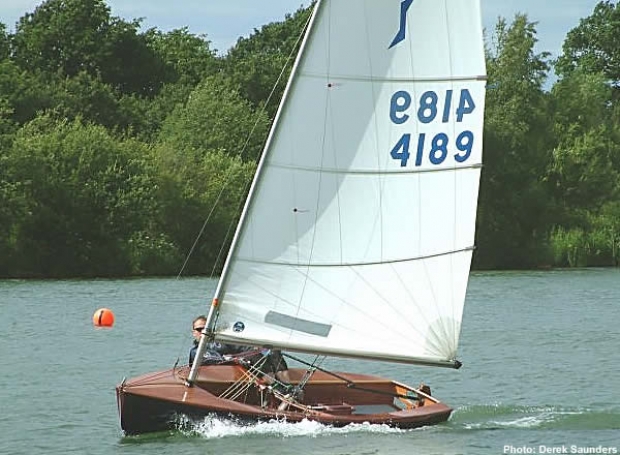
Designed by Jack Holt in 1956, the Solo was conceived as a well mannered singlehander for river sailing. The principle characteristics of the boat are a simple stayed mast (without spreaders), an 8.3sqm fully battened mainsail and a chined hull 3.7m long. Originally the boat was designed for home build and so was not strictly one design, but had ‘tolerances’ for the amateur builder.
Over the years however, the design has been refined to near one-design. “The designs have been optimised - putting it onto CAD - and so a lot of the variables have almost gone now,” says the Class’ Measurer Gordon Barclay. “The floor has a very flat run aft, so that the boat planes well and the bow has been pulled in - so to create a finer bow shape as possible.”

There are several builders of the boat and only until recently the wooden hulls, rather than anything more modern, have been the really only sensible choice if you wanted to win anything. Barclay explains the nuances of the Solo design: “The wooden boats have double thickness bottoms. In addition to the outer 6mm of ply, you have at least another 5mm of wood panel laid inside which creates a floor that just doesn’t move.
“The problem with the early GRP boats was that they couldn’t make a lighter boat than the wooden ones and the floor panels used to move around. So when you were going through a sea-way it was just not working.”
That has now changed since the introduction of the FRP (foam sandwich) technique of hull build, finally laying difficulties of a bendy plastic floor in a nice light boat to rest. Winder boats were the first to come up with the new hull four or five years ago - and a modern looking, lower maintenance hull has provided a little bump in class activity.
"The Winder Solo is built from epoxy foam sandwich with panels at least as thick as ply, yet with the fibre stiffness of glass," Guy Winder tells us. "The glass skins either side of the foam core are thin and the foam is light. This results in a panel stiffness superior to the equivalent plywood yet having similar or less weight."
New this year is another FRP hull, this time from Speed Sails, in early March they had already taken 14 orders. “The new Speed boat is another supplier seeing that there is a demand here. We have never liked being in the position where they was a monopolistic situation of suppliers,” says Barclay.
There is a healthy competition in the fleet between the various brands in the class. In addition to the hulls, the foils, masts, sails and hardware can come from any manufacturer.
One of the main features of the Solo is the wide range of crew weights the boat can cater for. The principle reason for this is the choice of sail and mast: A less powerful and more forgiving set-up for a 10 stone helm through to a more boned combination for a 16 stone helm.
Barclay says that the variety of mast sections available for the Solo enables all weights to compete relatively equally. “Something like the Wavelength, which has a more flexible top section, and it just flicks off. That is really good for the guys at the lighter end and they can be just as competitive in a force six than a guy who is 15-16 stone.”
This choice of rigs has been married up to a range of sail designs. The most active in the fleet are North, Speed, Wavelength and Red Eye. “All of them have representatives sailing in the fleet and so a lot of development has gone in,” says Barclay. “They really are performing well, around the windward mark - let the foot out and take off the cunningham - and you have a really big and powerful sail for off-wind sailing. Putting the controls back on, you then have a good upwind sail again. It is that adjustment that the development has provided.”
The use of Kevlar in the sails has also helped with the Solo’s recent image improvement.
The simple and effective rig controls bring in a degree of technicality to the boat. There are stays, which without spreaders, help keep the mast from moving too much at various points. The forestay allows mast rake to be put in or taken out, combined with a mast chock at the deck level to influence lower pre-bend. The sail has an outhaul and cunningham, a kicker, and the mainsheet is on a central track.
All of this adds up to a class which is really humming.

“The biggest injection has come from having the boat that is more modern in appearance. It is a perception thing,” says Barclay. “It won’t be quite as quick on the plane as a Laser, or a trapezing skiff… But at the same time there isn’t a condition, if the race officer has put a race on, that I wouldn’t be happy about going out and racing in. Force six...we’re off!”
The main event in the Solo calendar is the Nations Cup, which traditionally attracts some of the Dutch fleet (there is a fleet in Australia too). In 2004 this was held on Lake Garda and this year it will be North Berwick’s turn with sponsor support is coming from Purple Marine and Gill. The class’ Publicity Officer Claire Clark is hoping that this location will attract some of the Scottish sailors. “The Dutch are very keen too. Usually eight or ten of them make their way over if it fits in with their calendar,” she says.
In all there are about 130 recognised Solo fleets says Clark, with the biggest being at Papercourt Sailing Club in Ripley, Surrey. Through the year around 70 open meetings take place, with about 14 in each geographical region making up a Traveller Series.
The inlands this year will be held at Rutland in June (2004 attendance: 101), with other main Championships held in Scotland and Wales and Holland.
So is the Solo an old-man’s boat? Perhaps that is a little unfair. It just can be sailed by a wide range of sailors. “We have got a lot of guys who are in their 60s, 70s and we have even got some who are into their 80s and are still sailing,” comments Barclay. “And that is down to the rig, because in strong gusts it absorbs the initial shock, and that is the reason why is appeals to older sailors.”
Barclay concludes with remark made at a windy championship some years back, (which perhaps could create a new stereotype): “I remember when Geoff Carveth was in his early 30s and came ashore at Paignton and said: ‘The next guy that tells me that the Solo is an old mans' boat I am going to kick him firmly between the legs!’”
A new complete FRP boat will cost around the £5,800 mark. A two year old, very competitive wooden boat will be around £4,000.
The excellent class website is: http://www.solosailing.org.uk
Most Read
Most Commented
Comments
Businesses

Pro businesses
-
United Kingdom
-
United Kingdom
-
Italy
-
Editor's choice
Member blogs
-
 Ned Collier Wakefield: MOD70 round BarbadosWell that was intense. 12 hard fought for seconds for the win. In idyllic conditions, Tony Lawsons MOD ...
 -
 Mini Transat leg 2 reportThe second leg of the Mini Transat started on 31st October, just over a month after ...
 -
Leg 1 reportI’ve been working towards the Mini Transat now for three years. In 2013 I was part ...
Business blogs
-
 The Island Sailing Club in Cowes, Isle of Wight, is delighted that Prince Michael of Kent ...
 -
Peta Stuart-Hunt chats with the 25 year-old British solo sailor Lizzy Foreman before she sets sail ...
-
The 2015 Student Yachting World Cup (SYWoC), an ISAF-recognised event hosted and run by students for ...
Editor's Choice
All time favourites...
-
 Three legs down into Ian Walker’s
 -
 Winning all but two races at
 -
 For the first time in its
Latest Comments
Add a comment - Members log in