
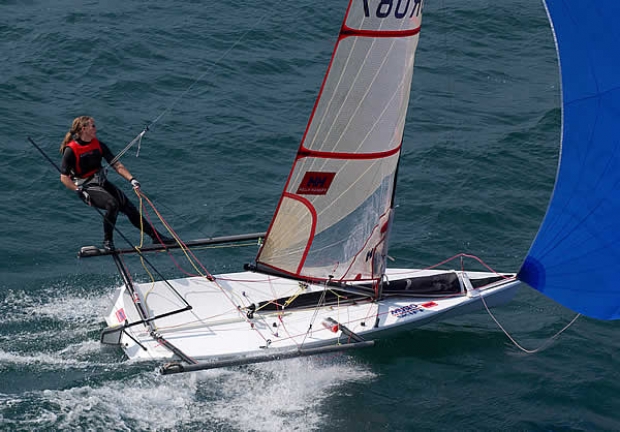
Gunning for the top
Thursday April 21st 2005, Author: Andy Nicholson, Location: United Kingdom
The Musto Skiff is the self proclaimed Subaru Impreza of the dinghy sailing world: It is high tech, super fast and goes about its business as if it had a large exhaust pipe.
The design was first mooted by German sailor and designer Joachim Harpprecht in 1999 and was picked up by Devoti Sailing who market and sell it. The boat proudly wears its ‘partners’ on its sleeve, the hull is Ovington, the deck gear Harken, the mast Selden, the sail Hyde and class itself carries the name Musto.
Rick Perkins, the class’ communications man, says that Nigel Musto was a key character in getting the whole project off the ground initially although the clothing company now sits in the background. “Nigel Musto supports the class by making an investment in our promotional activity,” he confirms. “But beyond that Musto do not have any commercial involvement in the class.”
The class has a very active association and has seen a solid growth in numbers. 40 boats were sold last year which Perkins describes as “very good”, and in the first three months of 2005 Devoti have taken orders for another 23.
Importantly for the class a good proportion of these new boats - around 45% - are going overseas and building strong fleets in several countries outside the UK. Spain, Germany and Switzerland have fleets that are growing rapidly, but there are sales to the US and Canada too. Dealers are now also in place for New Zealand and Australia, Italy, Croatia and Slovenia too.
This is improving international competition and last year 37 boats from eight countries contested the class’ Gold Cup on Garda.
The class’ clear goal for this year is to attain ISAF status. “To achieve that,” says Perkins, “I believe you need to have four fleets of more than 20 boats in four different countries, or you can three fleets of more than 20 boats on two continents.”
This has the full support of the class members and a recent online survey on the class' website confirmed this. “96% of people were supportive of us getting ISAF status,” says Perkins. “And 86% people were also supportive of putting the class forward for Olympic adoption.” Perkins is keen to point out that it is very much one step at a time.
However this does present a somewhat chicken and an egg scenario for the Musto Skiff. To gain a foothold in other countries - especially Europe - ISAF endorsement would help to open a lot of doors.
“It is very difficult,” says Perkins, “because the sport is so institutionalised in mainland Europe. Getting that ISAF rubber stamp for your class really helps to develop those fleets in those countries. If it is ISAF-recognised then the sports governing body in each country is more likely to consider that it is a good boat.”
Spain is a perfect example says Perkins. There sailing clubs are the purchasers of the boats, which their members then sail. As a result buyers are conservative in their choices, going for the classes that their National Authority have adopted (ie largely ISAF classes).
However the tide is turning says Perkins and the recent example of the German adoption of the 29er is a good example (where the selection of the class by the national authority was largely driven through by parents, whose children did not just want to sail 420s). “The internationalisation of skiff boats is very slow. If you look at the UK, it happened very quickly. So this ISAF recognition is a big deal for us.”
Behind the two of the big European fleets are key individuals who have given the Musto Skiff some useful status. “In Germany we have Gabriel Wicke,” says Perkins. “He is a former Contender World Champion. The main guy in Spain is Pablo Arandia, who used to be one of their top Europe sailors. You need an advocate who is local if you were to present your class to the national authority.”

This interest and growth of the class creates its own problems in the short term such as getting hold of a cheap boat to start in. Secondhand boats are sold soon after they are advertised and prices remain high.
“One of the challenges we do have is that the boats really retain their value,” says Perkins. “What that means is the cheapest you can get a secondhand boat for is £5,000, so entry to the class is expensive. On a positive note, owners get a good investment. My first boat I bought for £5,000 and sold 18 months later for £4,900. And during that time I bought a new mainsheet. So very cheap sailing, but you have to find the money to start with.”
ISAF status also brings its own costs too. While the class could hold a bone-fide World Championship, they would also need a bone-fide International Jury and the additional expense to competitors that brings. ISAF also, for example, take a fee off each new boat built and insist on what Perkins thinks is a wholly outdated form of communication - the annual printed class handbook. “That just seems backward to me,” he says. “Why would an international class want to cut down trees and ship them around the world - when the same level of investment online would yield a so much better return. That’s an example of where the administration of the sport needs to get with it a little bit. It’s not green. Everyone has internet access these days, so you are not dividing the world in any way.”
Perkins is a champion of electronic communication – as can been seen at http://mustoskiff.com. They now also have another three websites supporting the class - a German language site, a Spanish site and a Swiss site (which also in German).
2005 sees a packed Calendar of events for the Musto Skiff. The class will have its UK Nationals in Paignton - along with the 49ers, 29ers and B14s. The Gold Cup will be held in Spain in Denia in July. Both these events will feature pre-regatta coaching sessions following on from the very positive response to Mark Rushall’s training camp in Garda last year.
While Richard Stenhouse has dominated the fleet for the past couple of seasons, he is increasingly coming under pressure from the other sailors who have caught up. He did not successfully defend his Nationals title last year (Kev Anderson picked that up) and this, says Perkins, is because the class is getting more and more competitive.
So is there a future for the Musto Skiff as an Olympic boat? The sailors certainly support the idea, and the goal of ISAF status is the first step. One thing that keeps the class chattering is the name of their boat if this came to pass. “If you look ahead to say 2012 - would the IOC allow the Musto brand on the boat - I think the answer to that will be no,” confirms Perkins. While 'MPS' is one alternative another has emerged from the class' ‘yoof’ element - the Mussie: A little more ‘street’ and ‘big exhaust pipe’ we think.
Most Read
Most Commented
Comments
Businesses

Pro businesses
-
France
-
United Kingdom
-
United Kingdom
-
Editor's choice
Member blogs
-
 Ned Collier Wakefield: MOD70 round BarbadosWell that was intense. 12 hard fought for seconds for the win. In idyllic conditions, Tony Lawsons MOD ...
 -
 Mini Transat leg 2 reportThe second leg of the Mini Transat started on 31st October, just over a month after ...
 -
Leg 1 reportI’ve been working towards the Mini Transat now for three years. In 2013 I was part ...
Business blogs
-
 The Island Sailing Club in Cowes, Isle of Wight, is delighted that Prince Michael of Kent ...
 -
Peta Stuart-Hunt chats with the 25 year-old British solo sailor Lizzy Foreman before she sets sail ...
-
The 2015 Student Yachting World Cup (SYWoC), an ISAF-recognised event hosted and run by students for ...
Editor's Choice
All time favourites...
-
 Three legs down into Ian Walker’s
 -
 Winning all but two races at
 -
 For the first time in its
Latest Comments
Add a comment - Members log in