
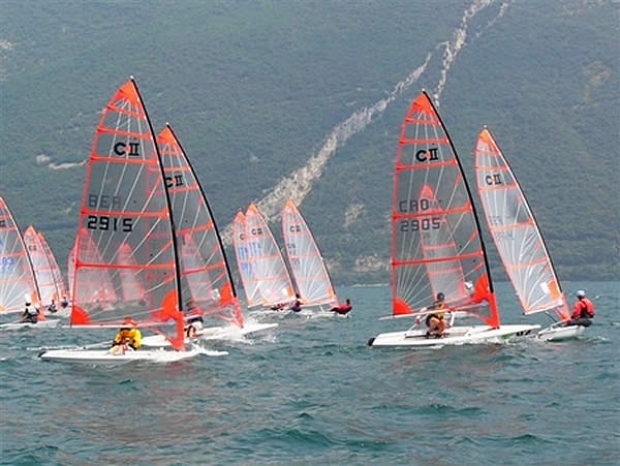
New Byte CII rig
Thursday July 14th 2005, Author: Toby Heppell, Location: United Kingdom
Upgrading dinghy masts to carbon fibre is nothing new these days, but the Byte class went one step further in 2004 by changing from a conventional unstayed rig to a self depowering skiff style rig. TheDailySail takes a look at this new rig to see what is new and what is different.
The CII rig comprises of a two piece carbon mast (hence CII) that is ‘self-depowering’ in much the same way as many modern skiffs, like the 29er and 49er are. The sail is also new having moved away from the previous 50 year old triangular rig design. It is significantly taller with a much bigger roach and full battens.
Ian Bruce, the designer of the Byte says that he had read an article by the President of ISAF, Paul Henderson who mentioned that ISAF were looking for an out of the box boat for the Women’s Olympic singlehander. In the article the Byte was mentioned along with one or two others as a potential possibility. At the time there were over 2700 Bytes worldwide as a base for Bruce to work from, he contacted Julian Bethwaite and asked if a self-depowering rig concept could work on an unstayed mast. Bethwaite came back to him and said that he could see no problem with the concept working.
Ian Bruce’s design brief called for trying to create a rig that he says would be more powerful than the original Byte in light winds where the Byte’s small sail plan puts it at a real disadvantage. However, even though it would be more powerful in light air, the rig should also be easier to control in windy weather to lower the weight of sailor who could handle the boat in a breeze.
It was thought that this would be particularly important to those from Asia and SE Asia, as sailors from all over the world needed to be competitive.
“Cost was always going to be a big factor when developing any new boat and as the new Byte rig was being developed for Olympic consideration it was very important, as the less the boat costs the more chance there is of the poorer nations being able to compete competitively,” explained Ian Bruce. For this reason it was decided that the boat must be an Absolute one-design to include spars, foils and sails with equipment supplied by the Class if it was chosen to be the Olympic boat. Bruce adds: “Performance had to be improved over the Byte with the weight range of sailors being broadened to the maximum possible and hopefully, extended below the present weight range of the Byte.”
The concept calls for a two-piece mast with the bottom carbon fibre and the top a hybrid of carbon and glass, but mostly glass. The reason for the glass is that the self de-powering rig requires a flexibility in the upper mast that cannot be achieved with pure carbon as it produces too stiff a section. The sail is a fully battened Mylar laminate and was developed by Ian MacDiarmid in Australia who worked in partnership with Julian Bethwaite. Together with Neil Pryde, MacDiarmid developed and produced the 49er sails after the 2000 Olympics. The first new sails to be made for the Byte were made from a 3mm laminate - the same as the 49er sails – but MacDiarmid felt this was a little heavy for such a small boat and created a 2mm laminate especially for the Byte.
Many of the present singlehanders like the Finn, Laser, Laser Radial, Europe and the Byte itself, have what Ian Bruce refers to as a “triangular” sail: “There is very little roach, they do not use full-length battens and the sails are all set on relatively stiff masts. Any necessary bending of the mast to reduce the camber and to de-power the sail is accomplished by pulling down on the boom either with mainsheet tension or with the kicking strap, which is translated into leech tension, which in turn bends the mast. In a Class like the Laser, Laser Radial or the original Byte where the sail and spars are one-design and the mast bend predetermined, the weight range of the sailor capable of sailing that boat is narrowed down. If the sails are not true one-design but measured to a rule and if the mast flexibility is changeable, then tweaking these variables will change the rig response for differing weights but all still within the broad parameters of that class. This has become the rule in the Europe.”
The CII’s higher area distribution is supported on a mast with a very flexible top that bends more in the upper section than in the lower. This is a completely different dynamic from ‘triangular sails’ which must be hung on masts with a uniform bend to set properly. The statement made above that a one-design sail and spar narrow down the weight range even further would seem to be a good argument for not having an ‘out of the box’ one-design. However, introduce an automatic response rig and the dynamics change completely. The overall sail area of the new self de-powering CII rig is actually greater than the Byte and its centre of effort is positioned higher off the water due to the large upper roach.
As Ian Bruce explains “the flexibility in the upper section of the CII, combined with the full-length battens, results in a sail that will open up in a gust faster than a sailor can respond by easing the mainsheet and will de-power dramatically in response to the Cunningham, which effectively becomes the accelerator pedal. With a pre-bend always present in the mast, tensioning of the Cunningham transmits a load directly to the mast tip and the mast bends in response, opening the leech. Add to this the fact that the battens are always trying to straighten themselves out and this force against the mast track augments the bending action.”
The Byte World Championships were held at Lake Garda this year between 27 June and 3 July. Before this year's World Championships it was predicted that the optimum weight for the CII would be between 48 and 68kg but after the Worlds it appears the average weight for the Byte sailor is a little broader than that. The new Byte World Champion is Jean Baptiste who weighs 73kgs but immediately behind him are two people from Singapore who weigh much less. When asked about whether this was an expected outcome Ian Bruce says “Julian (Bethwaite) put a lot of work into developing the self-depowering rig so the fact that there is a large weight range at the World Championships only goes to show that it is doing it’s job effectively.”
The new CII rig appears to be having the desired effect and seems set to breathe new vitality into the Byte class. It also a good showcase of what can be done to properly update a slightly ageing boat back into a modern desirable racer.
Most Read
Most Commented
Comments
Businesses

Pro businesses
-
United Kingdom
-
-
United Kingdom
-
Editor's choice
Member blogs
-
 Ned Collier Wakefield: MOD70 round BarbadosWell that was intense. 12 hard fought for seconds for the win. In idyllic conditions, Tony Lawsons MOD ...
 -
 Mini Transat leg 2 reportThe second leg of the Mini Transat started on 31st October, just over a month after ...
 -
Leg 1 reportI’ve been working towards the Mini Transat now for three years. In 2013 I was part ...
Business blogs
-
 The Island Sailing Club in Cowes, Isle of Wight, is delighted that Prince Michael of Kent ...
 -
Peta Stuart-Hunt chats with the 25 year-old British solo sailor Lizzy Foreman before she sets sail ...
-
The 2015 Student Yachting World Cup (SYWoC), an ISAF-recognised event hosted and run by students for ...
Editor's Choice
All time favourites...
-
 Three legs down into Ian Walker’s
 -
 Winning all but two races at
 -
 For the first time in its
Latest Comments
Add a comment - Members log in