
What kit?
Friday December 9th 2005, Author: Toby Heppell, Location: United Kingdom
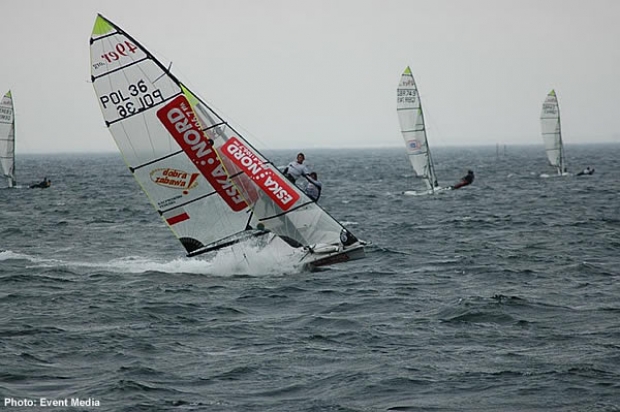
49er sailing is notoriously difficult; it requires a great deal of skill to keep the boat upright when just sailing around let alone racing. So what can you do to give yourself an edge in this highly competitive class? The answer to that question is put a lot of hours of work in…
The 49er hull is produced by different companies depending on the country that it is manufactured in. Each manufacturer has a slightly different way of making the boats, meaning that theoretically some of the hulls should be quicker than others. In practice; however, this is not really the case. Double 49er Olympic medallist Simon Hiscocks explains his method: “We have always gone for the Ovington boats 49er. Speed-wise there is not really much to choose between the hulls. We use Ovington boats mainly because of the geographical ease of them being based in the UK.”
As there is little difference between each factory-new 49er it is very important to give yourself any speed edge that you possibly can. Because of this when most of the top sailors get their new boats they will normally have a list of work to be done on them. “We take all the ropes off the boat,” explains Hiscocks. “We refit the foils because the webbing that comes in the daggerboard case and rudder stock is far too loose and it allows the plate to wobble too much. So we take all the webbing out, clean it up and refit the foils. We use a cold-pour polyurethane resin for that which is a bit of a fiddly job. Then we line the daggerboard and rudder up as best as we can which we basically do by eye. Often we will take all of the fittings off and epoxy them back on again. They do come with some sealant on but we prefer using epoxy for them. On the outboard wing fittings we use Sicoflex as they tend to move a bit. Then it is just a case of putting the ropes back on. We have had a few new boats in our time so it is a fairly slick operation now. “
A new 49er hull comes with fittings - the make of which changes from builder to builder - but many people replace some or all of these according to taste. There are some fittings that are more or less class standard. Most people use a Holt pulley at the top of the mast for the spinnaker halyard as it is very robust but most people use the Holt double block for the spinnaker halyard/bowsprit system.
Masts are things of great importance to 49er sailors and many of the best sailors have one special mast that they only use for very important events. The amount that a 49er mast bends varies quite a lot, because they cannot be manufactured to be exactly the same, so finding the right mast for you is very important. The 49er mast comes in two piece swith the bottom section made of aluminium and the top section made from fibreglass. Because of this one of the important things to look for in a mast is a consistent curve between the two sections. Also as people are different weights and have different styles of sailing the bend characteristics that people look for in a mast vary. Generally, however, people opt for the stiffest mast that they can find. A factory-new mast does not really need much playing with as Hiscocks explains: “We get them from Ovington boats and they come pretty much ready to go. We put our own halyards and trapeze lines on them but other than that we just use them as they come really. They do a very good job at Ovington putting the masts together.”
Perhaps more interesting than the mast itself is the rigging, where there has been some change going on. The 49er used to be notoriously hard to change rigging settings while sailing. This is because the boat was designed with the concept that once you left the beach it is all down to who is the fastest sailor. This is a fine idea but inevitably after a while people started to develop systems for adjusting their rigging on the water. These were, almost always, very expensive, time consuming and frustrating. With this in mind the 49er class association brought out a new system. “There has recently been a change to turnbuckles on the shroud adjustment, which came in last year,” comments Hiscocks, “but there was a limited response from the class. Almost everyone put them on the lowers straight away and there has been a real improvement there. It has saved people a lot of time and money. The actual turnbuckles themselves are quite expensive but the old way was still more expensive and frustrating.”

Although the turnbuckles have not really taken off for the shrouds and cap shrouds the class is looking into ways to replace them. “There are a few people around the world - myself included - that are trialling better systems for doing the shrouds,” Hiscocks explains. “The original system had the normal shroud plates on top of the turnbuckle which nobody really liked they looked ungainly and it really was not the answer to the problem. We are now experimenting with having a smaller individual turnbuckle for the cap shrouds. This is great because you will be able to adjust everything either independently or all together. There will be an infinite amount of adjustment which will be much better although it will cost more than just a couple of shroud plates.”
The fact that it will cost more is unlikely to stop many of the 49er sailors buying the new turnbuckles - when they are approved and available – as they will neatly solve a whole range of issues. One of the major issues that the class is hoping to solve is that when you buy a set of shrouds or lowers or cap shrouds often one is longer than the other. When the only adjustments you can make are using chain plates then this is a major problem, because you do not have tiny amounts of adjustment. This should hopefully be remedied by the turnbuckle system as there is more or less infinite scope for movement.
As with any one design class there is not a great deal to be said about the sails. They are all manufactured by the same company – Neil Pryde and MacDiarmid - and vary such a tiny amount it is not really worth worrying about them. Hiscocks says that there have been times when they have bought a new jib and when they went sailing with it discovered that it had a tremendous amount of leech flutter but even that is not a particularly major problem.
There are, however, two major issues to do with sails in the 49er. The first is the jib battens. The problem here is that they have to be flexible enough to wrap around themselves - if the jib gets wrapped up - but they also have to be strong enough to be of some use. The actual batten design is very good but it is still not quite good enough and regularly you hear about people that have just been on the beach with their jib flapping and one of their battens has snapped. The class has been trying for a while to come up ways to solve this problem but as yet there have been no major breakthroughs. This problem is slightly enhanced by the fact that even the battens are one design so you do not get lots of people trying different systems.
The second issue is the life of spinnakers. This is not as much of a problem as people used to say it was. Essentially the problem is that as you are pulling a lot of spinnaker into a not very big chute this of course is not very good for the spinnaker and means that its waterproof coating comes off a lot quicker than you would expect. This means that the spinnaker starts to take on water making it harder to hoist and drop and also harder to gybe with. This is realistically not something that can be remedied easily and so for the moment things will have to stay as they are.
One of the poorer areas of the boat is the vang system. This is also something of a point of argument as Hiscocks explains: “Some people use the top vang hole and some people use the one below. There is some debate on the merits of that but my own view is that when it is on the top vang hole it is significantly harder to adjust the tension.” Hiscocks adds that the vang arms are definitely something worth taking time over. If the vang arms do not line up with the centre of the boom - and often they don’t - when you let the vang off it catches on the vang arms and then it just bends the system and the whole thing is totally ruined. The way to stop this is to swap the vang arms around from side to side until you get the best fit that you can. Then it is just a case of tightening the whole thing up so it is not too loose.
One thing that you must be good at if you want to become a top 49er sailor is boat prep. Because the boat is so high performance it is important not to have too much clutter around. The way to avoid this is to come up with clever little self tailing devices for halyards, sheets and sail controls among others. An example of one of these self tailing systems is one that a lot of people use in the 49er fleet for keeping their spinnaker sheets out of the water and is easily transferable to many classes. The concept is that you have a piece of elastic with a loop on the end that goes round the spinnaker sheet. It then goes through a hole in the jib track, into the spinnaker chute and back onto the aft end of the bowsprit. When the spinnaker is up and the bowsprit is sticking out, the elastic is loose and when the spinnaker is down with the bowsprit in then the elastic is tight and keeps the sheets in the boat. This is effectively an hour’s work - if that - but there are lots and lots of these little things that need to be replaced, checked or improved and onshore playing with ropes forms a major part of the 49er sailor’s time.
The time that is spent on boat prep is significant even on an amateur level. When you start looking at the professional level it becomes even more intense. “We make a lot of the stuff that we use on our boats ourselves,” says Hiscocks. “We make our own carbon trapeze handles, our own carbon compass bracket; we even make - and now sell - our own foot straps, which are becoming something of a class standard now with most people having them. We spend quite a bit of time splicing our own rope systems as well. I am naturally a bit of a tinkerer so things like trapeze handles you could probably buy, but it just saves us money to make them ourselves. Other things like our compass bracket no one else makes one that is like the one we use. So although it is not really that cheap to make and it takes a bit of time it is good, light, it does not move and it is easy to put on and take off when you want to put the mast up and down.”
The 49er is actually a very good one design class with little differences between boats and rigs. What is most important about sailing this boat is that you set up systems that are easy to use and you are comfortable with. It is no use coming up to a screaming bear away in 25 knots of wind and big waves only to realise you can’t let the kicker off because you have not got round to putting on continuous control lines yet and you are out of play in the rope on your approach tack. Essentially that is what 49er sailing is all about: hours of sitting on the shore sewing in battens and splicing rope interspersed with some thrilling and highly competitive racing, whereas you tend to be screaming around a course cursing because you just saw another jib batten break which means a lot more sewing to come.
Most Read
Most Commented
Comments
Businesses

Pro businesses
-
France
-
United Kingdom
-
Italy
-
United Kingdom
Editor's choice
Member blogs
-
 Ned Collier Wakefield: MOD70 round BarbadosWell that was intense. 12 hard fought for seconds for the win. In idyllic conditions, Tony Lawsons MOD ...
 -
 Mini Transat leg 2 reportThe second leg of the Mini Transat started on 31st October, just over a month after ...
 -
Leg 1 reportI’ve been working towards the Mini Transat now for three years. In 2013 I was part ...
Business blogs
-
 The Island Sailing Club in Cowes, Isle of Wight, is delighted that Prince Michael of Kent ...
 -
Peta Stuart-Hunt chats with the 25 year-old British solo sailor Lizzy Foreman before she sets sail ...
-
The 2015 Student Yachting World Cup (SYWoC), an ISAF-recognised event hosted and run by students for ...
Editor's Choice
All time favourites...
-
 Three legs down into Ian Walker’s
 -
 Winning all but two races at
 -
 For the first time in its
Latest Comments
Add a comment - Members log in