
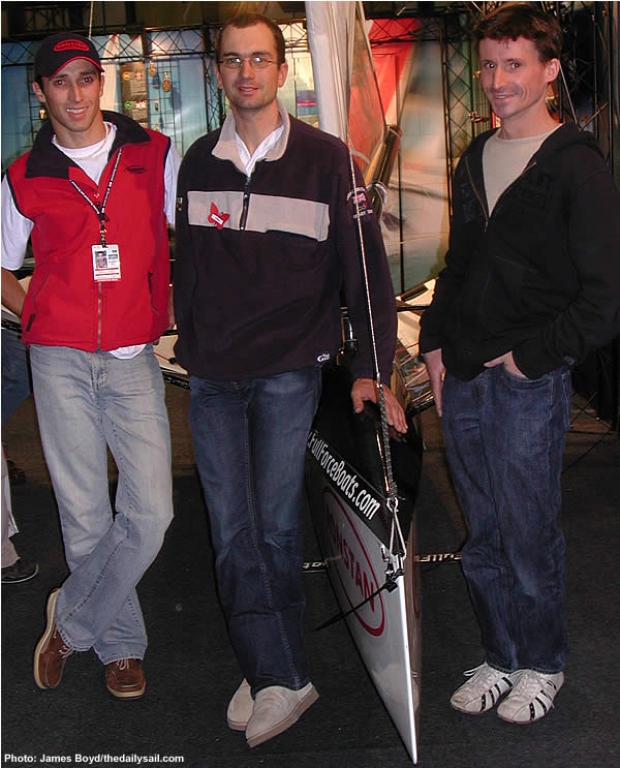
From left to right: World Champion Rohan Veal, Adam May and boat builder Linton Jenkins
Class on the up
Tuesday March 8th 2005, Author: James Boyd, Location: United Kingdom
Prize for the most discussed class at this weekend's Dinghy Sailing Show in London's Alexandra Palace once again went to the International Moth, with the poster of World Champion Rohan Veal mid-flight with his characteristic 'Veal heel' to weather being the most sought-after keepsake from the weekend.
With the Worlds in Australia now out of the way, the Moths are focussing over the next 18 months on Europe with the European Championship on Lake Garda in early August, just after the Nationals in New Quay, Wales mid-July. These are followed in July 2006 with the next World Championship in Horsens, Denmark.
Meanwhile, now the Moths have made the brave leap to going fully airborne on their foils, so the class is very much hoping for a period of consolidation, enabling fleet numbers to build.
Down in Weymouth, Linton Jenkins and Full Force boats have now completed six of their The Mistress design fully-foiling Moths and according to Jenkins they have more orders on the books. Their boat, as designed and sailed by Adam May, has a new bow wand mechanism that Jenkins hopes will be a development of the system pioneered by in Perth, Western Australia by John Ilett at Fastacraft and used on a majority of the most successful foiling Moths to date.
To recap - the bow wand is used as an automatic wave sensor and its pitch in the water dictates the angle of the trailing edge flap on the horizontal inverted T-foil at the bottom of the centreboard. The new system, as can just be seen on the bow of the boat pictured above, incorporates a carbon wand and instead of a Morse cable running over the deck there is a rod running inside the hull to the top of the centreboard where it hooks up to the mechanics inside the board for adjusting the lifting flap on the back of the T-foil.
"It is simplified, we have got away from the cables and tried to go for a frictionless system so that it is more active," explains Jenkins. "And we have a better hinge system in the lifting foil more like an aeroplane wing aileron, so we have a concave curve to fit the flap in and there is basically less drag and it is quite stiff to operate." The new wand arrangement has yet to be proved on the race course, but early trials seem positive.
The Mistress design also features a raisable centreboard/T-foil. "This is to make sure people can sail in an onshore breeze by themselves, which is a definite issue," says Jenkins. "At present tyou have to launch them on their side - and then you have to wade out as far as you can, so that you can’t breath any more, climb on the centreboard and in the duration it takes for you to right it, the boat in any sort of breeze has blown back and you hit the foils on the ground. So with this you could sail out with the foils just 6 inches down and just step in the boat and sail out..."

Meanwhile the ever inventive Adam May is gagging to build a new boat. "I’ve got lots of ideas, but it is a matter of what is practical or not do," says the former Olympic Tornado sailor. "I have probably designed about two or three generations ahead, but I haven’t got the time to build all the different ones I’d like to do. So I might do a newer lighter stiffer version and go from there.
"We have got to the stage to the stage where it is all working," he continues. "We are all learning a lot about the foils, what sizes to run them, what to do with the wand systems and how we sail them and the techniques - we are just learning all the time. I think we are into a period of subtle refinement and just see if that is going in the right direction."
There is also a distinct feeling of not wanting to race away with development in order that those sailors getting into foiling can catch up. To help with this process Adam May and Simon Payne are considering running a 'Foil School' at key clubs this year.
While many within the class are moving up to foils, so the Moths new airborne ability is attracting those from other classes such as RS 700 National Champion Jason Belben and Dave Ellis from the Laser 4000 class. "Anyone who is under 80kg is seriously considering one of these boats," says Jenkins, in full sales mode.
Early resentment of foiling Moths by the non-foilers is now more or less a thing of the past says May, now that many of the waterborne majority have had a chance to experience foiling themselves and also due to the huge amount of media attention the flying Moth has been getting over the last months.
"It is just out there on its own," adds Jenkins. "Every other class out there is in competition with something. This is the fastest singlehanded boat. And it is easy to sail," claims, amusingly, also made around the Dinghy Show by a number of other classes such as the RS700s and the Contenders...
At present among the foiling Moths are the two dominant designs - the Fastacraft-built Prowler as sailed by Rohan Veal and Simon Payne to first and second place in the recent Worlds and since last year, The Mistress in which May finished third at the Worlds. One gets the feeling that there is the hope within the class that rather than Moth sailors going out at this stage to develop their own foilers they should learn how to sail the 'standard kit' first. Certainly results over the past 18 months in the class have indicated that those trying different foil configurations haven't enjoyed the same success as those using the wand and T-foil centerboard with flap set-up.
"I think that this configuration is the most efficient for lifting the boat out of the water," says Jenkins. "Most of the other systems have more drag. But the basic problem is to build this requires the ultimate process you can employ in a workshop. The little 16mm x 16mm joint [on the T foil] is taking 100s of kgs and it is just minute. It is one hell of an engineering thing, using carbon to its absolute most. It is damned difficult to build anything that will do the job well. You can build something that will be a lot bigger and will support the forces naturally but unfortunately that means the boat will be going slower and you won’t be able to foil..."
Saying this there have been discussions about moving the rig and forward foil closer to the bow to give the boat more fore and aft stability. However this is a double-edged sword, says May. "We sail upwind with an angle of attack and the further forward you put the mast the deeper the centreboard then has to be. And also the less control you have because at the moment our weight influence is quite powerful. We can come up almost in front of the centreboard. The further forward you put the foil the less influence you have over that and therefore you’d have to play a lot with your foil sizes and things. So you are not going to see all the rigs suddenly jump forwards. We might see rigs creep forwards. Rohan was going to move it 10cm further forward, but John [Ilett] has said he is too busy to do a lot of the changes Rohan wanted."
We watch with interest to see how the Moths progress. Already much interest is being shown in other countries outside of the UK and Australia with a new class association set up in Italy and a lot of interest from the States.
Most Read
Most Commented
Comments
Businesses
Pro businesses
-
Netherlands
-
United Kingdom
-
-
Italy
Editor's choice
Member blogs
-
 Ned Collier Wakefield: MOD70 round BarbadosWell that was intense. 12 hard fought for seconds for the win. In idyllic conditions, Tony Lawsons MOD ...
 -
 Mini Transat leg 2 reportThe second leg of the Mini Transat started on 31st October, just over a month after ...
 -
Leg 1 reportI’ve been working towards the Mini Transat now for three years. In 2013 I was part ...
Business blogs
-
 The Island Sailing Club in Cowes, Isle of Wight, is delighted that Prince Michael of Kent ...
 -
Peta Stuart-Hunt chats with the 25 year-old British solo sailor Lizzy Foreman before she sets sail ...
-
The 2015 Student Yachting World Cup (SYWoC), an ISAF-recognised event hosted and run by students for ...
Editor's Choice
All time favourites...
-
 Three legs down into Ian Walker’s
 -
 Winning all but two races at
 -
 For the first time in its
Latest Comments
Add a comment - Members log in