
Back on the up
Friday November 11th 2005, Author: Toby Heppell, Location: United Kingdom
The Laser 4000 held its tenth annual UK National Championships this year at Hayling Island SC. With nearly 60 boats turning out it is clear that the Laser 4000 is bouncing back after some years of hot competition in the market place drove its numbers downward.
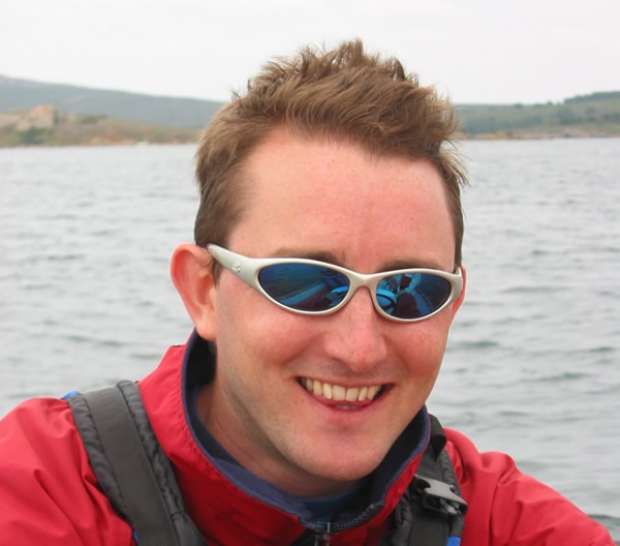
Current European champion, UK National Champion and runner up at the Endeavour Trophy, Andy Palmer Felgate, has been sailing a 4000 for four years.
Working full time in London, 28 year old Felgate has his sailing roots in the Topper Class. He has been sailing since he was ten and started off sailing a Mirror dinghy but quickly moved on to the Topper - one of the early fibreglass ones. He continued to sail Toppers until he turned 17 at which point it was clear that his aim to sail a Laser was never going to be realised on account of his small size. From here on he chose to sail two man boats. He was a good size for a helm and jumped through several classes before settling on the Laser 4000.
The water, it would seem is in the blood for Felgate family. His father, who got him into sailing in as a child, works on a ship and sails a Solo when back at home. When at work in his office in London, Felgate is organizing the laying of telecommunications wires across oceans.
Aside from Laser 4000 sailing Felgate is also an active team racer and sails for Castaways – an ex London University students team. He owns his own wooden Firefly but rarely sails it as boats are mostly supplied at team racing events. In addition to this he is also an occasional bowman on a J/24 owned by a friend of his and if this does not keep him too busy, he likes to get out for a bit of windsurfing.
This year Felgate competed in the Endeavour trophy for the third time. Previously he has done the event as both Topper National Champion in 1996 and Laser II National Champion in 2001. When Felgate attended the event representing the Laser II he had won the nationals with Lee Sydenham crewing for him. Neither of them had an RS400 available for the Endeavour and Felgate ended up doing the event with another friend who owned one.
Felgate seems to be happy with his progress in the event, stating that: “The first time I did the event I came second to last. In 2001 I came about ninth so it is quite nice to steadily work my way up!” He is modest with his achievement this year sailing with crewJon Modral, finishing in second place behind Nick Craig and James Stewart. Thisresult meant that Felgate nowhas the highest overall position at the Endeavour of any Laser 4000 sailor – the previous best being Pete Barton who came fifth in 2003.
Felgate has had a mixed year in terms of his crew, with his regular frontman in the 4000 Jon Modral missing both the National and European Championships due to work commitments. Paddy Gamble was his crew when they won the Laser 4000 Nationals this summer - but Gamble,a regular RS800 sailor, was unable to attend the Endeavour. As it worked out, however, Modral was able to join Felgate in Burnham.
The sailing highlight for Felgate this year was winning the European Championships in Bandol, France. “It was a fantastic event because it was just perfect conditions. We had a Mistral come in on the last day that was a force six which was really awesome,” he recalls. Having done so well at the Endeavour, however has also been a highlight and seems to have inspired Felgate.
“I have not actually done a lot of sailing this year, and I was not planning on doing a huge amount next year either,” he explains. “But having done so well at the Endeavour has really motivated me to do more. I would quite like to move on to a different class but the question is which fleet to move into? I am tempted by the International 14 - they look like a lot of fun but maybe a bit too much cheque book sailing for me.” For the time being at least,he seems quite happy to continue sailing the 4000 over the winter while he thinks about his options.He and Modral will be sailing in their Laser 4000 in the Datchet SC Winter Series.
With over 60 boats at both the European and national Championships it is clear that the Laser 4000 has a large following. Felgate points out that although the class has experienced some troubles with attendance in previous years numbers are actually back on the up and the class is attracting new people to it. He puts this down to there being a quite significant drop in the secondhand market. “After Audi pulled out as primary class sponsor two years ago a lot of boats came onto the second hand marketthat steadily dropped in price,” he explains. “This year we have had a lot of students and younger people buy the boats so the numbers have really picked up again at the events.There have been 40 or so pretty consistently for open meetings, so it has been pretty strong this year.” With this influx of new people the social side of the class has really taken off again too with lots of young and mixed crews wanting to have fun in the evenings.
Although cost must contribute a great deal to the resurgence of the class – at £3,500 for a competitive secondhand boat not many other classes can compete with it price wise - it would seemthat there must be other factors involved as well. The big brother of the 4000, the Laser 5000 has in recent years seen a big drop in numbers as well as cost of secondhand boats but has yet to show any sign of resurgence as the 4000 has done. We asked Felgate why he thought this was. “I think it is really the design of the boat,” he comments. “The 5000 is very heavy and it takes a lot of breeze to get it going. Although it is also heavy, the 4000 is a smaller boat so it is inherently lighter.It planes well downwind and upwind and is very manoeuvrable. You get a nice combination of tactical sailing where you can throw lots of tacks in upwind and tack on every shift. Then you have planing downwind with the crew out on the wire where you can get a real speed buzz. It is a good compromise between the stress of having a 49er or an International 14 and having a hiking boat which is a lot of grunt work. It is a nice balance really.”
The 4000 seems to have found a nice little niche for itself 10 years on. We wondered how the emergence of boats like the RS800 had impacted on the class. Felgate seems to dismiss this problem pretty quickly commenting that numbers were affected early on by the RS800 launch and also that if people were going to leave the class for newer more exciting boats they have already done so. He also adds that that the RS800 is different enough from the Laser 4000 for there not to be too much of a problem.“The 4000 for me is more tactical as it is a slightly more conventional design. The 800 is much more of a high performance boat it is all about thrills and spills.”
The Laser 4000 was one of the first modern asymmetric production designs and this is in some way responsible for its new popularity. It is single trapeze which makes it easy to transfer to from other more conventional boats, such as a Fireballand also is slow enough that there is more of a tactical edge to it. The older skiff style rig design is more conservative compared to modern boats and due to the smaller sail the Laser 4000 is more controllable in stronger winds across a wider range of sailor size and skill.
The Laser 4000 obviously does not have the same spot within the market place that it used to have. It is now not a boat that you buy for cutting edge high performance racing, partly due to it’s age, partly due to it’s more conventional design and partly due to many more modern high performance boats now on the market. It is, however a good boat to buy for those that want to race a fast asymmetric boat without all the hassle and cost of many of the newer classes.
With 60 boats attending this years nationals, a successful European regatta in France and their top sailor coming second at the Endeavour the Laser 4000 class would seem to be doing very nicely thankyou.
Most Read
Most Commented
Comments
Businesses

Pro businesses
-
United Kingdom
-
-
-
Editor's choice
Member blogs
-
 Ned Collier Wakefield: MOD70 round BarbadosWell that was intense. 12 hard fought for seconds for the win. In idyllic conditions, Tony Lawsons MOD ...
 -
 Mini Transat leg 2 reportThe second leg of the Mini Transat started on 31st October, just over a month after ...
 -
Leg 1 reportI’ve been working towards the Mini Transat now for three years. In 2013 I was part ...
Business blogs
-
 The Island Sailing Club in Cowes, Isle of Wight, is delighted that Prince Michael of Kent ...
 -
Peta Stuart-Hunt chats with the 25 year-old British solo sailor Lizzy Foreman before she sets sail ...
-
The 2015 Student Yachting World Cup (SYWoC), an ISAF-recognised event hosted and run by students for ...
Editor's Choice
All time favourites...
-
 Three legs down into Ian Walker’s
 -
 Winning all but two races at
 -
 For the first time in its
Latest Comments
Add a comment - Members log in